--- Local source: submodules/grand-archive/.agents/skills/grand-archive-rules/references/grand-archive-comprehensive-rules/general-rules/general-rules-card-characteristics.md Publisher's current source: [Weebs of the Shore](https://rules.gatcg.com/general-rules/general-rules-card-characteristics) # General Rules - Card Characteristics #### General Rules 1. A characteristic of a card or object is any part of the card that can be referenced by effect text or the game. Characteristics can include: * Element * Cost * Types (including supertypes and subtypes) * Abilities * Stats (power, life, durability) * Speed (fast, slow) * Name 2. Characteristics do not include [properties or states](/game-mechanics/game-mechanics-properties-and-states.md). #### Type-Overwriting and Type-setting 1. If an effect sets an object's typing to a specified type, it will replace the originally noted typing. Any typing not modified is retained, such as subtyping. 2. If the specified overwriting sets the card type, it will also lose its supertypes. Supertypes must be redefined whenever a card’s type is set or overridden. {% hint style="info" %} E.g., Triskit, Angel of Guidance, loses the original Unique Ally typing if a player accepts the On Enter ability and will instead become a Unique Champion. Subtyping is conserved, and Triskit will still be a Warrior Angel.  {% endhint %} #### Type-Acting 1. If an effect states that an object may perform an action “as though it were \[object type],” it will not set nor overwrite its own type to match that as the type it is acting as. 2. These effects may allow objects to behave as other object types but will not innately change their own type nor the targeting, damage, timing, and other attributes specific to its own type. 3. Card effects will generally specify what behavior is granted in the effect text. #### Type-Expansion 1. If an effect confers additional types to an object or card, it will then have all attributes of all of its card types without duplication of any overlapping attributes or behaviors. 2. If any characteristics overlap where their rules conflict, such as being sent to banishment versus graveyard when being destroyed, the more restrictive characteristic applies (banishment being more restrictive than the graveyard as a designated zone). #### Stat-Setting 1. If an effect were to set or establish a card or object's stat (such as power or life) where that card or object did not previously have such a stat, it is initially given that stat with a default value of 0 before any stat-setting is applied. --- Local source: submodules/grand-archive/.agents/skills/grand-archive-rules/references/grand-archive-comprehensive-rules/general-rules/general-rules-card-characteristics/double-faced-cards.md Publisher's current source: [Weebs of the Shore](https://rules.gatcg.com/general-rules/general-rules-card-characteristics/double-faced-cards) # Double-faced Cards In Grand Archive, some cards exist that have two faces, or two sides, each with separate characteristics as opposed to a single side of information and rules text with an information-less card back. There is only one type of double-faced card in Grand Archive, currently. General Rules: 1. Double-faced cards have no card back and, instead, have another full card face with characteristics and rules text. The default cost symbols of the card are replaced such that the reserve or memory cost icon reflects which side of the card is being examined, in addition to an embossed upward-pointing arrow in the bottom left of the card. 1. The "default side" of a card is represented by the default appearance of the cost icons located on the top left of the card. This is noted by solid cost bubbles, either yellow for reserve or blue for memory. It will also be absent of the downward-pointing arrow found on the flip side. 2. The side of the card that replaces the regular Grand Archive card back is the "flip side." The flip sid**e** is denoted by the embossed downward-pointing arrow in the reserve or memory cost bubble, in addition to a solid downward-pointing arrow on the bottom left of its text box. 2. To flip a card to another side during a game, the rules text will typically tell a player to "transform" the card as a player action. Transform is the player action that means to flip a card to the other side. 3. Double-faced cards must be played on their "default side" initially. This side is represented by the typical reserve and memory cost icons found on regular, non-double-faced cards. The side with the modified symbol (shown by an embossed arrow on "Fatebound" or "Fatestone"-subtyped cards printed in Abyssal Heaven) can't be played. If a card is currently on its flip side on the field, it is considered "transformed" (and has the transformed property). 4. Only the characteristics (rules text, abilities, stats, name, type, etc.) on the face-up side are considered for game actions and evaluating the game state. While not on the field, only the default side of the card is considered for characteristics in all other zones. 1. If a transformed double-faced card is moved from the field to any other zone, it must be physically flipped back to the default side. Last-known information will still consider any characteristics of the transformed side, if applicable. 2. If a transformed double-face card has a different type than the type on the default side that would change the rules about which zone it would be moved to, it would move to the zone corresponding with the appropriate rules applied to the default side of the card. {% hint style="info" %} E.g., If Seiryuu, an ally with a reserve cost is destroyed by any effect, the default side of the card, Fabled Azurite Fatestone, is examined when determining which zone the card would be placed in. In this context, "Seiryuu" would be placed in Banishment, flipped back to its default side as the Fatestone. Similarly, if an effect attempts to move Seiryuu to the hand, memory, or main deck, it will instead be returned to the material deck as Fabled Azurite Fatestone, a regalia item.\ \
{% endhint %} 5. If a player has knowledge permissions associated with a double-faced card (i.e., that card is either public or private to that player), they may examine either side of the card by flipping it. 6. Flipping it in this way will not be considered a transformation. 7. If a double-faced card is copied, only the characteristics of the present side are copied. 1. If a card copies the characteristics of a transformed card, the copy will share the characteristics of that card in its transformed state. 2. Copies of double-faced cards cannot themselves transform. If a player attempts to transform a copy of a card that is either transformed or can be transformed, nothing will happen, and the action is skipped. Any costs paid will not be "refunded." {% hint style="danger" %}
 \
\
E.g., The Cosmic Bolts generated from Polaris must first be revealed to all players in a game before being shuffled into the Main Deck. This is not true of Quicksilver Grail since the Banishment is a public zone, even though the card added is face-down and considered private.
{% endhint %}
2. Face-up cards, their attributes, properties, stats, rules text, and other information are considered public.
3. A player may look at and examine any face-up cards in a game. If a card is moved this way, it must be returned to the zone it is in and in the same orientation.
4. Players can’t hide any information about face-up cards or misrepresent information about face-up cards.
5. All cards in a lineage or similar stack of cards are considered face-up.
6. Face-down cards are considered private information known only to the player who currently controls that card.
1. Except for cards in the main deck and unknown face-down cards in banishment, all other face-down cards may be looked at by their controlling player at any time. If an effect banished cards from a zone face-down and gave a specific player certain permissions for that card, such as activation or materialization, those cards are considered private for that player.
1. When a card becomes private in a public zone (e.g., banishment), and that card was visible to a player due to that card being public information, that player will retain private information about that card and may look at that card. If an ability of that card would grant play permissions, that player can exercise the play permissions on that card.
{% hint style="success" %}
\
\
E.g., The Cosmic Bolts generated from Polaris must first be revealed to all players in a game before being shuffled into the Main Deck. This is not true of Quicksilver Grail since the Banishment is a public zone, even though the card added is face-down and considered private.
{% endhint %}
2. Face-up cards, their attributes, properties, stats, rules text, and other information are considered public.
3. A player may look at and examine any face-up cards in a game. If a card is moved this way, it must be returned to the zone it is in and in the same orientation.
4. Players can’t hide any information about face-up cards or misrepresent information about face-up cards.
5. All cards in a lineage or similar stack of cards are considered face-up.
6. Face-down cards are considered private information known only to the player who currently controls that card.
1. Except for cards in the main deck and unknown face-down cards in banishment, all other face-down cards may be looked at by their controlling player at any time. If an effect banished cards from a zone face-down and gave a specific player certain permissions for that card, such as activation or materialization, those cards are considered private for that player.
1. When a card becomes private in a public zone (e.g., banishment), and that card was visible to a player due to that card being public information, that player will retain private information about that card and may look at that card. If an ability of that card would grant play permissions, that player can exercise the play permissions on that card.
{% hint style="success" %}  
{% endhint %}
---
Local source: submodules/grand-archive/.agents/skills/grand-archive-rules/references/grand-archive-comprehensive-rules/game-mechanics/game-mechanics-game-zones/game-zones-hand.md
Publisher's current source: [Weebs of the Shore](https://rules.gatcg.com/game-mechanics/game-mechanics-game-zones/game-zones-hand)
# Game Zones - Hand
#### General Rules:
1. The Hand is a private zone owned by a player. Each player has their Hand zone.
{% hint style="info" %}
The Hand zone is referred to by the term “hand.”
{% endhint %}
2. There is no maximum hand size.
3. Any card that is sent to hand is sent to its owner’s hand.
---
Local source: submodules/grand-archive/.agents/skills/grand-archive-rules/references/grand-archive-comprehensive-rules/game-mechanics/game-mechanics-game-zones/game-zones-effects-stack.md
Publisher's current source: [Weebs of the Shore](https://rules.gatcg.com/game-mechanics/game-mechanics-game-zones/game-zones-effects-stack)
# Game Zones - Effects Stack
#### General Rules:
1. The Effects Stack zone is a public zone shared by all players and has no owner.
{% hint style="info" %}
The Effects Stack zone is referred to by the term “effects stack.”
{% endhint %}
2. The Effects Stack contains an ordered collection of stacked card activations, materializations, and abilities pending resolution which uses a stacking structure. Each discrete item in this zone has its own layer and each layer will resolve on its own. The topmost layer is the first card to resolve any time an item in the effects stack were to resolve whereas the bottom layer corresponds to the item that would resolve last. In essence, this zone uses a first-in-last-out (FILO) system.
3. Once a card or ability resolves from the Effects Stack, each of its effects will fully resolve as it is removed from the Effects Stack.
{% hint style="info" %}
E.g., Glacial Guidance will still grant an enlighten counter as it is ending the combat phase.\

{% endhint %}
---
Local source: submodules/grand-archive/.agents/skills/grand-archive-rules/references/grand-archive-comprehensive-rules/game-mechanics/game-mechanics-game-zones/game-zones-hand.md
Publisher's current source: [Weebs of the Shore](https://rules.gatcg.com/game-mechanics/game-mechanics-game-zones/game-zones-hand)
# Game Zones - Hand
#### General Rules:
1. The Hand is a private zone owned by a player. Each player has their Hand zone.
{% hint style="info" %}
The Hand zone is referred to by the term “hand.”
{% endhint %}
2. There is no maximum hand size.
3. Any card that is sent to hand is sent to its owner’s hand.
---
Local source: submodules/grand-archive/.agents/skills/grand-archive-rules/references/grand-archive-comprehensive-rules/game-mechanics/game-mechanics-game-zones/game-zones-effects-stack.md
Publisher's current source: [Weebs of the Shore](https://rules.gatcg.com/game-mechanics/game-mechanics-game-zones/game-zones-effects-stack)
# Game Zones - Effects Stack
#### General Rules:
1. The Effects Stack zone is a public zone shared by all players and has no owner.
{% hint style="info" %}
The Effects Stack zone is referred to by the term “effects stack.”
{% endhint %}
2. The Effects Stack contains an ordered collection of stacked card activations, materializations, and abilities pending resolution which uses a stacking structure. Each discrete item in this zone has its own layer and each layer will resolve on its own. The topmost layer is the first card to resolve any time an item in the effects stack were to resolve whereas the bottom layer corresponds to the item that would resolve last. In essence, this zone uses a first-in-last-out (FILO) system.
3. Once a card or ability resolves from the Effects Stack, each of its effects will fully resolve as it is removed from the Effects Stack.
{% hint style="info" %}
E.g., Glacial Guidance will still grant an enlighten counter as it is ending the combat phase.\  {% endhint %}
4. Players can’t change the order of cards in the effects stack.
---
Local source: submodules/grand-archive/.agents/skills/grand-archive-rules/references/grand-archive-comprehensive-rules/game-mechanics/game-mechanics-game-zones/game-zones-intent.md
Publisher's current source: [Weebs of the Shore](https://rules.gatcg.com/game-mechanics/game-mechanics-game-zones/game-zones-intent)
# Game Zones - Intent
#### General Rules:
1. The Intent zone is a public zone, and each champion has an Intent zone owned by the champion’s controlling player that exists during the Combat Phase.
{% hint style="info" %}
The Intent Zone and all cards within that zone are referred to by the term “Intent.”
{% endhint %}
2. All cards in the Intent are intents. Any card can be sent to and exist in the intent.
1. Copies made of Intents are still Intents. However, they are not cards and will cease to exist when they are removed from the Intent.
3. Cards in the intent are considered the source for any triggered or activated abilities from within the intent.
---
Local source: submodules/grand-archive/.agents/skills/grand-archive-rules/references/grand-archive-comprehensive-rules/game-mechanics/game-mechanics-game-zones/game-zones-pantheon.md
Publisher's current source: [Weebs of the Shore](https://rules.gatcg.com/game-mechanics/game-mechanics-game-zones/game-zones-pantheon)
# Game Zones - Pantheon
#### General Rules
1. The Pantheon is a private zone owned by a player. Each player has their own Pantheon zone
2. The Lesser and Greater Boons that a player selects and presents during a Pantheon match will start the game face down in this zone.
3. Players may play a Boon from this zone by bestowing the boon. This process is similar to that of activating or materializing a card, however, players can't have Opportunity until the boon has finished bestowing.
4. Players can look at their own face down boons at any time.
5. Boons in the Pantheon zone are not considered objects and can't be the target of activations, materializations, or abilities.
---
Local source: submodules/grand-archive/.agents/skills/grand-archive-rules/references/grand-archive-comprehensive-rules/game-mechanics/game-mechanics-game-zones/game-zones-object-specific-zones.md
Publisher's current source: [Weebs of the Shore](https://rules.gatcg.com/game-mechanics/game-mechanics-game-zones/game-zones-object-specific-zones)
# Game Zones - Object-Specific Zones
#### General Rules:
1. Whenever an object leaves the field, all cards in its object-specific zones will be placed into the graveyard.
{% hint style="info" %}
If a card is a regalia, it is placed into the Banishment, instead.
{% endhint %}
#### Inner Lineage
1. All cards stacked beneath the topmost champion in a lineage form the Inner Lineage.
2. All cards within the inner lineage are not considered objects nor on the field and are only treated as cards.
3. Each lineage has exactly one inner lineage.
#### Loaded Cards
1. Each object having the Loaded property placed underneath another object is a part of the Loaded Cards of that object.
1. Cards Loaded into an object will still be Loaded as long as that object remains on the field.
2. All loaded cards are not considered objects nor on the field and are only treated as cards.
3. When a Loaded object attacks or is wielded for an attack, it places each of its Loaded Cards into the Intent.
4. Each object has its own loaded cards.
---
Local source: submodules/grand-archive/.agents/skills/grand-archive-rules/references/grand-archive-comprehensive-rules/game-mechanics/game-mechanics-turn-order.md
Publisher's current source: [Weebs of the Shore](https://rules.gatcg.com/game-mechanics/game-mechanics-turn-order)
# Game Mechanics - Turn Order
#### General Rules:
1. Turn order follows Wake Up, Materialize, Recollection, Draw, Main, and End phases.
1. In a two-player game, the first turn player skips their first wake up, materialization, recollection, and draw phases, and instead begins their turn in their main phase. The second player skips their first wake up, materialization, and recollection phases, and instead proceeds to their draw phase, followed by the main phase.
2. In a multiplayer game, the first turn player will follow the sequence of events as denoted for the second player in the above point, i.e., they will not skip their first draw phase. Each other player will also follow the same sequence of events for each of their first turns.
2. The turn player receives Opportunity at the beginning of the Recollection phase, the Main phase, and the beginning of the End phase. These are the only non-combat phases in which the turn player will be given Opportunity naturally.
3. A phase where players are given or gain Opportunity can end if and only if the Effects Stack is empty, all players have passed Opportunity in succession, and all events or actions associated with that phase are completed.
4. If no players are given Opportunity in a phase, that phase instead ends after all phase actions are completed and the Effects Stack is empty.
5. Any effects that last “until end of \[phase]” end as that phase ends before the next phase begins.
6. Any effects that trigger “at the beginning of \[phase]” are triggered and placed onto the Effects Stack and the turn player gains Opportunity when that phase begins.
7. Game events can’t happen between phases and steps; events will always happen in one of the discrete phases or steps within a phase.
The following pages discuss these topics:
* [Wake Up Phase](/game-mechanics/game-mechanics-turn-order/turn-order-wake-up-phase.md)
* [Materialize Phase](/game-mechanics/game-mechanics-turn-order/turn-order-materialize-phase.md)
* [Recollection Phase](/game-mechanics/game-mechanics-turn-order/turn-order-recollection-phase.md)
* [Draw Phase](/game-mechanics/game-mechanics-turn-order/turn-order-draw-phase.md)
* [Main Phase](/game-mechanics/game-mechanics-turn-order/turn-order-main-phase.md)
* [End Phase](/game-mechanics/game-mechanics-turn-order/turn-order-end-phase.md)
* [Combat Phase](/game-mechanics/game-mechanics-turn-order/turn-order-combat-phase.md)
* [Ending Phases](/game-mechanics/game-mechanics-turn-order/turn-order-ending-phases.md)
* [Skipping Phases](/game-mechanics/game-mechanics-turn-order/turn-order-skipping-phases.md)
---
Local source: submodules/grand-archive/.agents/skills/grand-archive-rules/references/grand-archive-comprehensive-rules/game-mechanics/game-mechanics-turn-order/turn-order-wake-up-phase.md
Publisher's current source: [Weebs of the Shore](https://rules.gatcg.com/game-mechanics/game-mechanics-turn-order/turn-order-wake-up-phase)
# Turn Order - Wake Up Phase
#### General Rules:
1. Turn-based Action: During this phase, the game simultaneously wakes up each rested object on the field controlled by the turn player. This is a turn-based action and cannot be responded to. Units that are awake will not be considered to have woken.
2. State-based effects are checked: If any effects cause a change in the game state, the turn player gains Opportunity after each ability pending resolution is placed onto the Effects Stack. The phase will continue to the next step after the Effects Stack is empty.
3. The game moves to the Materialize phase.
---
Local source: submodules/grand-archive/.agents/skills/grand-archive-rules/references/grand-archive-comprehensive-rules/game-mechanics/game-mechanics-turn-order/turn-order-materialize-phase.md
Publisher's current source: [Weebs of the Shore](https://rules.gatcg.com/game-mechanics/game-mechanics-turn-order/turn-order-materialize-phase)
# Turn Order - Materialize Phase
#### General Rules:
1. The materialize phase is skipped on each player’s first turn during a game.
2. State-based effects are checked: If any effects cause a change in the game state, the turn player gains Opportunity after each ability pending resolution is placed onto the Effects Stack. The phase will continue to the next step after the Effects Stack is empty.
3. Turn-based Action: The turn player may choose to materialize a card from their material deck as a turn-based action. Players may only materialize a regalia or champion card from their material deck during this phase. If a player opts to materialize in this way, it counts as a materialization where Opportunity is generated, and players may respond to the materialization. After this round of Opportunity has passed, no additional window to take actions will be generated apart from those from abilities pending resolution.
4. State-based effects are checked. If any effects cause a change in the game state, the turn player gains Opportunity after each ability pending resolution is placed onto the Effects Stack. The phase will continue to the next step after the Effects Stack is empty. After the Effects Stack is empty and all players have passed Opportunity in succession,
1. If no change in the game state was noted, the turn player will not gain Opportunity. (This can happen if the turn player did not materialize a card, for example.)
5. The game moves to the Recollection phase.
{% hint style="warning" %}
Players are not naturally given Opportunity at both step 2 and step 4 in the Materialize Phase. Opportunity will only be generated if, during the state-based checks, there is a change in the game state. If no change occurs, no Opportunity is generated, and the game will proceed to the Recollection phase.
{% endhint %}
---
Local source: submodules/grand-archive/.agents/skills/grand-archive-rules/references/grand-archive-comprehensive-rules/game-mechanics/game-mechanics-turn-order/turn-order-recollection-phase.md
Publisher's current source: [Weebs of the Shore](https://rules.gatcg.com/game-mechanics/game-mechanics-turn-order/turn-order-recollection-phase)
# Turn Order - Recollection Phase
#### General Rules:
1. State-based effects are checked: If any effects cause a change in the game state, the turn player gains Opportunity after each ability pending resolution is placed onto the Effects Stack. The phase will continue to the next step after the Effects Stack is empty.
1. During this step, any “beginning of recollection” abilities will enter the Effects Stack.
2. Opportunity: After the Effects Stack is empty, the turn player will immediately gain Opportunity. This is the last time players may act before the recollection of cards in the memory zone will take place as a turn-based action.
3. Turn-based Action: After the Effects Stack is empty and all players have passed Opportunity in succession in step 2, the turn player returns all cards in their memory zone to their hand as a turn-based game action that can’t be responded to. This is called recollection.
4. State-based effects are checked: If any effects cause a change in the game state, the turn player gains Opportunity after each ability pending resolution is placed onto the Effects Stack. The phase will continue to the next step after the Effects Stack is empty.
5. The game moves to the Draw phase.
---
Local source: submodules/grand-archive/.agents/skills/grand-archive-rules/references/grand-archive-comprehensive-rules/game-mechanics/game-mechanics-turn-order/turn-order-draw-phase.md
Publisher's current source: [Weebs of the Shore](https://rules.gatcg.com/game-mechanics/game-mechanics-turn-order/turn-order-draw-phase)
# Turn Order - Draw Phase
#### General Rules:
1. Turn-based action: The turn player immediately draws a card as a turn-based game action to which players can't respond.
2. State-based effects are checked: If any effects cause a change in the game state, the turn player gains Opportunity after each ability pending resolution is placed onto the Effects Stack. The phase will continue to the next step after the Effects Stack is empty.
3. The game moves to the Main phase.
---
Local source: submodules/grand-archive/.agents/skills/grand-archive-rules/references/grand-archive-comprehensive-rules/game-mechanics/game-mechanics-turn-order/turn-order-main-phase.md
Publisher's current source: [Weebs of the Shore](https://rules.gatcg.com/game-mechanics/game-mechanics-turn-order/turn-order-main-phase)
# Turn Order - Main Phase
#### General Rules:
1. State-based effects are checked: If any effects cause a change in the game state, the turn player gains Opportunity after each ability pending resolution is placed onto the Effects Stack. The phase will continue to the next step after the Effects Stack is empty.
2. Opportunity: The turn player receives Opportunity.
1. During this phase, the turn player may perform any slow or fast player actions while they have Opportunity and the Effects Stack is empty or they may proceed to the end phase.
2. Attacking is considered to be a slow player action and will immediately start a [combat phase](/game-mechanics/game-mechanics-turn-order/turn-order-combat-phase.md). The game will return to the main phase after the end of combat at step 2.
1. A new main phase will not begin; there is only one main phase per turn.
3. If any player actions were taken during the passing of Opportunity or any effects, activations, or materializations entered the Effects Stack, step 2 happens again (the turn player receives Opportunity) after Effects Stack becomes empty.
4. Non-turn players may only activate cards or take player actions at fast speed during this phase when they have Opportunity.
3. The turn player controls the passage to the end phase from the main phase. If the turn player passes Opportunity while the Effects Stack is empty, and each other player passed Opportunity with taking an action, the game immediately proceeds to the end phase.
---
Local source: submodules/grand-archive/.agents/skills/grand-archive-rules/references/grand-archive-comprehensive-rules/game-mechanics/game-mechanics-turn-order/turn-order-end-phase.md
Publisher's current source: [Weebs of the Shore](https://rules.gatcg.com/game-mechanics/game-mechanics-turn-order/turn-order-end-phase)
# Turn Order - End Phase
#### General Rules:
1. First, any "beginning of the end phase" abilities are placed on top of the Effects Stack. This includes any delayed triggers that would put an ability on the Effects Stack.
1. Only objects on the field or active cards in play during this step can have their abilities enter the Effects Stack at this point. If any future objects enter the field or additional delayed triggers corresponding to an end phase were to be generated, they will be put onto the Effects Stack during the next available end phase.
2. Opportunity: Second, the turn player receives Opportunity. This step is considered "before end of turn" and is the only time players are given Opportunity to act before this turn proceeds to the third and last step, termed "clean-up."
3. Clean-up: Third, after all effects are resolved and all players have passed on Opportunity in succession, the game immediately proceeds through a series of the following special game actions that happen simultaneously:
* Temporary damage marked on allies is removed.
* Any “until the end of the turn,” “this turn” or other (similar effects (EOT)/one-shot effects) end, and any effects that happen “as turns end” or “as your turn ends” (or other variations) occur.
* If any hand-size or memory-size limits are imposed, the turn player must discard cards from either of the zones until the limit is not exceeded.
4. If any of the events in step 3 were to cause a change in the game state, the turn player gains Opportunity after each ability pending resolution is placed onto the Effects Stacks, and (after the Effects Stack is empty and all players have passed Opportunity) the game will then start another Step 3 of the end phase.
5. After Step 3 is finished and Step 4 confirms no change in the game state, the current turn ends, the next player in turn order becomes the turn player, and they start their turn at the Wake Up phase.
---
Local source: submodules/grand-archive/.agents/skills/grand-archive-rules/references/grand-archive-comprehensive-rules/game-mechanics/game-mechanics-turn-order/turn-order-combat-phase.md
Publisher's current source: [Weebs of the Shore](https://rules.gatcg.com/game-mechanics/game-mechanics-turn-order/turn-order-combat-phase)
# Turn Order - Combat Phase
The combat phase has the following sections:
* [Attacking and the Combat Phase](/game-mechanics/game-mechanics-turn-order/turn-order-combat-phase/combat-phase-attacking-and-the-combat-phase.md)
* [Attack Declarations](/game-mechanics/game-mechanics-turn-order/turn-order-combat-phase/combat-phase-attack-declaration.md)
* [Retaliation Step](/game-mechanics/game-mechanics-turn-order/turn-order-combat-phase/combat-phase-retaliation-step.md)
* [Damage Step](/game-mechanics/game-mechanics-turn-order/turn-order-combat-phase/combat-phase-damage-step.md)
---
Local source: submodules/grand-archive/.agents/skills/grand-archive-rules/references/grand-archive-comprehensive-rules/game-mechanics/game-mechanics-turn-order/turn-order-combat-phase/combat-phase-attacking-and-the-combat-phase.md
Publisher's current source: [Weebs of the Shore](https://rules.gatcg.com/game-mechanics/game-mechanics-turn-order/turn-order-combat-phase/combat-phase-attacking-and-the-combat-phase)
# Combat Phase - Attacking and the Combat Phase
#### General Rules:
1. An attack is an event that may be initiated by a player through an ally object or a champion object to an attackable unit or object.
1. All units may attack the turn they enter the field as long as they are awake, unless that player is on their first turn and they are not the last player in the turn cycle.
2. Attacks are declared as a slow player action during a player’s main phase.
3. Attacks can’t be declared by allies without a power stat or with 0 or less power. Champions can declare attacks if they either have a power greater than zero, are wielding a weapon, or can declare attacks with a resolving attack card.
1. Attack options for champions are not mutually exclusive.
2. Allies with a power stat of zero may still declare attack if they would be wielding a weapon while an attack declaration is made if that weapon were to make the attack have greater than zero power.
4. Attacking will rest the attacking unit as a cost to declaring an attack or activating an attack card.
5. If there are any additional costs imposed for declaring attacks, they must be paid as attacks are being declared. If they can’t be paid, the attack can’t be declared.
6. Attacking is a player action that begins a Combat phase.
7. Only one combat phase will be initiated per attack declaration, and only one combat phase may resolve at a time. No player receives Opportunity during attack declarations.
1. If an attack card resolves during combat and a new attack declaration is attempted, it will fizzle, and combat will continue as normal.
8. Players can't declare attacks on their first turn unless they are the last player in the first turn cycle. E.g., in a 4-player game, only the 4th player may declare attacks on their first turn of the game.
2. Attacking has steps involving attack activation (if it is an attack card), declaration of the attack, and initiation of a Combat phase involving a Retaliation step, then a Damage step.
1. Attack cards can still be activated without a legal attack target on the field; however, the attack will immediately fizzle when a target declaration can’t occur.
2. Attack declarations from allies and champions must specify the attack target during declaration. If there is no valid target, the attack cannot be declared.
3. While an attack attempts to resolve, it will go through some state-based checks. If any of the following are true, the attack will fizzle as it attempts to resolve. No attack will be declared, and no combat phase will begin.
1. The attack is attempting to resolve while another card or ability is on the effects stack
2. The player who controls the attack is not in a Main Phase
3. It is not the controlling player's turn.
3. Target declarations of attacks using attack cards are declared after the attack cards resolve and enter a champion’s intent zone. There is no window between an attack card resolving and entering the intent zone in which a player is given Opportunity.
4. After an attack declaration, objects and players involved in the initiated combat phase assume certain roles: The player controlling the attacked objects is designated the defending player; the player controlling the attacking units is designated the attacking player. The unit attacking immediately is designated an attacking unit, or attacker, and gains the "attacking" property. Similarly, the target/targets of the attack also becomes/become the defending object, or defender, and gain the "defending" property.
1. The role of attacking and defending players remains defined until the end of the combat phase, regardless of whether any objects are currently attacking or defending.
2. If a defending object becomes an illegal or invalid target for an ongoing attack, the defending object immediately stops being a defending object as a result of state-based effects and loses the defender/defending object role.
3. An attacking unit/attacker will retain this role until the end of the combat phase, similarly to players. If its attack has no current target/no valid target, effects may still change the target of the attack to a legal target.
5. Attacks performed through a champion may be performed through a wielded weapon, through activating an attack card, attacking normally if the champion has a power stat greater than 0, or any combination of these simultaneously.
1. Attacks declared by wielding a weapon may be performed in the main phase using slow timing conventions.
2. If a player attacks through their champion using an attack card, the player must announce whether or not they will have the champion wield a weapon during the attack declaration (after the attack card has resolved and entered the intent zone).
1. If a player does not announce a weapon wield during this time, a weapon can't be chosen to be wielded later in combat.
3. The power stat of the champion (if the champion has a power stat) and all of the cards, objects, and effects involved in the attack, as well as damage-altering effects, are combined only during the damage step. Cards and objects used in an attack can include any cards in the intent zone, wielded weapons, or any other cards specified during attack declarations. All cards and objects involved in an attack will contribute their power during damage calculation, regardless of card typing.
1. Even if all cards in the intent or weapons used in the attack were to leave the field, the champion is still considered attacking, and their attack will benefit from any effects applied to the current attack or to the champion itself.
4. If a weapon leaves the field before damage is dealt by a champion, any damage that would be dealt due to the weapon will not be calculated during the damage step of the combat phase. If the weapon is type-changed during an attack it was used, it will still be considered as a card involved in the attack and will still contribute its power in the damage calculation if it still has a power stat.
6. After an attack card resolves, it enters the intent where the attack is reflected, and modifiers may affect it.
1. To represent a resolved attack card, players should place the card somewhere in the play area visible to all players. This will be considered a part of the intent until the end of combat.
2. While in the intent until the Damage Step, all cards involved in that attack are subject to any effects that may modify components of that attack. (E.g., weapon power, ally power, modifiers to the power of the attack itself.)
7. If an attacking unit were to leave the field before the Damage Step of combat, no cards involved in the attack will deal damage during the Damage Step.
8. If an object being attacked were to leave the field before the damage step, that object would never be dealt the damage it would have been dealt.
9. Players can’t target objects they control with attacks.
10. If an attacking or defending object were to have its controller change to another player, it will be immediately removed from combat and lose the attacker or defender role, respectively.
11. When an object is designated as an attacker or defender (i.e., they are given one of these roles in combat), that object will retain that role even if the object type changes.
1. Objects wielded for combat or otherwise used for combat will similarly remain wielded.
---
Local source: submodules/grand-archive/.agents/skills/grand-archive-rules/references/grand-archive-comprehensive-rules/game-mechanics/game-mechanics-turn-order/turn-order-combat-phase/combat-phase-attack-declaration.md
Publisher's current source: [Weebs of the Shore](https://rules.gatcg.com/game-mechanics/game-mechanics-turn-order/turn-order-combat-phase/combat-phase-attack-declaration)
# Combat Phase - Attack Declaration
#### General Rules:
1. First, a player declares an attack. After an attack declaration, the turn immediately enters the combat phase.
1. If an attack has cleave, the attack target is replaced with choosing a player, which will designate all of that player's units as defenders for a combat phase, if legal.
2. Then, if an attack has multistrike N, the attacking player can designate up to N additional targets that are not yet set as defenders in this combat phase.
2. Attack declarations cannot be responded to and no player receives Opportunity as a result of an attack declaration.
3. Attack cards must first resolve and enter a champion’s intent before attack declarations can be made and combat can begin.
4. After an attack is declared, any On Attack triggers are placed onto the Effects Stack and players will be able to respond at the beginning of the Retaliation Step of combat.
5. Combat will not end as a result of either all defending or all attacking units leaving the field during combat; the combat phase will still proceed through all combat steps and sub-phases.
#### Declaring an Attack
1. To declare an attack, players must go through a series of steps to enact the attack as fully declared and verified as a legal attack. Steps are listed under rule 2 of Declaring an Attack (below).
1. The steps must be followed in order, but are considered to all happen at the same time.
2. If any effects were to trigger due to state-based effects that would occur during declarations, those triggers will be placed onto the effects stack the next time state-based effects are checked.
3. If, after selecting an attacker in step 2.a., one or more effects or restrictions would cause that attack to become illegal, the attack declaration will be considered invalid/illegal, and any steps taken for the attack to be declared are reversed.
4. If any effects instruct that a player must attack with an object, that player can't proceed to the End Phase from their Main Phase without attempting to declare an attack with that object. If the attack is deemed illegal, no further attempts are necessary.
{% hint style="success" %}
{% endhint %}
4. Players can’t change the order of cards in the effects stack.
---
Local source: submodules/grand-archive/.agents/skills/grand-archive-rules/references/grand-archive-comprehensive-rules/game-mechanics/game-mechanics-game-zones/game-zones-intent.md
Publisher's current source: [Weebs of the Shore](https://rules.gatcg.com/game-mechanics/game-mechanics-game-zones/game-zones-intent)
# Game Zones - Intent
#### General Rules:
1. The Intent zone is a public zone, and each champion has an Intent zone owned by the champion’s controlling player that exists during the Combat Phase.
{% hint style="info" %}
The Intent Zone and all cards within that zone are referred to by the term “Intent.”
{% endhint %}
2. All cards in the Intent are intents. Any card can be sent to and exist in the intent.
1. Copies made of Intents are still Intents. However, they are not cards and will cease to exist when they are removed from the Intent.
3. Cards in the intent are considered the source for any triggered or activated abilities from within the intent.
---
Local source: submodules/grand-archive/.agents/skills/grand-archive-rules/references/grand-archive-comprehensive-rules/game-mechanics/game-mechanics-game-zones/game-zones-pantheon.md
Publisher's current source: [Weebs of the Shore](https://rules.gatcg.com/game-mechanics/game-mechanics-game-zones/game-zones-pantheon)
# Game Zones - Pantheon
#### General Rules
1. The Pantheon is a private zone owned by a player. Each player has their own Pantheon zone
2. The Lesser and Greater Boons that a player selects and presents during a Pantheon match will start the game face down in this zone.
3. Players may play a Boon from this zone by bestowing the boon. This process is similar to that of activating or materializing a card, however, players can't have Opportunity until the boon has finished bestowing.
4. Players can look at their own face down boons at any time.
5. Boons in the Pantheon zone are not considered objects and can't be the target of activations, materializations, or abilities.
---
Local source: submodules/grand-archive/.agents/skills/grand-archive-rules/references/grand-archive-comprehensive-rules/game-mechanics/game-mechanics-game-zones/game-zones-object-specific-zones.md
Publisher's current source: [Weebs of the Shore](https://rules.gatcg.com/game-mechanics/game-mechanics-game-zones/game-zones-object-specific-zones)
# Game Zones - Object-Specific Zones
#### General Rules:
1. Whenever an object leaves the field, all cards in its object-specific zones will be placed into the graveyard.
{% hint style="info" %}
If a card is a regalia, it is placed into the Banishment, instead.
{% endhint %}
#### Inner Lineage
1. All cards stacked beneath the topmost champion in a lineage form the Inner Lineage.
2. All cards within the inner lineage are not considered objects nor on the field and are only treated as cards.
3. Each lineage has exactly one inner lineage.
#### Loaded Cards
1. Each object having the Loaded property placed underneath another object is a part of the Loaded Cards of that object.
1. Cards Loaded into an object will still be Loaded as long as that object remains on the field.
2. All loaded cards are not considered objects nor on the field and are only treated as cards.
3. When a Loaded object attacks or is wielded for an attack, it places each of its Loaded Cards into the Intent.
4. Each object has its own loaded cards.
---
Local source: submodules/grand-archive/.agents/skills/grand-archive-rules/references/grand-archive-comprehensive-rules/game-mechanics/game-mechanics-turn-order.md
Publisher's current source: [Weebs of the Shore](https://rules.gatcg.com/game-mechanics/game-mechanics-turn-order)
# Game Mechanics - Turn Order
#### General Rules:
1. Turn order follows Wake Up, Materialize, Recollection, Draw, Main, and End phases.
1. In a two-player game, the first turn player skips their first wake up, materialization, recollection, and draw phases, and instead begins their turn in their main phase. The second player skips their first wake up, materialization, and recollection phases, and instead proceeds to their draw phase, followed by the main phase.
2. In a multiplayer game, the first turn player will follow the sequence of events as denoted for the second player in the above point, i.e., they will not skip their first draw phase. Each other player will also follow the same sequence of events for each of their first turns.
2. The turn player receives Opportunity at the beginning of the Recollection phase, the Main phase, and the beginning of the End phase. These are the only non-combat phases in which the turn player will be given Opportunity naturally.
3. A phase where players are given or gain Opportunity can end if and only if the Effects Stack is empty, all players have passed Opportunity in succession, and all events or actions associated with that phase are completed.
4. If no players are given Opportunity in a phase, that phase instead ends after all phase actions are completed and the Effects Stack is empty.
5. Any effects that last “until end of \[phase]” end as that phase ends before the next phase begins.
6. Any effects that trigger “at the beginning of \[phase]” are triggered and placed onto the Effects Stack and the turn player gains Opportunity when that phase begins.
7. Game events can’t happen between phases and steps; events will always happen in one of the discrete phases or steps within a phase.
The following pages discuss these topics:
* [Wake Up Phase](/game-mechanics/game-mechanics-turn-order/turn-order-wake-up-phase.md)
* [Materialize Phase](/game-mechanics/game-mechanics-turn-order/turn-order-materialize-phase.md)
* [Recollection Phase](/game-mechanics/game-mechanics-turn-order/turn-order-recollection-phase.md)
* [Draw Phase](/game-mechanics/game-mechanics-turn-order/turn-order-draw-phase.md)
* [Main Phase](/game-mechanics/game-mechanics-turn-order/turn-order-main-phase.md)
* [End Phase](/game-mechanics/game-mechanics-turn-order/turn-order-end-phase.md)
* [Combat Phase](/game-mechanics/game-mechanics-turn-order/turn-order-combat-phase.md)
* [Ending Phases](/game-mechanics/game-mechanics-turn-order/turn-order-ending-phases.md)
* [Skipping Phases](/game-mechanics/game-mechanics-turn-order/turn-order-skipping-phases.md)
---
Local source: submodules/grand-archive/.agents/skills/grand-archive-rules/references/grand-archive-comprehensive-rules/game-mechanics/game-mechanics-turn-order/turn-order-wake-up-phase.md
Publisher's current source: [Weebs of the Shore](https://rules.gatcg.com/game-mechanics/game-mechanics-turn-order/turn-order-wake-up-phase)
# Turn Order - Wake Up Phase
#### General Rules:
1. Turn-based Action: During this phase, the game simultaneously wakes up each rested object on the field controlled by the turn player. This is a turn-based action and cannot be responded to. Units that are awake will not be considered to have woken.
2. State-based effects are checked: If any effects cause a change in the game state, the turn player gains Opportunity after each ability pending resolution is placed onto the Effects Stack. The phase will continue to the next step after the Effects Stack is empty.
3. The game moves to the Materialize phase.
---
Local source: submodules/grand-archive/.agents/skills/grand-archive-rules/references/grand-archive-comprehensive-rules/game-mechanics/game-mechanics-turn-order/turn-order-materialize-phase.md
Publisher's current source: [Weebs of the Shore](https://rules.gatcg.com/game-mechanics/game-mechanics-turn-order/turn-order-materialize-phase)
# Turn Order - Materialize Phase
#### General Rules:
1. The materialize phase is skipped on each player’s first turn during a game.
2. State-based effects are checked: If any effects cause a change in the game state, the turn player gains Opportunity after each ability pending resolution is placed onto the Effects Stack. The phase will continue to the next step after the Effects Stack is empty.
3. Turn-based Action: The turn player may choose to materialize a card from their material deck as a turn-based action. Players may only materialize a regalia or champion card from their material deck during this phase. If a player opts to materialize in this way, it counts as a materialization where Opportunity is generated, and players may respond to the materialization. After this round of Opportunity has passed, no additional window to take actions will be generated apart from those from abilities pending resolution.
4. State-based effects are checked. If any effects cause a change in the game state, the turn player gains Opportunity after each ability pending resolution is placed onto the Effects Stack. The phase will continue to the next step after the Effects Stack is empty. After the Effects Stack is empty and all players have passed Opportunity in succession,
1. If no change in the game state was noted, the turn player will not gain Opportunity. (This can happen if the turn player did not materialize a card, for example.)
5. The game moves to the Recollection phase.
{% hint style="warning" %}
Players are not naturally given Opportunity at both step 2 and step 4 in the Materialize Phase. Opportunity will only be generated if, during the state-based checks, there is a change in the game state. If no change occurs, no Opportunity is generated, and the game will proceed to the Recollection phase.
{% endhint %}
---
Local source: submodules/grand-archive/.agents/skills/grand-archive-rules/references/grand-archive-comprehensive-rules/game-mechanics/game-mechanics-turn-order/turn-order-recollection-phase.md
Publisher's current source: [Weebs of the Shore](https://rules.gatcg.com/game-mechanics/game-mechanics-turn-order/turn-order-recollection-phase)
# Turn Order - Recollection Phase
#### General Rules:
1. State-based effects are checked: If any effects cause a change in the game state, the turn player gains Opportunity after each ability pending resolution is placed onto the Effects Stack. The phase will continue to the next step after the Effects Stack is empty.
1. During this step, any “beginning of recollection” abilities will enter the Effects Stack.
2. Opportunity: After the Effects Stack is empty, the turn player will immediately gain Opportunity. This is the last time players may act before the recollection of cards in the memory zone will take place as a turn-based action.
3. Turn-based Action: After the Effects Stack is empty and all players have passed Opportunity in succession in step 2, the turn player returns all cards in their memory zone to their hand as a turn-based game action that can’t be responded to. This is called recollection.
4. State-based effects are checked: If any effects cause a change in the game state, the turn player gains Opportunity after each ability pending resolution is placed onto the Effects Stack. The phase will continue to the next step after the Effects Stack is empty.
5. The game moves to the Draw phase.
---
Local source: submodules/grand-archive/.agents/skills/grand-archive-rules/references/grand-archive-comprehensive-rules/game-mechanics/game-mechanics-turn-order/turn-order-draw-phase.md
Publisher's current source: [Weebs of the Shore](https://rules.gatcg.com/game-mechanics/game-mechanics-turn-order/turn-order-draw-phase)
# Turn Order - Draw Phase
#### General Rules:
1. Turn-based action: The turn player immediately draws a card as a turn-based game action to which players can't respond.
2. State-based effects are checked: If any effects cause a change in the game state, the turn player gains Opportunity after each ability pending resolution is placed onto the Effects Stack. The phase will continue to the next step after the Effects Stack is empty.
3. The game moves to the Main phase.
---
Local source: submodules/grand-archive/.agents/skills/grand-archive-rules/references/grand-archive-comprehensive-rules/game-mechanics/game-mechanics-turn-order/turn-order-main-phase.md
Publisher's current source: [Weebs of the Shore](https://rules.gatcg.com/game-mechanics/game-mechanics-turn-order/turn-order-main-phase)
# Turn Order - Main Phase
#### General Rules:
1. State-based effects are checked: If any effects cause a change in the game state, the turn player gains Opportunity after each ability pending resolution is placed onto the Effects Stack. The phase will continue to the next step after the Effects Stack is empty.
2. Opportunity: The turn player receives Opportunity.
1. During this phase, the turn player may perform any slow or fast player actions while they have Opportunity and the Effects Stack is empty or they may proceed to the end phase.
2. Attacking is considered to be a slow player action and will immediately start a [combat phase](/game-mechanics/game-mechanics-turn-order/turn-order-combat-phase.md). The game will return to the main phase after the end of combat at step 2.
1. A new main phase will not begin; there is only one main phase per turn.
3. If any player actions were taken during the passing of Opportunity or any effects, activations, or materializations entered the Effects Stack, step 2 happens again (the turn player receives Opportunity) after Effects Stack becomes empty.
4. Non-turn players may only activate cards or take player actions at fast speed during this phase when they have Opportunity.
3. The turn player controls the passage to the end phase from the main phase. If the turn player passes Opportunity while the Effects Stack is empty, and each other player passed Opportunity with taking an action, the game immediately proceeds to the end phase.
---
Local source: submodules/grand-archive/.agents/skills/grand-archive-rules/references/grand-archive-comprehensive-rules/game-mechanics/game-mechanics-turn-order/turn-order-end-phase.md
Publisher's current source: [Weebs of the Shore](https://rules.gatcg.com/game-mechanics/game-mechanics-turn-order/turn-order-end-phase)
# Turn Order - End Phase
#### General Rules:
1. First, any "beginning of the end phase" abilities are placed on top of the Effects Stack. This includes any delayed triggers that would put an ability on the Effects Stack.
1. Only objects on the field or active cards in play during this step can have their abilities enter the Effects Stack at this point. If any future objects enter the field or additional delayed triggers corresponding to an end phase were to be generated, they will be put onto the Effects Stack during the next available end phase.
2. Opportunity: Second, the turn player receives Opportunity. This step is considered "before end of turn" and is the only time players are given Opportunity to act before this turn proceeds to the third and last step, termed "clean-up."
3. Clean-up: Third, after all effects are resolved and all players have passed on Opportunity in succession, the game immediately proceeds through a series of the following special game actions that happen simultaneously:
* Temporary damage marked on allies is removed.
* Any “until the end of the turn,” “this turn” or other (similar effects (EOT)/one-shot effects) end, and any effects that happen “as turns end” or “as your turn ends” (or other variations) occur.
* If any hand-size or memory-size limits are imposed, the turn player must discard cards from either of the zones until the limit is not exceeded.
4. If any of the events in step 3 were to cause a change in the game state, the turn player gains Opportunity after each ability pending resolution is placed onto the Effects Stacks, and (after the Effects Stack is empty and all players have passed Opportunity) the game will then start another Step 3 of the end phase.
5. After Step 3 is finished and Step 4 confirms no change in the game state, the current turn ends, the next player in turn order becomes the turn player, and they start their turn at the Wake Up phase.
---
Local source: submodules/grand-archive/.agents/skills/grand-archive-rules/references/grand-archive-comprehensive-rules/game-mechanics/game-mechanics-turn-order/turn-order-combat-phase.md
Publisher's current source: [Weebs of the Shore](https://rules.gatcg.com/game-mechanics/game-mechanics-turn-order/turn-order-combat-phase)
# Turn Order - Combat Phase
The combat phase has the following sections:
* [Attacking and the Combat Phase](/game-mechanics/game-mechanics-turn-order/turn-order-combat-phase/combat-phase-attacking-and-the-combat-phase.md)
* [Attack Declarations](/game-mechanics/game-mechanics-turn-order/turn-order-combat-phase/combat-phase-attack-declaration.md)
* [Retaliation Step](/game-mechanics/game-mechanics-turn-order/turn-order-combat-phase/combat-phase-retaliation-step.md)
* [Damage Step](/game-mechanics/game-mechanics-turn-order/turn-order-combat-phase/combat-phase-damage-step.md)
---
Local source: submodules/grand-archive/.agents/skills/grand-archive-rules/references/grand-archive-comprehensive-rules/game-mechanics/game-mechanics-turn-order/turn-order-combat-phase/combat-phase-attacking-and-the-combat-phase.md
Publisher's current source: [Weebs of the Shore](https://rules.gatcg.com/game-mechanics/game-mechanics-turn-order/turn-order-combat-phase/combat-phase-attacking-and-the-combat-phase)
# Combat Phase - Attacking and the Combat Phase
#### General Rules:
1. An attack is an event that may be initiated by a player through an ally object or a champion object to an attackable unit or object.
1. All units may attack the turn they enter the field as long as they are awake, unless that player is on their first turn and they are not the last player in the turn cycle.
2. Attacks are declared as a slow player action during a player’s main phase.
3. Attacks can’t be declared by allies without a power stat or with 0 or less power. Champions can declare attacks if they either have a power greater than zero, are wielding a weapon, or can declare attacks with a resolving attack card.
1. Attack options for champions are not mutually exclusive.
2. Allies with a power stat of zero may still declare attack if they would be wielding a weapon while an attack declaration is made if that weapon were to make the attack have greater than zero power.
4. Attacking will rest the attacking unit as a cost to declaring an attack or activating an attack card.
5. If there are any additional costs imposed for declaring attacks, they must be paid as attacks are being declared. If they can’t be paid, the attack can’t be declared.
6. Attacking is a player action that begins a Combat phase.
7. Only one combat phase will be initiated per attack declaration, and only one combat phase may resolve at a time. No player receives Opportunity during attack declarations.
1. If an attack card resolves during combat and a new attack declaration is attempted, it will fizzle, and combat will continue as normal.
8. Players can't declare attacks on their first turn unless they are the last player in the first turn cycle. E.g., in a 4-player game, only the 4th player may declare attacks on their first turn of the game.
2. Attacking has steps involving attack activation (if it is an attack card), declaration of the attack, and initiation of a Combat phase involving a Retaliation step, then a Damage step.
1. Attack cards can still be activated without a legal attack target on the field; however, the attack will immediately fizzle when a target declaration can’t occur.
2. Attack declarations from allies and champions must specify the attack target during declaration. If there is no valid target, the attack cannot be declared.
3. While an attack attempts to resolve, it will go through some state-based checks. If any of the following are true, the attack will fizzle as it attempts to resolve. No attack will be declared, and no combat phase will begin.
1. The attack is attempting to resolve while another card or ability is on the effects stack
2. The player who controls the attack is not in a Main Phase
3. It is not the controlling player's turn.
3. Target declarations of attacks using attack cards are declared after the attack cards resolve and enter a champion’s intent zone. There is no window between an attack card resolving and entering the intent zone in which a player is given Opportunity.
4. After an attack declaration, objects and players involved in the initiated combat phase assume certain roles: The player controlling the attacked objects is designated the defending player; the player controlling the attacking units is designated the attacking player. The unit attacking immediately is designated an attacking unit, or attacker, and gains the "attacking" property. Similarly, the target/targets of the attack also becomes/become the defending object, or defender, and gain the "defending" property.
1. The role of attacking and defending players remains defined until the end of the combat phase, regardless of whether any objects are currently attacking or defending.
2. If a defending object becomes an illegal or invalid target for an ongoing attack, the defending object immediately stops being a defending object as a result of state-based effects and loses the defender/defending object role.
3. An attacking unit/attacker will retain this role until the end of the combat phase, similarly to players. If its attack has no current target/no valid target, effects may still change the target of the attack to a legal target.
5. Attacks performed through a champion may be performed through a wielded weapon, through activating an attack card, attacking normally if the champion has a power stat greater than 0, or any combination of these simultaneously.
1. Attacks declared by wielding a weapon may be performed in the main phase using slow timing conventions.
2. If a player attacks through their champion using an attack card, the player must announce whether or not they will have the champion wield a weapon during the attack declaration (after the attack card has resolved and entered the intent zone).
1. If a player does not announce a weapon wield during this time, a weapon can't be chosen to be wielded later in combat.
3. The power stat of the champion (if the champion has a power stat) and all of the cards, objects, and effects involved in the attack, as well as damage-altering effects, are combined only during the damage step. Cards and objects used in an attack can include any cards in the intent zone, wielded weapons, or any other cards specified during attack declarations. All cards and objects involved in an attack will contribute their power during damage calculation, regardless of card typing.
1. Even if all cards in the intent or weapons used in the attack were to leave the field, the champion is still considered attacking, and their attack will benefit from any effects applied to the current attack or to the champion itself.
4. If a weapon leaves the field before damage is dealt by a champion, any damage that would be dealt due to the weapon will not be calculated during the damage step of the combat phase. If the weapon is type-changed during an attack it was used, it will still be considered as a card involved in the attack and will still contribute its power in the damage calculation if it still has a power stat.
6. After an attack card resolves, it enters the intent where the attack is reflected, and modifiers may affect it.
1. To represent a resolved attack card, players should place the card somewhere in the play area visible to all players. This will be considered a part of the intent until the end of combat.
2. While in the intent until the Damage Step, all cards involved in that attack are subject to any effects that may modify components of that attack. (E.g., weapon power, ally power, modifiers to the power of the attack itself.)
7. If an attacking unit were to leave the field before the Damage Step of combat, no cards involved in the attack will deal damage during the Damage Step.
8. If an object being attacked were to leave the field before the damage step, that object would never be dealt the damage it would have been dealt.
9. Players can’t target objects they control with attacks.
10. If an attacking or defending object were to have its controller change to another player, it will be immediately removed from combat and lose the attacker or defender role, respectively.
11. When an object is designated as an attacker or defender (i.e., they are given one of these roles in combat), that object will retain that role even if the object type changes.
1. Objects wielded for combat or otherwise used for combat will similarly remain wielded.
---
Local source: submodules/grand-archive/.agents/skills/grand-archive-rules/references/grand-archive-comprehensive-rules/game-mechanics/game-mechanics-turn-order/turn-order-combat-phase/combat-phase-attack-declaration.md
Publisher's current source: [Weebs of the Shore](https://rules.gatcg.com/game-mechanics/game-mechanics-turn-order/turn-order-combat-phase/combat-phase-attack-declaration)
# Combat Phase - Attack Declaration
#### General Rules:
1. First, a player declares an attack. After an attack declaration, the turn immediately enters the combat phase.
1. If an attack has cleave, the attack target is replaced with choosing a player, which will designate all of that player's units as defenders for a combat phase, if legal.
2. Then, if an attack has multistrike N, the attacking player can designate up to N additional targets that are not yet set as defenders in this combat phase.
2. Attack declarations cannot be responded to and no player receives Opportunity as a result of an attack declaration.
3. Attack cards must first resolve and enter a champion’s intent before attack declarations can be made and combat can begin.
4. After an attack is declared, any On Attack triggers are placed onto the Effects Stack and players will be able to respond at the beginning of the Retaliation Step of combat.
5. Combat will not end as a result of either all defending or all attacking units leaving the field during combat; the combat phase will still proceed through all combat steps and sub-phases.
#### Declaring an Attack
1. To declare an attack, players must go through a series of steps to enact the attack as fully declared and verified as a legal attack. Steps are listed under rule 2 of Declaring an Attack (below).
1. The steps must be followed in order, but are considered to all happen at the same time.
2. If any effects were to trigger due to state-based effects that would occur during declarations, those triggers will be placed onto the effects stack the next time state-based effects are checked.
3. If, after selecting an attacker in step 2.a., one or more effects or restrictions would cause that attack to become illegal, the attack declaration will be considered invalid/illegal, and any steps taken for the attack to be declared are reversed.
4. If any effects instruct that a player must attack with an object, that player can't proceed to the End Phase from their Main Phase without attempting to declare an attack with that object. If the attack is deemed illegal, no further attempts are necessary.
{% hint style="success" %} 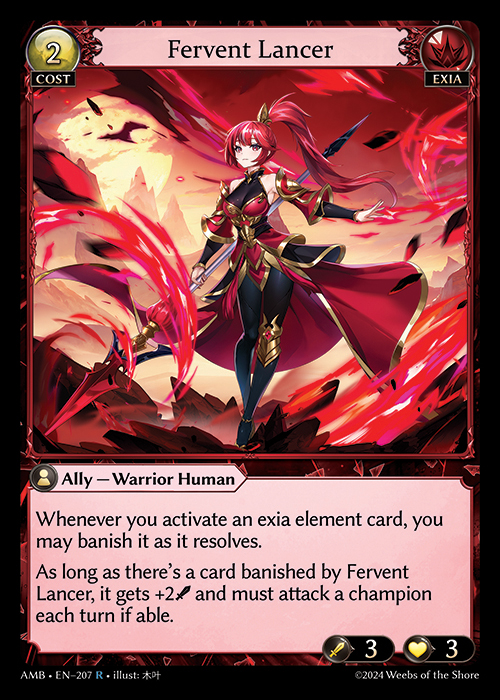 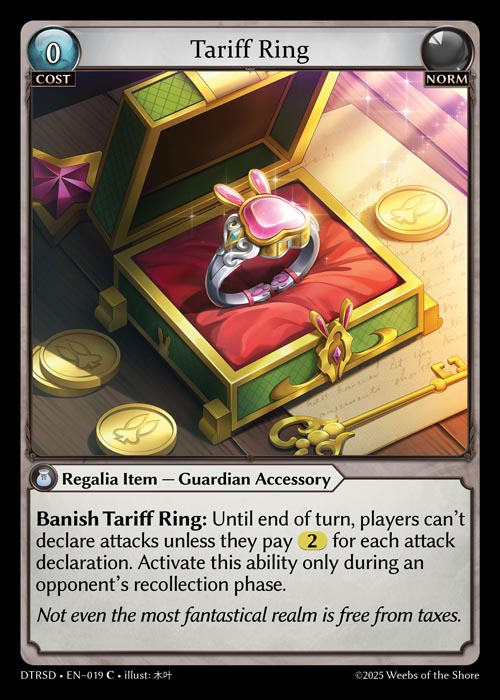\
\
E.g., If a player under the effect of an opponent's Tariff Ring must attack with a Fervent Lancer, they must attempt to declare an attack. However, during step 2.d., they may opt not to pay the extra 2 reserve. This would render the attack illegal, and any steps taken to declare the attack will be reversed.
{% endhint %}
2. The following steps must be done in sequence:
1. A player first selects the object they wish to declare an attack with.
1. The object must be able to attack (either granted permission due to an effect, or, if an ally or champion, must be awake).
1. Awake allies and champions that are chosen under 2.a. must be rested as a cost to attack.
2. Second, the attacking player may choose, if able, any additional weapons or objects they may wield during the attack.
1. The selected objects will be treated as part of the combat phase after declarations but will not receive attacker roles (only the attacking unit/object is treated as an attacker).
3. Third, the attacking player must choose an attack target (i.e., what becomes the defending unit).
1. If the attacker is granted Cleave by either an ability it possesses or due to a Cleave ability of an object they are using in conjunction with the attack declaration in step 2.b., the attacking player will instead choose a player whose units will become defending units. The defending units will not be treated as attack targets.
4. Fourth, after all objects involved in combat are selected and targets have been chosen, any calculated costs (including additional costs) to declare attacks must be paid during this step.
5. Fifth, the player must acknowledge and reconcile any restrictions that may alter costs to be paid to declare the attack or that may modify the legality of the attack.
1. Any extra costs imposed that are not explicitly declared as "additional costs" to declare the attack must be paid during this step.
1. Players are not required to pay these costs; if a player refuses to pay the cost, the attack will be considered illegal.
2. Any restrictions that are imposed, such as targeting restrictions via Taunt abilities, must be fulfilled.
3. If one or more necessary conditions or restrictions on the attack declaration are not fulfilled, the attack is considered illegal and all steps taken to attempt to declare the attack are reversed; players must fulfill all mandatory restrictions to have a legal attack. The game will resume at the point in time prior to the attack declaration.
{% hint style="success" %}
\
\
E.g., If a player under the effect of an opponent's Tariff Ring must attack with a Fervent Lancer, they must attempt to declare an attack. However, during step 2.d., they may opt not to pay the extra 2 reserve. This would render the attack illegal, and any steps taken to declare the attack will be reversed.
{% endhint %}
2. The following steps must be done in sequence:
1. A player first selects the object they wish to declare an attack with.
1. The object must be able to attack (either granted permission due to an effect, or, if an ally or champion, must be awake).
1. Awake allies and champions that are chosen under 2.a. must be rested as a cost to attack.
2. Second, the attacking player may choose, if able, any additional weapons or objects they may wield during the attack.
1. The selected objects will be treated as part of the combat phase after declarations but will not receive attacker roles (only the attacking unit/object is treated as an attacker).
3. Third, the attacking player must choose an attack target (i.e., what becomes the defending unit).
1. If the attacker is granted Cleave by either an ability it possesses or due to a Cleave ability of an object they are using in conjunction with the attack declaration in step 2.b., the attacking player will instead choose a player whose units will become defending units. The defending units will not be treated as attack targets.
4. Fourth, after all objects involved in combat are selected and targets have been chosen, any calculated costs (including additional costs) to declare attacks must be paid during this step.
5. Fifth, the player must acknowledge and reconcile any restrictions that may alter costs to be paid to declare the attack or that may modify the legality of the attack.
1. Any extra costs imposed that are not explicitly declared as "additional costs" to declare the attack must be paid during this step.
1. Players are not required to pay these costs; if a player refuses to pay the cost, the attack will be considered illegal.
2. Any restrictions that are imposed, such as targeting restrictions via Taunt abilities, must be fulfilled.
3. If one or more necessary conditions or restrictions on the attack declaration are not fulfilled, the attack is considered illegal and all steps taken to attempt to declare the attack are reversed; players must fulfill all mandatory restrictions to have a legal attack. The game will resume at the point in time prior to the attack declaration.
{% hint style="success" %}  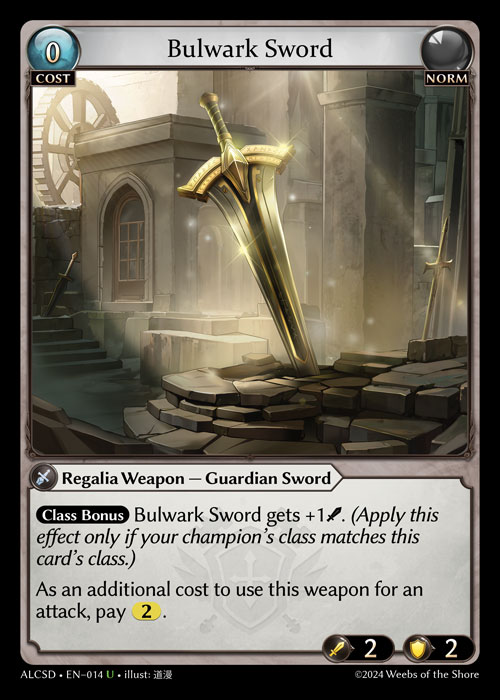\
\
E.g., Both Tariff Ring and Bulwark Sword invoke extra costs to declare attacks. Tariff Ring is not an additional cost, but rather treated as a cost restriction. Bulwark Sword, on the other hand, is an additional cost and must be paid in step 2.c. to be wielded.
{% endhint %}
---
Local source: submodules/grand-archive/.agents/skills/grand-archive-rules/references/grand-archive-comprehensive-rules/game-mechanics/game-mechanics-turn-order/turn-order-combat-phase/combat-phase-retaliation-step.md
Publisher's current source: [Weebs of the Shore](https://rules.gatcg.com/game-mechanics/game-mechanics-turn-order/turn-order-combat-phase/combat-phase-retaliation-step)
# Combat Phase - Retaliation Step
#### General Rules:
1. First, if any abilities or effects were placed onto the Effects Stack during or after attack declarations, players will receive Opportunity in turn order to respond to these effects. After the Effects Stack is empty, the game will proceed to step 2.
2. Second, turn player receives opportunity. This point at which players are granted Opportunity during this phase is considered “before retaliation” and is the only time players may act before the game progresses until the damage step is entered.
3. Third, if there are any awake defending units, for each of those units, its controlling player may choose to rest that unit to retaliate against the attacking unit.
1. If they do so, the unit being retaliated becomes the target of retaliation of the retaliating unit and the retaliating unit will deal damage according to its power stat to its retaliation target during the Damage Step.
2. Units without a power stat or that have a power stat of 0 or less cannot retaliate. Weapons can’t be wielded during retaliation.
4. Then, after the Effects Stack is empty, and each player has passed on Opportunity in succession, the game immediately proceeds to the Damage Step of combat.
---
Local source: submodules/grand-archive/.agents/skills/grand-archive-rules/references/grand-archive-comprehensive-rules/game-mechanics/game-mechanics-turn-order/turn-order-combat-phase/combat-phase-damage-step.md
Publisher's current source: [Weebs of the Shore](https://rules.gatcg.com/game-mechanics/game-mechanics-turn-order/turn-order-combat-phase/combat-phase-damage-step)
# Combat Phase - Damage Step
#### General Rules:
1. First, the turn player receives opportunity. This point at which players are granted Opportunity during this phase is considered “before damage” and is the only time players may act before the game progresses until the conclusion combat phase.
2. Second, if there are multiple units retaliating against the attacker, the attacking player chooses the order in which the retaliating units will deal damage to the attacking unit. Damage will be done simultaneously, however the order determines how damage will interact with any replacement effects such as damage prevention and for On Hit and On Kill triggers.
1. For each attacker, the only On Kill abilities from a retaliating source that will trigger are those from the damage source marking lethal damage and that would send the attacking unit to the graveyard as a result of combat damage
3. Third, after the Effects Stack is empty, and each player has passed on Opportunity in succession, damage is dealt simultaneously between the attacking unit and its target, and, if any, the retaliating unit(s) to its/their retaliation targets.
1. Damage calculation from the attacker first involves summation of power stats of all Intents (all cards in the intent), weapons wielded by the attacker, and any additive or subtractive power modifiers. Any replacement effects or further modifiers are applied after this.
2. If a retaliating unit were to leave the field before the damage step, it would deal no damage and be dealt no damage.
3. A retaliating unit will still deal damage to its retaliation target even if the attacking unit is no longer considered to be attacking.
4. Damage dealt by a retaliating unit is considered combat damage.
5. If any weapon or attack card effects would modify the damage dealt by an attack or create additional effects, those effects are applied after the combining of power stats during the dealing of damage within the damage step. Damage is all applied in one instance.
6. If any replacement effects with damage occur, the controller of the object taking damage chooses the order in which they apply sequentially and step-wise for each replacement effect.
7. Combat damage and removal of durability counters for weapons involved in attacks are done simultaneously.
1. Damage dependent upon the number of durability counters on a weapon is taken before any durability counters are removed.
2. If a weapon is wielded in an attack and was part of dealing damage or dealt damage, a durability counter is removed in this phase. Durability is still removed if the damage dealt is 0. No durability counters are removed if the attack was negated or fizzled, the defending object left the field or became an illegal attack target before damage was dealt, or if the weapon left the field before damage was dealt.
8. In the time that an instance of damage is being dealt, no Opportunity is given; no actions may be taken by players during this game state.
4. Finally, after damage is calculated correctly and dealt, the game progresses to the End of Combat step.
{% hint style="danger" %}
Regarding retaliation damage: If a retaliating unit was given stealth at the beginning of the damage step, a targeted attack without True Sight will become illegal and the unit retaliating won’t be dealt damage, however, the retaliating unit will still deal damage to the unit declared attacking.
{% endhint %}
{% hint style="warning" %}
Regarding damage prevention: A player controlling an effect that prevents 1 damage from a source has a champion being attacked by another player’s champion using Rending Flames as well as an effect that increases damage dealt by 1. The defending player may order the effects such that: Damage is decreased by 1, then doubled, and then increased by 1 to minimize damage dealt.
{% endhint %}
---
Local source: submodules/grand-archive/.agents/skills/grand-archive-rules/references/grand-archive-comprehensive-rules/game-mechanics/game-mechanics-turn-order/turn-order-ending-phases.md
Publisher's current source: [Weebs of the Shore](https://rules.gatcg.com/game-mechanics/game-mechanics-turn-order/turn-order-ending-phases)
# Turn Order - Ending Phases
#### General Rules:
1. If an effect or condition ends a phase of the game, all effects in the Effects Stack will not resolve and all cards in the Effects Stack will be banished.
1. If there are any sub-phases or steps associated with the phase other than the ending of a phase, those will be skipped and the game will immediately proceed to the end of the phase.
2. If the combat phase is ended, the game will proceed to the end of the combat step and then immediately proceed to the main phase.
2. If an effect or condition ends the turn, all effects in the Effects Stack will not resolve and all cards in the Effects Stack will be banished. The game will immediately proceed to End Phase Step 4, the final part of the End Phase, complete any associated game actions, and then directly proceed to the following turn.
1. The card or ability that ended the phase will not be banished itself; it will (by default) go to the graveyard as it resolves before the phase is ended.
---
Local source: submodules/grand-archive/.agents/skills/grand-archive-rules/references/grand-archive-comprehensive-rules/game-mechanics/game-mechanics-turn-order/turn-order-skipping-phases.md
Publisher's current source: [Weebs of the Shore](https://rules.gatcg.com/game-mechanics/game-mechanics-turn-order/turn-order-skipping-phases)
# Turn Order - Skipping Phases
#### General Rules:
1. If an effect or condition would skip a phase in the game, that phase does not happen. No turn-based actions or effects would take place that are tied to that phase and a player would never receive Opportunity to take player actions during that phase if they would be granted Opportunity during that phase.
2. Phases can be skipped multiple times. If this occurs, those phases will be individually skipped, even across multiple turns, if necessary.
3. The skipped phase will not proceed through any end-of-phase effects or turn-based actions.
{% hint style="info" %}
E.g., If a player’s End Phase were skipped, nothing that would take place during the End Phase (such as end of turn effects) would take place. If a pending trigger specified “the next end phase,” it would happen during the next player’s End Phase. If a pending trigger instead said “your next end phase,” it would happen during your next turn’s end phase.
{% endhint %}
---
Local source: submodules/grand-archive/.agents/skills/grand-archive-rules/references/grand-archive-comprehensive-rules/game-mechanics/game-mechanics-playing-cards.md
Publisher's current source: [Weebs of the Shore](https://rules.gatcg.com/game-mechanics/game-mechanics-playing-cards)
# Game Mechanics - Playing Cards
#### General Rules:
1. Activating, materializing, or bestowing a card is considered playing that card.
2. A card can only be played if a player has control of that card or is given play permissions for that card.
3. If playing a card is illegal, the actions directly taken to play that card are canceled and the game state will revert to the point before the attempt to play that card was made.
4. All cards in the Effects Stack are controlled by the player who played them.
5. The activations, materializations, and bestowments of that card belong to whichever player created that instance and put it onto the Effects Stack.
6. When a card is played, that card is moved to the Effects Stack and given a timestamp corresponding to when it was played. This will also automatically add one instance of either an activation, materialization, or bestowment to the Effects Stack, corresponding with the play method used for that card.
7. A played card will be removed from the Effects Stack and moved to its appropriate zone after each instance of its activations is resolved or removed from the Effects Stack (see [state-based checks](/game-mechanics/game-mechanics-miscellaneous-topics/state-based-checks-and-effects.md)).
1. Cards with reserve costs will go to the Graveyard from the Effects Stack; cards with memory costs will go to Banishment. If a non-copy instance resolves and becomes an object, then the card will instead be placed on the field to represent the object.
8. If a card is removed from the Effects Stack, any instances of its activation, materialization, or bestowment will be removed from the Effects Stack, as well.
{% hint style="info" %}
\
\
E.g., Both Tariff Ring and Bulwark Sword invoke extra costs to declare attacks. Tariff Ring is not an additional cost, but rather treated as a cost restriction. Bulwark Sword, on the other hand, is an additional cost and must be paid in step 2.c. to be wielded.
{% endhint %}
---
Local source: submodules/grand-archive/.agents/skills/grand-archive-rules/references/grand-archive-comprehensive-rules/game-mechanics/game-mechanics-turn-order/turn-order-combat-phase/combat-phase-retaliation-step.md
Publisher's current source: [Weebs of the Shore](https://rules.gatcg.com/game-mechanics/game-mechanics-turn-order/turn-order-combat-phase/combat-phase-retaliation-step)
# Combat Phase - Retaliation Step
#### General Rules:
1. First, if any abilities or effects were placed onto the Effects Stack during or after attack declarations, players will receive Opportunity in turn order to respond to these effects. After the Effects Stack is empty, the game will proceed to step 2.
2. Second, turn player receives opportunity. This point at which players are granted Opportunity during this phase is considered “before retaliation” and is the only time players may act before the game progresses until the damage step is entered.
3. Third, if there are any awake defending units, for each of those units, its controlling player may choose to rest that unit to retaliate against the attacking unit.
1. If they do so, the unit being retaliated becomes the target of retaliation of the retaliating unit and the retaliating unit will deal damage according to its power stat to its retaliation target during the Damage Step.
2. Units without a power stat or that have a power stat of 0 or less cannot retaliate. Weapons can’t be wielded during retaliation.
4. Then, after the Effects Stack is empty, and each player has passed on Opportunity in succession, the game immediately proceeds to the Damage Step of combat.
---
Local source: submodules/grand-archive/.agents/skills/grand-archive-rules/references/grand-archive-comprehensive-rules/game-mechanics/game-mechanics-turn-order/turn-order-combat-phase/combat-phase-damage-step.md
Publisher's current source: [Weebs of the Shore](https://rules.gatcg.com/game-mechanics/game-mechanics-turn-order/turn-order-combat-phase/combat-phase-damage-step)
# Combat Phase - Damage Step
#### General Rules:
1. First, the turn player receives opportunity. This point at which players are granted Opportunity during this phase is considered “before damage” and is the only time players may act before the game progresses until the conclusion combat phase.
2. Second, if there are multiple units retaliating against the attacker, the attacking player chooses the order in which the retaliating units will deal damage to the attacking unit. Damage will be done simultaneously, however the order determines how damage will interact with any replacement effects such as damage prevention and for On Hit and On Kill triggers.
1. For each attacker, the only On Kill abilities from a retaliating source that will trigger are those from the damage source marking lethal damage and that would send the attacking unit to the graveyard as a result of combat damage
3. Third, after the Effects Stack is empty, and each player has passed on Opportunity in succession, damage is dealt simultaneously between the attacking unit and its target, and, if any, the retaliating unit(s) to its/their retaliation targets.
1. Damage calculation from the attacker first involves summation of power stats of all Intents (all cards in the intent), weapons wielded by the attacker, and any additive or subtractive power modifiers. Any replacement effects or further modifiers are applied after this.
2. If a retaliating unit were to leave the field before the damage step, it would deal no damage and be dealt no damage.
3. A retaliating unit will still deal damage to its retaliation target even if the attacking unit is no longer considered to be attacking.
4. Damage dealt by a retaliating unit is considered combat damage.
5. If any weapon or attack card effects would modify the damage dealt by an attack or create additional effects, those effects are applied after the combining of power stats during the dealing of damage within the damage step. Damage is all applied in one instance.
6. If any replacement effects with damage occur, the controller of the object taking damage chooses the order in which they apply sequentially and step-wise for each replacement effect.
7. Combat damage and removal of durability counters for weapons involved in attacks are done simultaneously.
1. Damage dependent upon the number of durability counters on a weapon is taken before any durability counters are removed.
2. If a weapon is wielded in an attack and was part of dealing damage or dealt damage, a durability counter is removed in this phase. Durability is still removed if the damage dealt is 0. No durability counters are removed if the attack was negated or fizzled, the defending object left the field or became an illegal attack target before damage was dealt, or if the weapon left the field before damage was dealt.
8. In the time that an instance of damage is being dealt, no Opportunity is given; no actions may be taken by players during this game state.
4. Finally, after damage is calculated correctly and dealt, the game progresses to the End of Combat step.
{% hint style="danger" %}
Regarding retaliation damage: If a retaliating unit was given stealth at the beginning of the damage step, a targeted attack without True Sight will become illegal and the unit retaliating won’t be dealt damage, however, the retaliating unit will still deal damage to the unit declared attacking.
{% endhint %}
{% hint style="warning" %}
Regarding damage prevention: A player controlling an effect that prevents 1 damage from a source has a champion being attacked by another player’s champion using Rending Flames as well as an effect that increases damage dealt by 1. The defending player may order the effects such that: Damage is decreased by 1, then doubled, and then increased by 1 to minimize damage dealt.
{% endhint %}
---
Local source: submodules/grand-archive/.agents/skills/grand-archive-rules/references/grand-archive-comprehensive-rules/game-mechanics/game-mechanics-turn-order/turn-order-ending-phases.md
Publisher's current source: [Weebs of the Shore](https://rules.gatcg.com/game-mechanics/game-mechanics-turn-order/turn-order-ending-phases)
# Turn Order - Ending Phases
#### General Rules:
1. If an effect or condition ends a phase of the game, all effects in the Effects Stack will not resolve and all cards in the Effects Stack will be banished.
1. If there are any sub-phases or steps associated with the phase other than the ending of a phase, those will be skipped and the game will immediately proceed to the end of the phase.
2. If the combat phase is ended, the game will proceed to the end of the combat step and then immediately proceed to the main phase.
2. If an effect or condition ends the turn, all effects in the Effects Stack will not resolve and all cards in the Effects Stack will be banished. The game will immediately proceed to End Phase Step 4, the final part of the End Phase, complete any associated game actions, and then directly proceed to the following turn.
1. The card or ability that ended the phase will not be banished itself; it will (by default) go to the graveyard as it resolves before the phase is ended.
---
Local source: submodules/grand-archive/.agents/skills/grand-archive-rules/references/grand-archive-comprehensive-rules/game-mechanics/game-mechanics-turn-order/turn-order-skipping-phases.md
Publisher's current source: [Weebs of the Shore](https://rules.gatcg.com/game-mechanics/game-mechanics-turn-order/turn-order-skipping-phases)
# Turn Order - Skipping Phases
#### General Rules:
1. If an effect or condition would skip a phase in the game, that phase does not happen. No turn-based actions or effects would take place that are tied to that phase and a player would never receive Opportunity to take player actions during that phase if they would be granted Opportunity during that phase.
2. Phases can be skipped multiple times. If this occurs, those phases will be individually skipped, even across multiple turns, if necessary.
3. The skipped phase will not proceed through any end-of-phase effects or turn-based actions.
{% hint style="info" %}
E.g., If a player’s End Phase were skipped, nothing that would take place during the End Phase (such as end of turn effects) would take place. If a pending trigger specified “the next end phase,” it would happen during the next player’s End Phase. If a pending trigger instead said “your next end phase,” it would happen during your next turn’s end phase.
{% endhint %}
---
Local source: submodules/grand-archive/.agents/skills/grand-archive-rules/references/grand-archive-comprehensive-rules/game-mechanics/game-mechanics-playing-cards.md
Publisher's current source: [Weebs of the Shore](https://rules.gatcg.com/game-mechanics/game-mechanics-playing-cards)
# Game Mechanics - Playing Cards
#### General Rules:
1. Activating, materializing, or bestowing a card is considered playing that card.
2. A card can only be played if a player has control of that card or is given play permissions for that card.
3. If playing a card is illegal, the actions directly taken to play that card are canceled and the game state will revert to the point before the attempt to play that card was made.
4. All cards in the Effects Stack are controlled by the player who played them.
5. The activations, materializations, and bestowments of that card belong to whichever player created that instance and put it onto the Effects Stack.
6. When a card is played, that card is moved to the Effects Stack and given a timestamp corresponding to when it was played. This will also automatically add one instance of either an activation, materialization, or bestowment to the Effects Stack, corresponding with the play method used for that card.
7. A played card will be removed from the Effects Stack and moved to its appropriate zone after each instance of its activations is resolved or removed from the Effects Stack (see [state-based checks](/game-mechanics/game-mechanics-miscellaneous-topics/state-based-checks-and-effects.md)).
1. Cards with reserve costs will go to the Graveyard from the Effects Stack; cards with memory costs will go to Banishment. If a non-copy instance resolves and becomes an object, then the card will instead be placed on the field to represent the object.
8. If a card is removed from the Effects Stack, any instances of its activation, materialization, or bestowment will be removed from the Effects Stack, as well.
{% hint style="info" %}  {% endhint %}
**1.4 Selecting Modes:** Some cards require that one or more modes be selected out of given options when activating the card and placing it onto the effects stack. All modes must be selected as the card is placed onto the effects stack, and the selected modes may not be changed after the card is activated.
1. If any modes are selected based on unlocked class bonuses at the time of activation, these modes will still be selected and remain unchanged unless the class bonus is lost; they will not be regained statically if class bonus is lost.
**1.5 Declaring Targets**: After modes are selected, any necessary targets for successful activation must be chosen. A target may only be selected if it is legal. If an effect instructs a player to choose "up to" or "any number" or "any amount" or any variation of this, these targets are optional; they are not required for successful activation of the card. These targets will be inherited by the corresponding card activation.
**1.6 Checking Legality**: Then, the game performs a legality check for card activation and, if any part of the activation is not legal, the activation is canceled, and the game will revert to the point before the card activation was declared. No action will be considered to have been taken nor will event triggers be generated.
**1.7 Calculating Reserve Cost**: Next, the player calculates the reserve cost of the card with the following steps:
1. First, the starting reserve cost of the card is determined.
2. Second, effects that set a reserve cost are applied.
3. Third, effects that add or subtract to or from the reserve cost are applied simultaneously.
4. Fourth, effects that remove reserve costs are applied. This would cause reserve cost to become 0. Effects can’t cause the reserve cost to be less than 0.
**1.8 Paying Costs**: Next, the player pays the reserve cost and any additional or alternative costs of the card. If the costs cannot be paid, then the activation is illegal and the game state is reversed before activation was initiated. Costs can be paid in any order so long as they are fulfilled.
1. Costs may be paid through replacement effects.
2. If the payment of costs results in any modifications or additional modes being added to an activation, step 4 will be repeated for any new unselected modes or options. The same will be true for step 5 and 6, however, step 7 will not be repeated. Previously chosen targets and modes that were not modified or added in this step cannot be changed.
{% hint style="info" %}
E.g., For 1.8, Cordelia gives your tokens Reservable. You would be able to rest four Powercell tokens to pay for the reserve cost of Overlord before sacrificing the Powercells for the additional cost.
{% endhint %}
**1.4 Selecting Modes:** Some cards require that one or more modes be selected out of given options when activating the card and placing it onto the effects stack. All modes must be selected as the card is placed onto the effects stack, and the selected modes may not be changed after the card is activated.
1. If any modes are selected based on unlocked class bonuses at the time of activation, these modes will still be selected and remain unchanged unless the class bonus is lost; they will not be regained statically if class bonus is lost.
**1.5 Declaring Targets**: After modes are selected, any necessary targets for successful activation must be chosen. A target may only be selected if it is legal. If an effect instructs a player to choose "up to" or "any number" or "any amount" or any variation of this, these targets are optional; they are not required for successful activation of the card. These targets will be inherited by the corresponding card activation.
**1.6 Checking Legality**: Then, the game performs a legality check for card activation and, if any part of the activation is not legal, the activation is canceled, and the game will revert to the point before the card activation was declared. No action will be considered to have been taken nor will event triggers be generated.
**1.7 Calculating Reserve Cost**: Next, the player calculates the reserve cost of the card with the following steps:
1. First, the starting reserve cost of the card is determined.
2. Second, effects that set a reserve cost are applied.
3. Third, effects that add or subtract to or from the reserve cost are applied simultaneously.
4. Fourth, effects that remove reserve costs are applied. This would cause reserve cost to become 0. Effects can’t cause the reserve cost to be less than 0.
**1.8 Paying Costs**: Next, the player pays the reserve cost and any additional or alternative costs of the card. If the costs cannot be paid, then the activation is illegal and the game state is reversed before activation was initiated. Costs can be paid in any order so long as they are fulfilled.
1. Costs may be paid through replacement effects.
2. If the payment of costs results in any modifications or additional modes being added to an activation, step 4 will be repeated for any new unselected modes or options. The same will be true for step 5 and 6, however, step 7 will not be repeated. Previously chosen targets and modes that were not modified or added in this step cannot be changed.
{% hint style="info" %}
E.g., For 1.8, Cordelia gives your tokens Reservable. You would be able to rest four Powercell tokens to pay for the reserve cost of Overlord before sacrificing the Powercells for the additional cost.
 
{% endhint %}
**1.9 Activation**: Then, the card is considered activated, and the player who activated the card gains Opportunity. The card activation is placed at the top-most index of the Effects Stack (following first-in-last-out resolution ordering). The corresponding source card for the activation is only tracked via timestamp, but is not ordered in the Effects Stack. Any additional instances beyond the originally instanced activation is given the "copy" property.
1. Cards can only be activated from hand unless otherwise stated.
2. Some effects will specify that you may activate a card with a memory cost as opposed to materializing it. Activating a card this way will still require payment according to its memory costs, as well as placing the card into the Effects Stack. The card will receive a corresponding activation rather than a materialization.
3. Activating a card is not dependent upon whether a player has or has not materialized for this turn; players may still activate cards with memory costs if that player has materialized a card and vice versa.

{% endhint %}
**1.9 Activation**: Then, the card is considered activated, and the player who activated the card gains Opportunity. The card activation is placed at the top-most index of the Effects Stack (following first-in-last-out resolution ordering). The corresponding source card for the activation is only tracked via timestamp, but is not ordered in the Effects Stack. Any additional instances beyond the originally instanced activation is given the "copy" property.
1. Cards can only be activated from hand unless otherwise stated.
2. Some effects will specify that you may activate a card with a memory cost as opposed to materializing it. Activating a card this way will still require payment according to its memory costs, as well as placing the card into the Effects Stack. The card will receive a corresponding activation rather than a materialization.
3. Activating a card is not dependent upon whether a player has or has not materialized for this turn; players may still activate cards with memory costs if that player has materialized a card and vice versa.
--- Local source: submodules/grand-archive/.agents/skills/grand-archive-rules/references/grand-archive-comprehensive-rules/game-mechanics/game-mechanics-playing-cards/playing-cards-card-materialization.md Publisher's current source: [Weebs of the Shore](https://rules.gatcg.com/game-mechanics/game-mechanics-playing-cards/playing-cards-card-materialization) # Playing Cards - Card Materialization #### General Rules: 1. In materializing a card, a player takes the card from the zone it currently is in, puts it onto the Effects Stack, and pays its associated materialization costs. It is timestamped according to when it entered the effects stack. Materializing a card has the following steps in order: Announcing the Materialization, Checking Elements, Declaring Costs, Selecting Modes, Declaring Targets, Checking Legality, Calculating Memory Costs, Paying Costs, and Materialization. 2. A player may only materialize a card once per materialize phase or if an effect gives a player permission to materialize a card. 3. Materializing a card follows the same initial steps as listed in Card Activation Steps 1.1 through 1.5, with the exception that the card is announced for materialization rather than activation, and then follows with 3.1: **3.1 Checking Legality**: The game performs a legality check for card materialization and, if any part of the materialization is not legal, the materialization is canceled, and the game will revert to the point before the card materialization was declared. No action will be considered to have been taken nor will event triggers generated. 1. This part is distinguished from the step for activation as, specifically, for playing Champions, players must meet the requirements to play the champion intended for materialization, including any Lineage or leveling requirements. **3.2 Calculating Memory Cost**: Next, the player calculates the memory cost of the card with the following steps: 1. First, the starting memory cost of the card is determined. 2. Second, effects that set a memory cost are applied. 3. Third, effects that add or subtract to or from the memory cost are applied simultaneously. 4. Fourth, effects that remove memory costs are applied. This would cause the reserve cost to become 0. Effects can’t cause the memory cost to be less than 0. **3.3 Paying Costs**: Next, the player pays the memory cost and any additional or alternative costs of the card. If the costs cannot be paid, then the materialization is illegal and the game state is reversed before materialization was initiated. 1. Costs may be paid through replacement effects. 2. Unlike Activation, Materialization costs have to follow a specific order: if any [Floating Memory](/glossary/keywords-and-abilities.md#floating-memory) abilities are used to pay for a memory cost, those must be used first before any other costs and rendered and paid. **3.4 Materialization**: Then, the card is considered materialized, and the player who materialized the card gains opportunity. The card materialization is placed at the top-most index of the Effects Stack (following first-in-last-out resolution ordering). Any additional instances beyond the originally instanced materialization are given the "copy" property. 1. Cards that enter the Effects Stack as a result of that card having been materialized will cause that card to be considered a materialization while it is in the Effects Stack. 2. Cards without Memory Costs cannot be materialized. --- Local source: submodules/grand-archive/.agents/skills/grand-archive-rules/references/grand-archive-comprehensive-rules/game-mechanics/game-mechanics-playing-cards/playing-cards-costs-and-memory.md Publisher's current source: [Weebs of the Shore](https://rules.gatcg.com/game-mechanics/game-mechanics-playing-cards/playing-cards-costs-and-memory) # Playing Cards - Costs and Memory #### General Rules: 1. Reserve costs are paid by reserving cards into the memory zone from the hand. 1. Cards selected for reserve costs may only be changed up until the player confirms the selection and places the activated card onto the Effects Stack. 2. Players may not exchange reserved cards once this has been done and may not interchange already reserved cards while activating another card. 3. Players must clearly represent chosen and reserved cards. 4. Cards placed into memory for reserve costs remain there even if the card or effect does not resolve. 5. Materialization can involve cards with reserve costs. In this case, reserve costs are paid rather than memory costs. 2. Memory costs require banishing cards from cards in the memory zone at random. 1. Cards selected for memory costs are chosen randomly by a fair selection process (a process that provides equal probabilities for any one card to be selected). 2. Once cards have been selected for memory costs (including cards with floating memory chosen for payment), no cards may be interchanged or reselected and the chosen cards are then banished simultaneously. 3. The card is then immediately placed into the Effects Stack for resolution. 3. Cards without specified reserve costs can’t be paid for by reserving 0 cards; cards without memory costs can’t be paid for by paying a memory cost of 0. Not having a cost is not the same as having a cost of 0 in each of these respects; players can’t pay null/non-existent costs. See [floating memory](/glossary/keywords-and-abilities.md#floating-memory) for additional information on cost payment methods. --- Local source: submodules/grand-archive/.agents/skills/grand-archive-rules/references/grand-archive-comprehensive-rules/game-mechanics/game-mechanics-playing-cards/playing-cards-resolution.md Publisher's current source: [Weebs of the Shore](https://rules.gatcg.com/game-mechanics/game-mechanics-playing-cards/playing-cards-resolution) # Playing Cards - Resolution #### General Rules: 1. Resolution of cards happens after all costs for playing the card are paid, the card is played, passes legality checks, is placed into the Effects Stack (along with its corresponding play method instancing, such as a card activation, materialization or bestowment) and no player has taken any player actions or the game state has not changed in a way that would invalidate the card. 1. A card's corresponding activation/materialization/bestowment instance is then resolved when the above conditions are met and while no other game actions are taking place; these instances are resolved at discrete points of time within a game, with each instance having its own point in time to resolve. 2. Resolving a card's activation/materialization/bestowment causes the game to examine the card on the effects stack and either has the player perform or enact all effects and instructions listed on the card in top-to-bottom order, step by step, or (in the case of object-type cards) creates an objects with the described characteristics and properties that follow from the source card of that activation/materialization/bestowment. 1. Resolving an instance of an activation/materialization/bestowment will cause a simultaneous state-based check on whether or not any additional instances are associated with the source card. If the last instance is currently resolving, the source card will be removed from the Effects Stack and either go to the Graveyard (or Banishment, in the case of cards with memory costs) or become an object on the field. {% hint style="info" %} E.g., If an effect says “Glimpse 2. Draw a card,” the player must first Glimpse 2, only after which they can draw a card. No state-based checks occur between each instruction. {% endhint %} 3. “You” printed on a card or implicit in commands are directed to the controller, while other specified players or objects are referenced according to target declarations on activation/materialization/bestowment. 4. All effects will resolve from the perspective of the player who controlled the effect in the Effects Stack. 5. Some effects specify "may" as a permission-based clause during the resolution of an effect or ability. For these effects, the specified player will choose to accept or reject the option offered during the resolution. There is no later point in time at which this decision can be made. 6. If any optional choices are made for any effects during a resolution, such as "you may X" where X is a requirement, cost, or action, the player must completely do X for any related effects to happen; players can't partially fulfill the condition on optional effects. Typically, these effects are tied to a default case of "if you don't," which will automatically be applied if the optional cost/action is not taken. 7. All champions, allies, weapons, items, domains, tokens, and other objects will enter the field or intent under the control of the player who controlled the corresponding card or effect that would generate the object in the Effects Stack 8. All action cards will resolve from the perspective of the player who controlled the corresponding card in the Effects Stack. 9. As attack cards resolve, the game will check if it is legal for its controller to initiate a combat phase. If it is, the attack card will resolve and enter a player’s champion’s intent from the perspective of the player that controlled the corresponding card in the Effects Stack. If a combat phase cannot be initiated (e.g., an attack card was activated at fast speed during the opponent’s turn), the attack fizzles as a state-based action. 10. Replacement effects do not replace any actions taken during the resolution of a card; they may only adjust the outcome of that action after it has been performed. As a result, reflexive triggers that are part of a resolution contingent upon an action being performed will see the action as completed even if the result of that action is modified through a replacement effect. 11. A card is resolved when all of its materializations or activations have resolved from the Effects Stack, including the original and/or any copies. A card resolves and is removed from the Effects Stack as a result of state-based checks. 1. If a card has text that modifies its resolution (such as being banished instead of going to the graveyard) or the destination zone were to be changed due to a replacement effect or other ability, the destination zone is maintained if it is ngated. This is also true for rules set by supertypes, such as Regalia. #### Checking Resolution 1. Before a card activation/materialization/bestowment begins resolving, the game will perform a check to make sure that all conditions for successful resolution are met. 1. For champions, a level-check and lineage check will be performed in addition to any other legality checks upon attempted resolution of a champion materialization. 2. If the resolution is deemed illegal in any way, it will instead “fizzle”; if something fizzles any of the effects that would occur during its resolution don't, and it would not become an object if it were to do so. 3. The phrasing “Up to \[X] target \[object]” on cards and effects is treated as optional conditions and will not impact whether or not a card will resolve correctly. The same is true for wording such as "any number" or "any amount" for chosen targets. 4. Cards and effects that specify and quantify the necessary targets that must be chosen on the declaration of activation or playing of the card must have each of its targets still be valid/legal upon resolution. 1. A card resolves if and only if the targets selected are all still legal targets for the event upon resolution (apart from “Up to \[X]” target phrasings). 1. If any one of the necessary targets becomes illegal/invalid at the point of resolution, the entire card/effect does not resolve. If a card does not resolve this way, the card is then sent to the graveyard (or, if it is regalia, to banishment). --- Local source: submodules/grand-archive/.agents/skills/grand-archive-rules/references/grand-archive-comprehensive-rules/game-mechanics/game-mechanics-abilities.md Publisher's current source: [Weebs of the Shore](https://rules.gatcg.com/game-mechanics/game-mechanics-abilities) # Game Mechanics - Abilities #### General Rules: 1. Abilities are characteristics of cards and objects that affect the game and either produce an instanced effect or a continuous effect for a specified duration (E.g. “until end of turn”). 2. Abilities can be either Activated abilities, Triggered abilities, or Static abilities, and some abilities (or functional rules) can be bound by Restriction abilities. 3. Abilities are rules text and, therefore, are considered characteristics of the card. 1. Some abilities can be considered "intrinsic." An intrinsic ability is any ability that is coded in a way where its ability is keyworded or categorized. This considers [Keyword abilities](/glossary/keywords-and-abilities.md) as well as [Label Keyword](/glossary/game-terms.md#label-keywords) abilities. 1. If a keyword is tied to a restriction and an effect asks the game to check for the keyword, it will do so during resolution to determine the effect or action's legality. Failing the check would cause the game to act as if the checked characteristic is absent. 2. Effects that instruct a player to search for or specify a card can do so by defining an intrinsic ability as a filter. {% hint style="success" %} E.g., if an effect would instruct a player to search for "a card with Floating Memory" from the deck, they may find any card with Floating Memory in its rules text (provided it's unrestricted), even though the ability only functions from the Graveyard. {% endhint %} {% hint style="info" %} Abilities tied to objects generally only function from the field; however, cards may specify zones in which that ability functions. {% endhint %} 4. Abilities specifying a zone or zones in which they function may not function in any other zones. 5. Abilities specifying a zone or zones in which they do not function may function in other zones. 1. Abilities of action cards generally only function in the Effects Stacks. 2. Abilities of attack cards generally only function while they are in the intent. 3. Abilities of non-action, non-attack cards generally only function while they exist on the field as objects. 6. Cards in the intent can activate and trigger their abilities as if they were objects, with the exception of any abilities that require resting, sacrificing, or performing any object-related ability as a cost. This means any abilities a card would have been able to trigger or activate when it would have been an object may be triggered or activated from the intent. Cards in the intent will also apply any static abilities as if they were objects. 1. A card's static abilities, other than those that modify a card's characteristics, such as alternative play methods or abilities that grant special activation permissions. These abilities would reference the card as opposed to the object by name, as is by ability conventions. 7. Abilities can specify zones from where an effect may take place or from where that ability may be activated that are not their default functional zone (Effects Stack for action cards, the field for non-action card objects). 8. Multiple non-keyword abilities on a card or object are separated by paragraph breaks. 9. Some abilities can be granted temporarily or permanently to cards, objects, or players, by other effects or abilities. 10. Multiple instances of the same ability are taken into account only if that ability is not classified as redundant. 11. Redundant abilities and keywords of an object will only take effect once, regardless of the multiplicity of instances in which that ability or keyword is active. 12. Redundant abilities and keywords will only consider the first instance of that ability or keyword for counting purposes. {% hint style="info" %} E.g., If an ally has three instances of vigor, other cards and effects would see that ally as having only one ability. [Keywords](/glossary/keywords-and-abilities.md) contains information on ability redundancy. {% endhint %} 13. Abilities consider the source of the ability as the object or card that generated the ability and are controlled by the player who controlled that object or card that generated the ability, whether triggered or activated. If any ability refers to its source’s characteristics, the last known information regarding the source is used. {% hint style="info" %} E.g., If an ally with an On Death trigger has an effect based upon that ally’s power, the power considered will be that of the ally while it was on the field before it died. {% endhint %} 14. An ability placed in the Effects Stack exists independently of its source and will not be negated or fizzled if its source ceases to exist or is itself negated. If the source of the ability has left the zone it was in or changed control, the last known information under its controller at that time is used. 15. All abilities in the Effects Stack are controlled by the player who controlled the source generating that ability. 16. Face-down cards or cards in any non-public zones will have all abilities, intrinsic or otherwise, concealed from each player. They are considered as just cards without any other characteristics until they are revealed or their characteristics are checked in some manner. 17. Abilities that use "as a spell" in their rules text will confer the "Spell" subtyping to the ability while it is on the Effects Stack. Additionally, if the source of that ability is not a Spell, it will temporarily act as a Spell source during the resolution of the ability; however, it will not receive the Spell subtype as the ability does. 1. If it is an activated ability, this means that it will count as activating a spell. 2. When selecting targets, units with Spellshroud can't be targeted by abilities triggered or activated "as a spell" due to having the Spell subtyping. 3. If an object were to act as a Spell source in this way, any triggered abilities that have instanced conditions that specify some action resulting from a Spell source will count the ability's source as a Spell during state-based checks. The object only acts as a Spell source within the resolution of the ability. (This is similar to how [Spirit Blade: Ensoul allows weapons under its effect to attack as if they were allies](https://index.gatcg.com/edition/spirit-blade-ensoul-doa-alter), despite not having an ally typing, nor functionally becoming allies.) The following pages discuss these topics: * [Activated Abilities](/game-mechanics/game-mechanics-abilities/abilities-activated-abilities.md) * [Triggered Abilities](/game-mechanics/game-mechanics-abilities/abilities-triggered-abilities.md) * [Static Abilities](/game-mechanics/game-mechanics-abilities/abilities-static-abilities.md) * [Restriction Abilities](/game-mechanics/game-mechanics-abilities/abilities-restriction-abilities.md) * [Ability Tracking](/game-mechanics/game-mechanics-abilities/abilities-ability-tracking.md) --- Local source: submodules/grand-archive/.agents/skills/grand-archive-rules/references/grand-archive-comprehensive-rules/game-mechanics/game-mechanics-abilities/abilities-activated-abilities.md Publisher's current source: [Weebs of the Shore](https://rules.gatcg.com/game-mechanics/game-mechanics-abilities/abilities-activated-abilities) # Abilities - Activated Abilities #### General Rules: 1. Activation of abilities uses a process similar to card activations: To activate an ability, a player must: * Announce the ability they wish to activate, * Select its modes and targets, * And pay the associated costs of that ability (reserve and other costs). The ability is considered activated when all steps listed above have been completed. 2. After costs have been paid, the ability then goes to the Effects Stack for resolution, and Opportunity is then first given to the turn player to respond. 3. If there are no legal modes that can be chosen, the ability can’t be activated, following standard activation rules. 4. A player may only activate an ability when they have Opportunity and may legally do so according to timing conventions. 5. Activated abilities are worded as \[Cost] : \[Effect]. Any restrictions are specified after effects. 6. Activated abilities use fast speed by default. 7. Activated abilities can’t retroactively affect costs for activations in the Effects Stack nor any modes chosen for the activation. 8. Activated abilities of attack cards can only be used from the intent by default. 9. Some abilities can give a player who does not control the source of the activated ability permission to activate it. The specified player(s) will be able to activate the ability as if they are the controlling player for the purpose of activating that ability. 1. Control of the source and/or object does not change if an ability is activated this way. --- Local source: submodules/grand-archive/.agents/skills/grand-archive-rules/references/grand-archive-comprehensive-rules/game-mechanics/game-mechanics-abilities/abilities-triggered-abilities.md Publisher's current source: [Weebs of the Shore](https://rules.gatcg.com/game-mechanics/game-mechanics-abilities/abilities-triggered-abilities) # Abilities - Triggered Abilities #### General Rules: 1. Triggered abilities are abilities placed into the Effects Stack by a player during state-based checks due to fulfillment of a game event or condition (i.e., the “trigger”). Resolution of triggered abilities will cause the effect specified after the trigger to take effect. 1. Triggered abilities whose effects use the word “may” are an exception to this; the player who controls the trigger is often given a choice as to which effect, if any, were to happen during resolution. 2. Trigger abilities generally use the words “At,” “When,” or “Whenever,” to specify a triggering event, followed by (optionally) an intervening condition or “if” statement, and ultimately an effect. 1. Triggered abilities can be keyworded where the conditions and triggering events are shortened within the keyword, but will typically be absent of any intervening conditions. As such, keyworded triggered abilities will trigger as long as the keyword-bound condition is met, regardless of any further specified conditions listed in the effect(s) of the ability. 3. Triggered abilities are generally worded as “\[Trigger], \[Condition], \[Effect]. A \[Condition] can further modify the main trigger and typically uses words such as “If” or “Unless.” 1. For non-keyworded triggered abilities, the ability will fail to trigger if this condition is not satisfied in addition to the triggering event; it will never be placed onto the effects stack to pend resolution. 2. Additionally, if such a condition was specified and fulfilled such that the trigger entered the Effects Stack, the trigger will not resolve if the condition is unmet during resolution. 4. Some triggered abilities are conditionally triggered abilities that describe a condition that must be satisfied, followed by the effect that will be placed onto the Effects Stack when the trigger condition is met. Conditionally triggered abilities typically use keywords such as On Enter and are worded as “\[Trigger/Trigger Condition] : \[Effect]”. These conditions will typically be present for common events or uncomplicated conditions, such as On Enter, On Attack, or On Death. For each case, the trigger or trigger condition must be fulfilled for the trigger to enter the Effects Stack. 1. These abilities follow the resolution conventions the same way activated abilities do after they are placed into the Effects Stack. {% hint style="info" %} E.g., Lorraine, Wandering Warrior has “On Enter: Materialize a weapon card with memory cost 0 from your material deck.” The “On Enter” is a conditionally triggered ability that will place the effect of “Materialize a weapon card with memory cost 0 from your material deck” onto the Effects Stack when the trigger condition is met.
 {% endhint %}
5. **Triggers With Modes:** Some triggers have different modes that can be selected for how it would resolve. These kinds of triggers are divided into the two classes of "choose one" vs "depending on" effects.
1. "Choose one" effects will ask that a player choose a mode or option from a list. That mode selection must be made as the ability enters the Effects Stack and can’t be changed while it is there. If there are no legal modes that can be chosen, the ability will fizzle. Similarly, if a triggered ability requires a target, that target must be selected as it is placed onto the effects stack. If no legal targets are available or made illegal while it is pending resolution, the ability will fizzle.
2. "Depending on" effects describe modes that are dependent upon the game state or a certain condition. The valid mode of that ability will occur as the ability resolves, rather than when it is placed onto the Effects Stack. Unlike a "choose one" effect, the player does not get to decide which mode resolves; this is determined by the game state.
{% hint style="info" %}
\
\
E.g., Ciel's mastery, Servile Possessions, has a triggered ability that describes separate modes that resolve depending on the game state. The trigger is placed onto the Effects Stack after the champion attacks, and the ability's option/mode is determined as it resolves.
{% endhint %}
6. Some triggered abilities are delayed trigger abilities, which can generate delayed triggers that cause the ability to enter the Effects Stack at a later time, such as at the end of a turn. They may also use words such as “At” or “When,” but may not necessarily start with those words.
7. Delayed triggers are generated as a result of the resolution of another ability. If the original ability that would generate the delayed trigger is negated or fizzles, the delayed trigger will not be generated.
8. Delayed triggers only happen once, like normal triggered abilities. If the trigger fails at the next possible opportunity, it will not generate another delayed trigger to attempt resolving again.
9. Delayed triggered abilities are still considered abilities and may be negated or fizzled.
10. When multiple triggered abilities enter the Effects Stack simultaneously, they will be stacked in turn order starting with the abilities that belong to the turn player. Each player will be able to select which order their own abilities will enter the Effects Stack when it is their turn to place their abilities into the Effects Stack. Only after each triggered ability is placed into the Effects Stack this way will the turn player be granted Opportunity and the triggered abilities will have a chance to resolve after the sequential passing of Opportunity.
11. If a trigger is generated while another effect or activation is resolving, the trigger will be placed onto the Effects Stack only after that effect/activation is completely resolved. If a card generates its own trigger as it resolves or while it is resolving due to a condition, this is known as a [reflexive trigger](/glossary/game-terms.md#reflexive-trigger).
12. Triggered abilities will have the same typing, element, and other relevant characteristics as their source.
{% hint style="warning" %}
{% endhint %}
5. **Triggers With Modes:** Some triggers have different modes that can be selected for how it would resolve. These kinds of triggers are divided into the two classes of "choose one" vs "depending on" effects.
1. "Choose one" effects will ask that a player choose a mode or option from a list. That mode selection must be made as the ability enters the Effects Stack and can’t be changed while it is there. If there are no legal modes that can be chosen, the ability will fizzle. Similarly, if a triggered ability requires a target, that target must be selected as it is placed onto the effects stack. If no legal targets are available or made illegal while it is pending resolution, the ability will fizzle.
2. "Depending on" effects describe modes that are dependent upon the game state or a certain condition. The valid mode of that ability will occur as the ability resolves, rather than when it is placed onto the Effects Stack. Unlike a "choose one" effect, the player does not get to decide which mode resolves; this is determined by the game state.
{% hint style="info" %}
\
\
E.g., Ciel's mastery, Servile Possessions, has a triggered ability that describes separate modes that resolve depending on the game state. The trigger is placed onto the Effects Stack after the champion attacks, and the ability's option/mode is determined as it resolves.
{% endhint %}
6. Some triggered abilities are delayed trigger abilities, which can generate delayed triggers that cause the ability to enter the Effects Stack at a later time, such as at the end of a turn. They may also use words such as “At” or “When,” but may not necessarily start with those words.
7. Delayed triggers are generated as a result of the resolution of another ability. If the original ability that would generate the delayed trigger is negated or fizzles, the delayed trigger will not be generated.
8. Delayed triggers only happen once, like normal triggered abilities. If the trigger fails at the next possible opportunity, it will not generate another delayed trigger to attempt resolving again.
9. Delayed triggered abilities are still considered abilities and may be negated or fizzled.
10. When multiple triggered abilities enter the Effects Stack simultaneously, they will be stacked in turn order starting with the abilities that belong to the turn player. Each player will be able to select which order their own abilities will enter the Effects Stack when it is their turn to place their abilities into the Effects Stack. Only after each triggered ability is placed into the Effects Stack this way will the turn player be granted Opportunity and the triggered abilities will have a chance to resolve after the sequential passing of Opportunity.
11. If a trigger is generated while another effect or activation is resolving, the trigger will be placed onto the Effects Stack only after that effect/activation is completely resolved. If a card generates its own trigger as it resolves or while it is resolving due to a condition, this is known as a [reflexive trigger](/glossary/game-terms.md#reflexive-trigger).
12. Triggered abilities will have the same typing, element, and other relevant characteristics as their source.
{% hint style="warning" %} --- Local source: submodules/grand-archive/.agents/skills/grand-archive-rules/references/grand-archive-comprehensive-rules/game-mechanics/game-mechanics-abilities/abilities-restriction-abilities.md Publisher's current source: [Weebs of the Shore](https://rules.gatcg.com/game-mechanics/game-mechanics-abilities/abilities-restriction-abilities) # Abilities - Restriction Abilities #### General Rules: 1. Restrictions grant additional abilities or functional rules text for a card or object based on whether a specified condition is met. These restrictions are typically represented as a restriction bubble or a bolded level threshold on the card. Examples of restriction bubbles include Class Bonus and Element Bonus, while a level restriction appears as a bolded level threshold. 2. Multiple conditions can restrict the same ability or card text. In this case, each restriction condition must be fulfilled for the ability or rules text to be active. 1. If any of the restrictions preceding an ability on a card are not met, the associated effect rules text is ignored in all zones. 2. If any intrinsic properties would be granted to a card based on the restriction conditions, none of those properties would be granted if the conditions are not met. 3. If a restriction or combination of restrictions is not met, any associated abilities or rules text are ignored in all zones. Restrictions do not follow their associated abilities to the Effects Stack after an ability has been put onto the Effects Stack. **Types of Restrictions** Restriction abilities fall under two categories: static and inline restrictions. 1. Static restrictions appear as black bubbles with white text detailing the restriction ability. These restrictions will statically lock any modes or abilities listed after it for as long as the condition is not met. 1. When activating cards and abilities, the modes and targets of the activated card or ability enter the Effects Stack depending on the restriction ability's condition during activation. Changes in available targets or mode selections do not affect that spell or ability, regardless of whether the restriction ability's state changes. 2. Restriction abilities that precede effects requiring a target or mode selection do not fizzle when their condition is no longer met, if they were previously unlocked. 2. Inline restrictions appear as **bolded** black text next to effects on a card or ability. These restrictions typically do not depend on activation timing, necessary (non-optional) target selections, or mode selections. These restriction abilities function during the resolution of the card or ability rather than during activation. #### List of restriction abilities #### Level Restrictions 1. A card or ability might specify that an effect can only happen if a champion's level meets the restriction. 1. This considers any positive or negative level modifications for calculating the level for the requirement and not just the level printed on the champion card in play. {% hint style="info" %} For example, a restriction of 2+ requires the champion’s LV to be 2 or higher. {% endhint %} #### Class Restrictions 1. A card or ability might specify that an effect can only happen if one or more of a champion's classes match one or more classes on the card that is the ability's source. #### Damage Restrictions 1. A card or ability might specify that an effect can only happen if that player's champion has a minimum number of damage counters on it. #### Memory Restrictions 1. A card or ability might specify that an effect can only happen if the required number of cards is in that player's memory. #### Element Restrictions 1. A card or ability might specify that an effect can only happen if the element of the ability's source matches at least one of the elements of the ability's controller's champion. #### Champion Restrictions 1. A card or ability might specify that an effect can only happen if the champion's name (excluding title or other naming embellishments) matches the name specified by the champion restriction ability. #### Sheen X+ Restrictions 1. A card or ability might specify that an effect can only happen if at least X sheen counters are on that player's Fractured Memories [Mastery](/game-mechanics/game-mechanics-mastery.md).
--- Local source: submodules/grand-archive/.agents/skills/grand-archive-rules/references/grand-archive-comprehensive-rules/game-mechanics/game-mechanics-abilities/abilities-ability-tracking.md Publisher's current source: [Weebs of the Shore](https://rules.gatcg.com/game-mechanics/game-mechanics-abilities/abilities-ability-tracking) # Abilities - Ability Tracking Some abilities ask players to remember previously selected modes or options for abilities. Abilities tracked in this way depend on the card that creates and instances the ability. #### General Rules: 1. Cards that do not depend on lineages (which are most non-champion objects) can simply have the abilities and modes tracked for itself, either via note-taking or some other method. 2. For champions, ability tracking means that the champion card that creates the corresponding ability will track the selected options, not the champion object itself. This is analogous to an object leaving and re-entering the field with a new instance of that object being created, along with its abilities. {% hint style="info" %} E.g., Tonoris, Genesis Aegis says “At the beginning of your recollection phase, choose one that hasn’t been chosen —” followed by a list of options for summoning tokens. If this Tonoris were to be deleted into a level 2 champion and then the player levels back into Tonoris, Genesis Aegis, a new “version” of the champion card is seen as entering play and will re-instance the triggered ability without any memory of which options were previously chosen. This means a re-leveled champion will be able to select “previously selected” options. 
{% endhint %} 3. Abilities that trigger from the Intent zone will follow and apply their effects according to the [last-known information](/game-mechanics/game-mechanics-card-and-object-information.md#last-known-information) of their source, similar to how objects' On Death triggers will apply while their source is in the graveyard. 1. If the ability references the source card, it may only do so through the immediate change in zone. If it is moved from the zone it was expected to be in for the sake of resolving an effect related to the presence of the source card, it will not function if the card is positioned to another zone. {% hint style="success" %}  E.g., Seafletched Serpent can't be loaded if it is banished from the graveyard after its On Hit ability has triggered but not resolved. {% endhint %} --- Local source: submodules/grand-archive/.agents/skills/grand-archive-rules/references/grand-archive-comprehensive-rules/game-mechanics/game-mechanics-abilities/abilities-resolving-triggered-and-activated-abilities.md Publisher's current source: [Weebs of the Shore](https://rules.gatcg.com/game-mechanics/game-mechanics-abilities/abilities-resolving-triggered-and-activated-abilities) # Abilities - Resolving Triggered and Activated Abilities #### General Rules: 1. Resolving activated or triggered abilities follow much of the same rules as [resolving cards](/game-mechanics/game-mechanics-playing-cards/playing-cards-resolution.md), except for how an ability's source is tracked. When an ability is activated or triggered, it resolves in a discrete, instanced timing, unlike static abilities that generate continuous effects. 1. Rules largely follow and abide by the same as those described in [Resolution: General Rules #1 through 6](/game-mechanics/game-mechanics-playing-cards/playing-cards-resolution.md#general-rules), as well as for [Resolution: Checking Resolution](/game-mechanics/game-mechanics-playing-cards/playing-cards-resolution.md#checking-resolution) 1.b through 1.d. Mentions in these sections regarding card activations should be considered to apply to abilities within the context here. 2. Activated and triggered abilities will reference a source, similar to how activations/materializations/bestowments reference their source card on the Effects Stack. This source is not moved to the Effects Stack, but it is separately tracked based on either the source card or, if it was an object, the source object from which the ability was triggered or activated. 1. If the ability was activated or triggered from an object or card, the [last-known information](/game-mechanics/game-mechanics-card-and-object-information.md#last-known-information) of that card/object can be used (according to the rules therein). --- Local source: submodules/grand-archive/.agents/skills/grand-archive-rules/references/grand-archive-comprehensive-rules/game-mechanics/game-mechanics-types-of-effects.md Publisher's current source: [Weebs of the Shore](https://rules.gatcg.com/game-mechanics/game-mechanics-types-of-effects) # Game Mechanics - Types of Effects The following pages discuss these topics: * [Game Effects](/game-mechanics/game-mechanics-types-of-effects/types-of-effects-game-effects.md) * [Replacement Effects](/game-mechanics/game-mechanics-types-of-effects/types-of-effects-replacement-effects.md) * [Continuous Effects](/game-mechanics/game-mechanics-types-of-effects/types-of-effects-continuous-effects.md) --- Local source: submodules/grand-archive/.agents/skills/grand-archive-rules/references/grand-archive-comprehensive-rules/game-mechanics/game-mechanics-types-of-effects/types-of-effects-game-effects.md Publisher's current source: [Weebs of the Shore](https://rules.gatcg.com/game-mechanics/game-mechanics-types-of-effects/types-of-effects-game-effects) # Types of Effects - Game Effects #### General Rules: 1. Game effects are types of effects that only impact the game as a result of game mechanics and objects interacting to resolve a game state and to move the game to a state where players can again act. Game effects often rely on the state of the game to determine what events occur. Game effects include: * Temporary effects ending (apart from those ending during the end phase) * A weapon being destroyed or banished as a result of having 0 durability during the damage step of attacks * Allies being destroyed by having marked damage equal to or greater than the life stat of the ally card * Players losing the game as a result of having marked damage on their champion equal to or greater than the life stat of the champion * Players losing the game as a result of attempting to draw from an empty deck (“decking out”) * Tokens ceasing to exist if they exist in a zone other than the field during game state checks * Players being required to sacrifice copies of a controlled Unique object 2. The game will check the game state when a player receives Opportunity or as phases begin and end. State-based effects/actions will take place during this time. 3. No players receive Opportunity, nor may they take player actions when game effects are taking place. 4. If static effects in the game set contradicting rules within the game or are persistent or continuous effects, these effects use the most recently generated effect, modifying those rules. 1. The same rules are applied for the duration of the temporary effects. {% hint style="info" %} E.g., if a player has permanently enabled the fire element, and another player has permanently disabled the fire element afterward, the element is considered disabled. If, after this, the original player re-enables the fire element permanently, they have that element considered permanently enabled. {% endhint %} 5. For all such contradicting effects, “can” does not overwrite “can’t” even if the permission-granting effect is more recent. 6. Effects dependent on the destruction of an object do not produce effects if the object is instead put into Banishment. 7. Effects that would copy cards or objects copy all characteristics of those cards or objects at the time that effect resolves. 8. Game effects that trigger per discrete events will use "whenever \[discrete event occurs] and will consider each time that event has happened. On the other hand, if "whenever one or more \[discrete event]" is used instead, it will group all of those events and generate only one trigger. {% hint style="warning" %}
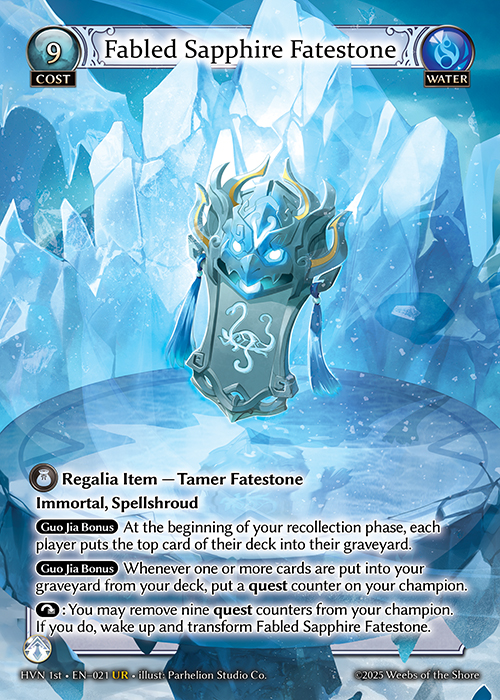 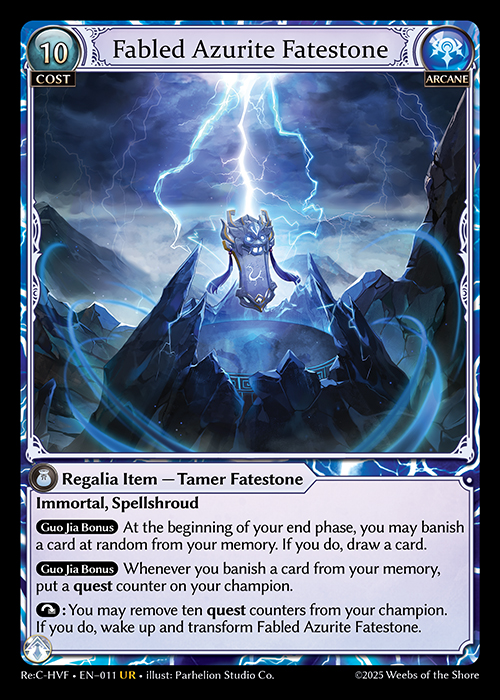\
\
E.g., Fabled Sapphire Fatestone will only trigger once, regardless of how many cards are moved from the deck to the graveyard in a single game event. On the other hand, Fabled Azurite Fatestone will trigger multiple times for each card banished from the memory in a game event.
{% endhint %}
---
Local source: submodules/grand-archive/.agents/skills/grand-archive-rules/references/grand-archive-comprehensive-rules/game-mechanics/game-mechanics-types-of-effects/types-of-effects-replacement-effects.md
Publisher's current source: [Weebs of the Shore](https://rules.gatcg.com/game-mechanics/game-mechanics-types-of-effects/types-of-effects-replacement-effects)
# Types of Effects - Replacement Effects
#### General Rules:
1. Replacement effects are effects that will cause a specified effect or outcome to occur instead of another or that override the default effects or outcomes as described in the game rules.
2. Replacement effects are applied in the order desired by the controlling player whose objects, zones, cards, etc, those replacement effects pertain to.
1. The replacement effect order is determined sequentially in a step-wise fashion; it does not follow the first-in-last-out structure like the Effects Stack.
3. When replacement effects are being applied, if multiple effects are replacing or modifying a single type of outcome (such as damage a unit would receive), the replacement effects of a given nature will be applied sequentially and determined discretely until there are no further replacement effects to consider.
1. After a replacement effect is applied, only any remaining effects that can apply will be pending replacement.
4. Replacement effects typically use phrasing such as “If \[X event] would occur, \[do Y]” and commonly use the word “instead.” (In rare cases, "when" and "whenever" have been used.)
1. Damage prevention is a common type of replacement effect that will also use the word “prevent.” Effects using this word are almost always replacement effects.
2. Replacement effects may still be generated as a result of a triggered ability. Vice versa, triggered abilities may become triggered as a result of an alternative outcome from the result of a prior replacement effect.
5. Replacement effects can also be continuous effects.
6. [Damage prevention effects](/game-mechanics/game-mechanics-damage-prevention.md) are often a type of replacement effect.
7. Some cards allow a player to replace a method of playing a card with another effect (such as Preserve, which replaces a materialization by returning the Preserved card from the material deck to the hand).
1. Situations in which a card (face-up or face-down) can be legally played in the manner being replaced do not require revealing that card. However, certain situations may result in attempting to replace a playing method that is not publicly known, typically caused by cards being set face-down in a zone with private or hidden characteristics. In those cases, the player replacing the play method with an effect must reveal the intended card and its intended play method before it can be replaced.
{% hint style="info" %}
E.g., a player controls a Quicksilver Grail and has banished a non-champion card. That player activates the ability of the Grail and states they wish to return a card Preserved in their Material deck to their hand rather than materializing the card. That player would have to reveal the face-down card and show that it was possible to materialize it. If, on the other hand, the face-down card was a card that could only be activated and not materialized, they would be unable to replace the play method with Preserve’s ability.
{% endhint %}
\
\
E.g., Fabled Sapphire Fatestone will only trigger once, regardless of how many cards are moved from the deck to the graveyard in a single game event. On the other hand, Fabled Azurite Fatestone will trigger multiple times for each card banished from the memory in a game event.
{% endhint %}
---
Local source: submodules/grand-archive/.agents/skills/grand-archive-rules/references/grand-archive-comprehensive-rules/game-mechanics/game-mechanics-types-of-effects/types-of-effects-replacement-effects.md
Publisher's current source: [Weebs of the Shore](https://rules.gatcg.com/game-mechanics/game-mechanics-types-of-effects/types-of-effects-replacement-effects)
# Types of Effects - Replacement Effects
#### General Rules:
1. Replacement effects are effects that will cause a specified effect or outcome to occur instead of another or that override the default effects or outcomes as described in the game rules.
2. Replacement effects are applied in the order desired by the controlling player whose objects, zones, cards, etc, those replacement effects pertain to.
1. The replacement effect order is determined sequentially in a step-wise fashion; it does not follow the first-in-last-out structure like the Effects Stack.
3. When replacement effects are being applied, if multiple effects are replacing or modifying a single type of outcome (such as damage a unit would receive), the replacement effects of a given nature will be applied sequentially and determined discretely until there are no further replacement effects to consider.
1. After a replacement effect is applied, only any remaining effects that can apply will be pending replacement.
4. Replacement effects typically use phrasing such as “If \[X event] would occur, \[do Y]” and commonly use the word “instead.” (In rare cases, "when" and "whenever" have been used.)
1. Damage prevention is a common type of replacement effect that will also use the word “prevent.” Effects using this word are almost always replacement effects.
2. Replacement effects may still be generated as a result of a triggered ability. Vice versa, triggered abilities may become triggered as a result of an alternative outcome from the result of a prior replacement effect.
5. Replacement effects can also be continuous effects.
6. [Damage prevention effects](/game-mechanics/game-mechanics-damage-prevention.md) are often a type of replacement effect.
7. Some cards allow a player to replace a method of playing a card with another effect (such as Preserve, which replaces a materialization by returning the Preserved card from the material deck to the hand).
1. Situations in which a card (face-up or face-down) can be legally played in the manner being replaced do not require revealing that card. However, certain situations may result in attempting to replace a playing method that is not publicly known, typically caused by cards being set face-down in a zone with private or hidden characteristics. In those cases, the player replacing the play method with an effect must reveal the intended card and its intended play method before it can be replaced.
{% hint style="info" %}
E.g., a player controls a Quicksilver Grail and has banished a non-champion card. That player activates the ability of the Grail and states they wish to return a card Preserved in their Material deck to their hand rather than materializing the card. That player would have to reveal the face-down card and show that it was possible to materialize it. If, on the other hand, the face-down card was a card that could only be activated and not materialized, they would be unable to replace the play method with Preserve’s ability.

{% endhint %}
--- Local source: submodules/grand-archive/.agents/skills/grand-archive-rules/references/grand-archive-comprehensive-rules/game-mechanics/game-mechanics-types-of-effects/types-of-effects-continuous-effects.md Publisher's current source: [Weebs of the Shore](https://rules.gatcg.com/game-mechanics/game-mechanics-types-of-effects/types-of-effects-continuous-effects) # Types of Effects - Continuous Effects #### General Rules: 1. Continuous effects can be generated due to resolved cards or abilities and can modify properties, stats, or other characteristics of cards, objects, activations, and materialization and can modify or set rules of the game or can affect players for defined or indefinite durations. 2. The duration of continuous effects is typically described by the rules text of the card that creates that effect. If no such duration is specified, the continuous effect lasts until the end of the game or until the object source of the ability leaves the field. The duration of continuous effects may be modified by conditions, typically using the wording “as long as,” which will update the "on-or-off" mode of that ability during [State-based](/game-mechanics/game-mechanics-miscellaneous-topics/state-based-checks-and-effects.md) checks. 3. There is no frame of time in which a player can act where cards, objects, activations, and materializations would not be under modifying continuous effects. #### Instanced Effects 1. If the resolution of a card activation, materialization, or ability creates a continuous effect that modifies the [characteristics ](broken://pages/d5fQPRV40fjs6PztDRCI)of objects or cards, that effect will only take into consideration the set of objects at the time that effect resolved. These are also known as "One-Shot effects." These effects typically use the words "get," "gain," or "become." 2. The set of objects will not change for the duration of that effect; any new objects that enter play after these continuous effects begin will not be affected. #### Static Effects 1. If a continuous effect that modifies or sets rules in a game of Grand Archive is statically applied, the game will apply that effect to all cards within the described set at all times. These are known as "Static Effects" and can affect cards, objects, activations, and materializations that were not initially present when the object or card that created the effect first began. These effects can use language such as "have" and "are." See [here](/glossary/game-terms.md#have-gain-get-become-are). {% hint style="info" %} E.g., inspiring Call is an example of an instanced continuous effect specifies that "allies you control get +1 power." Any allies that enter after the fact would not receive the +1 power as this effect is generated at the resolution of Inspiring Call. On the Other hand, Claude's ability to give all Automaton allies you control the abilities of Taunt and "On Death: Glimpse 3" is a continuous static ability. Allies that fit the set of "Automaton allies you control" will benefit from the ability, even if those allies entered play after Claude did. (I.e., those Automaton allies have a later [timestamp](#timestamps).)  {% endhint %} {% hint style="danger" %} E.g., Nullifying Lantern is another example of a static ability that will set the element type of all cards in graveyards to Norm regardless of whether those cards entered the graveyard after Nullifying Lantern entered play. Nullifying Mirror uses the word *are* here (see below).  {% endhint %} #### Syntax of Continuous Effects Have, Gain, Get, Become/Are 1. These words are used when an effect grants an ability or an effect to a set of described cards or objects. Depending on the word used and whether it is an instanced or static effect, the affected objects or cards in the defined set are either limited to those during resolution or for cards that would enter the set at a later time. 1. "Get/Gets," "Gains," and "Becomes" : These words are used for when a continuous effect confers abilities, modifies stats, or sets/modifies game rules to a set of cards defined at the resolution of the effect. These effects can only apply to cards or objects with an earlier timestamp than when the effect resolves. 1. "Loses" applies to the limited set during resolution in the context of continuous effects. 2. "Has/Have," and "Are" : These words are used for when a continuous effect confers abilities, modifies stats, or sets/modifies game rules statically to any cards or objects within a defined set, regardless of the timestamp of when those cards or objects entered that set; The difference from 1.a. is that the cards or objects that enter the set later will have the same timestamp for when the effect began as when they entered the set. The game will see those cards/object as being under the effect as soon as they entered the defined set. 1. Cards or objects that were in that defined set when the ability resolves might see a state or property change when the effect resolves. Cards or objects that later join the set would not have a state/property change since it will be seen as though those cards/objects would have simply existed in that state. 2. Unlike typical static abilities and static effects, the effects created by these continuous effects are typically given a defined duration, such as "until end of turn," or "for the rest of the game." 3. "Loses" will apply to a dynamic set in the context of static effects. {% hint style="info" %}
E.g., Nullifying Mirror establishes a continuous effect that affects the set "cards in memory" until end of turn using *are*. This means any cards that enter Memory will also be Norm. While in memory, if those cards entered memory after Mirror's ability resolved, those cards will not be seen as "becoming Norm" at any timepoint, while the cards that were previously in memory before the ability resolved will see this change in characteristic. On the other hand, Censer is an example of a static ability, rather than an instanced continuous effect. This will apply the loss of abilities to all cards in graveyards at all times, regardless of whether those cards entered the graveyard after Censer came into play.
{% endhint %}
#### Layers
Several continuous effects can be present during the game. In situations where an effect modifies the same properties of a card, object, or rule attributed to a player, those effects will take precedence based on the timestamp of the effect source. However, some effects can overlap, altering the same property, such as a card’s element or an ally’s power. Typically, these overlapping effects will be applied according to a "Timestamp" system (see below). Sometimes, these effects may need information about another continuous effect being applied on the same layer, creating a dependency.
1. Dependencies will override any timestamp-based determination of continuous effects. In these cases, there exists an order for how to apply these modifications, called "Layers". Layers of continuous effects are checked at the same time as state-based checks in the game.
2. Players receive no Opportunity to act as the game applies the effects through each layer. The order in which layers are applied is as follows:
1. Layer A: Effects/rules setting base values and properties apply. This includes the setting of playing cost values. This includes setting of power, life, durability, levels, playing costs, and default play permissions (i.e., Fast vs Slow play speed).
2. Layer B: Effects/rules that modify a card or object’s types (i.e. Supertype, Type, or Subtype) are applied.
3. Layer C: Effects/rules modifying a card or object’s element are applied.
4. Layer D: Effects/rules that add or subtract abilities are applied.
5. Layer E: Effects/rules that increase or decrease power, life, durability, levels, playing costs, or modify play permissions (i.e., Fast vs Slow play speed).
6. Specifically for power and life stats, several effects may modify these values in different ways and require a sub-layering: First, apply any changes from continuous effects that do not set these values. Then, apply any modifications from counters. Finally, if any effects may swap power and life, apply these last.
{% hint style="warning" %}
E.g., Nullifying Lantern and losing abilities — Nullifying Lantern says "Cards in graveyards are norm element.” If another effect causes Nullifying lantern to lose all abilities, Nullifying Lantern’s effect of changing element in the graveyard will still apply. This is because Nullifying Lantern’s effect operates on Layer C while loss of ability operates on Layer D; the effect applies in Layer C before the ability loss is applied in Layer D.

{% endhint %}
#### Timestamps
Simultaneous continuous effects that modify the same property, characteristic, value, ability, etc. within the same layer are applied according to the “timestamp” established when the effect began. Independent continuous effects within a layer are applied sequentially in order of how recent the timestamp was established, oldest to newest (first to most recent). Effects creating dependencies will instead use a different method (below).
1. A timestamp can be tracked as a chronological marker where objects and their effects can be categorized as older or newer relative to when that effect began.
1. For objects that have static abilities that create continuous effects, the timestamp for that effect is tied to when that object entered play.
2. For cards and triggered or activated abilities that produce a continuous effect, the timestamp is tied to when that card or ability is resolved.
3. Masteries (and their abilities) are given a timestamp when they are gained.
4. Boons will be timestamped according to when they are bestowed.
2. If the modified attribute happens in a mutually exclusive fashion, the newest static ability will override the older one; If they are not mutually exclusive, they will both be in effect according to the timestamping of the effects.
3. For champions, the champion object and cards within the lineage will each follow specific timestamp rules.
1. The champion object, which is represented by the top-most card in the lineage, has its timestamp set as when the first champion card in that lineage entered the field (usually this is the Lv 0 Spirit Champion).
1. Leveling up so that a new champion card represents the object is not considered a gain of abilities due to continuous effects and will not use Layers. That card's rules text is treated as the object's base rules text.
2. Any cards that enter the lineage will have a timestamp for when that card entered the lineage. This is separate from the timestamp of the champion object and is used to track any abilities or continuous effects from the cards in the lineage.
4. For objects that enter the field simultaneously, timestamps are established via the order in which they were sequenced to enter the field. If multiple players control the assignment order in the same timing instance, the assignment will follow player turn order, starting with the turn player. The earliest time stamp is assigned by the turn player first, while the latest timestamp for the objects are assigned by the last player.
#### Dependencies
Some continuous effects may modify characteristics or rules operating on the same layer where those effects are dependent upon the existence or modifications that arise from another effect.
1. A dependent effect is: applied in the same layer as another effect, modified in some way if another effect is applied first (either by a rules text change, objects to which they apply, or modifies the effect applied to those objects), and either both or neither set any characteristics (such as setting playing costs or any stats).
2. If the conditions to establish a dependency are fulfilled, then the timestamp system is disregarded and the dependent effect is applied only after any effects on which it depends are applied first.
1. Timestamp order for dependent effects only applies for simultaneous dependent effects that are independent of each other in the same layer (i.e., those dependent effects do not depend on each other) or if those dependent effects form a loop with each other.
2. The order in which effects can apply may change if a pending effect changes its dependency status, either becoming dependent or independent.
{% hint style="warning" %}
E.g., Mordred effect that gives attack cards in the graveyard Floating Memory depends on Caliburn of Silencing's ability. In this case, Caliburn's effect must be applied first since each ability is applied in Layer D for adding or subtracting abilities.
\
{% endhint %}
---
Local source: submodules/grand-archive/.agents/skills/grand-archive-rules/references/grand-archive-comprehensive-rules/game-mechanics/game-mechanics-objects-and-targeting.md
Publisher's current source: [Weebs of the Shore](https://rules.gatcg.com/game-mechanics/game-mechanics-objects-and-targeting)
# Game Mechanics - Objects and Targeting
#### Objects
1. Objects are defined as instanced representations of cards on the field, which include champions, allies, weapons, items, domains, phantasias, as well as any tokens.
2. Units are a subset of objects that only include allies and champions. These objects are interactable by effects that specify "target ally," "target champion," or "target unit" (for both). "Choose" may also be used instead of target, but will select a target as part of effects rather than as an activation requirement.
3. Innate stats tied to card characteristics (e.g., written Life and Power values, etc.) stay on objects even if they change to an object type that may not necessarily use or interact with that stat.
4. When effects of cards or abilities use a card type or subtype descriptor and do not refer to a card, activation, materialization, or source, these effects refer to the object with the described type or subtype on the field.
5. Effects that reference the source from which the effect originated (self-referential rules), the name of the card will be used as "this card" or "this object," depending on the context. The rules will use \[CARDNAME] for self references.
{% hint style="success" %}
\
\
E.g., If a Warrior champion attacks with Warrior's Longsword and the sword were to have its type changed to a Cleric Fractal Phantasia, the card still retains its power and durability stats. When damage is calculated in combat, the power of the card will contribute to damage, but will not benefit from the +1 power from its lost ability.
{% endhint %}
#### Non-Objects
1. Non-objects exist largely as cards in their respective zones, i.e., a card in the hand, graveyard, deck, memory, or banishment. They are treated as cards rather than objects and can't exist as an object representation on the field. This includes any activations, triggered abilities, or materializations.
1. Activations are either cards or abilities that have been activated and are in the Effects Stack.
1. Activations are interactable by effects that specify a target or chosen activation.
2. Materializations are cards that have been materialized and are in the Effects Stack.
1. Materializations are interactable by effects that specify a target or chosen materialization.
3. This also applies to cards in a champion's inner lineage (not the topmost champion card), intents, and [Loaded Cards](/glossary/game-terms.md#loaded); essentially, the rule extends to any card-specific zone.
1. These may be targeted by specific wording, such as "target card in an inner lineage," "target intent," or "target loaded card," respectively (these examples are not exhaustive).
#### Target
1. A "target" is a selected choice for the direction of an effect or action; the target is what those act upon. Whenever a target is specified, it can filter for and specify any of the aforementioned objects or non-object card types.
1. Unless otherwise specified, anything that is targeted can only be targeted once for that action or effect; targets must be unique. This applies to both effects and attacks.
{% hint style="warning" %}
E.g., In combat, an ally designated as a defender can only be targeted by an attack once. If that ally has Intercept, it can't redirect additional attack targets (such as with [Multistrike](/glossary/keywords-and-abilities.md#multistrike-n)). The same is true for effects that target; unless the effect specifically mentions that the same unit or other object can be selected more than once, a player would have to select **unique** targets.
{% endhint %}
1. An effect, action, activation, attack, etc., can only choose or target cards and/or objects of the specified types. I.e., If an effect specifies a specific object type as a target, it can only target objects of that type.
1. If an effect specifies objects by exclusion, it can target any objects that are not excluded.
2. If an effect specifies or targets one or more cards in a certain zone, it may only affect cards in that zone.
{% hint style="info" %}
E.g., “Target ally” can only target allies. “Target non-champion object” can target any object that is not a champion (allies, weapons, items, domains, etc.)
{% endhint %}
3. Tokens of a certain type (such as ally or regalia) follow the targeting conventions of those cards.
{% hint style="info" %}
E.g., A token ally can be targeted by any effect that can target an ally or a token.
{% endhint %}
4. Special cases with targeting involve effects that specify something is chosen rather than targeted. This usually occurs during the resolution of the effects in situations where targets can't be anticipated or specified during the activation process.
{% hint style="info" %}
E.g., the card Creative Shock instructs the player to choose a unit and deal 2 damage to it if a Fire card is discarded during the resolution of the spell. This only has a chosen unit after the spell has resolved and can't be specified before as the card to be discarded is yet unknown.

{% endhint %}
#### Redirect
1. Redirect is a game term that describes when the set target of an effect is modified to another (legal) target.
2. Redirecting can't happen from one target to another object that is already being targeted by the same effect or action; the target can only be changed to another unique target.
3. In combat, if a unit is already designated as a defender, it can't have another attack target redirected to it for that combat phase.
---
Local source: submodules/grand-archive/.agents/skills/grand-archive-rules/references/grand-archive-comprehensive-rules/game-mechanics/game-mechanics-timing-and-permissions.md
Publisher's current source: [Weebs of the Shore](https://rules.gatcg.com/game-mechanics/game-mechanics-timing-and-permissions)
# Game Mechanics - Timing and Permissions
#### Fast vs Slow
The timing for playing cards and activating abilities falls under two categories: Slow and Fast timing conventions or speeds.
1. Slow speed follows the following conventions:
1. The turn player may play slow action cards (action cards with slow speed), allies, weapons, items, domains, champions, phantasias, activate slow abilities, and may declare attacks when they have Opportunity and the Effects Stack is empty during their Main Phase. These are referred to as “Slow Player Actions.”
2. The non-turn player can't perform Slow Player Actions.
2. Fast speed follows the following conventions:
1. Any player may activate fast cards when they have Opportunity in the turn, or no events are otherwise taking place, and Opportunity passes as a result of the game state. These are referred to as “Fast Player Actions.”
2. Activated abilities can be activated at a fast speed.
#### Opportunity
Opportunity is a concept that governs the activation of cards and abilities at a fast speed.
1. Opportunity for players arises as a result of a game event taking place which designates a player to receive Opportunity.
1. Activation of cards or abilities or a triggered ability being placed on the Effects Stack all generate opportunities for players to act upon.
2. Opportunity will always arise whenever there is an effect pending resolution in the Effects Stack.
2. While a player has Opportunity, that player may activate any card or activate any ability with a fast speed. If the turn player has Opportunity and it is their main phase, they may perform slow player actions.
3. Players pass Opportunity in turn order declining to take further player actions.
4. Players pass Opportunity to the next player in turn order until every player has had a chance to respond to the top effect of the Effects Stack.
5. The top layer in the Effects Stack resolves after all players in a game have successfully passed on Opportunity for one cycle.
6. Following this, the taking of player actions and the passing of Opportunity is repeated until all effects, card activations and materializations, and abilities pending resolution have been resolved.
7. Any time the bottommost layer of the Effects Stack resolves, if the game is currently in the Main phase, the turn player regains control of the Main phase.
8. The turn player is the first player to receive Opportunity whenever Opportunity arises at the beginning of most phases and steps of phases, after the completion of turn-based actions, or after the topmost layer of the Effects Stack resolves.
1. After a player activates or materializes a card, activates an ability, they receive Opportunity by default even if they are not the turn player. In this manner, players can maintain Opportunity and commit to multiple consecutive player actions. However, pending actions cannot be resolved until they pass Opportunity and all players have had a chance to pass Opportunity in turn order.
9. State-based effects and turn-based actions will always happen before players receive Opportunity to act.
10. If a player were to receive Opportunity, state-based effects are first checked and the game will perform any necessary state-based actions before players have the Opportunity to act.
11. If all players pass on Opportunity while the Effects Stack is empty, the game will automatically proceed to the next phase.
Situations in which Opportunity arises:
* At the beginning of Recollection and End Phases
* After a card or ability enters the Effects Stack. (This can refer to materializations, activations, or triggers. Opportunity passes before resolution of that card or ability.)
* At the beginning of the retaliation step and damage step of the combat phase
* At the beginning of the main phase (turn player receives Opportunity and can perform Slow player actions)
* After an activation, trigger, or materialization resolves and there is another effect on the Effects Stack or a pending turn-based action
* After the turn player moves to the end of the turn, the opponent(s) will receive Opportunity before the end step
#### Special Play Permissions
Some effects will grant a player the ability to play, activate, or materialize a card they might not normally have the ability to.
1. Special Play Permission-granting effects explicitly give permission to a player as to the context of time and duration that the permission is granted.
1. These permissions will typically override or overrule any default cases, such as Fast or Slow stats on cards, as well as the zones from which a card can be played.
2. If a card states a given player "activate/play/materialize a card" (with or without a may) without establishing a duration for this effect, the permission is assumed to be given only as part of the effect and is considered an instruction to the player, just as an effect may state "Draw 2 cards."
1. After the effect has been completely resolved, any permission granted expires. This permission will allow players to seemingly activate cards with Slow play permissions while the Effects Stack is not empty.
{% hint style="info" %}

E.g., for cards such as Quicksilver Grail or Beseech The Winds, the player is granted permission to play the banished card or is instructed to materialize a card and is granted permission to do so through the effect, bypassing normal timing permissions.
{% endhint %}
3. If, on the other hand, an effect specifies a duration or conditions ("as long as...") modifying the play permission, the play permissions are altered or granted only after the effect has fully resolved and a player must still abide by any permissions that were not overridden.
1. These effects will typically modify permissions for zones from which a card is played rather than explicitly grant permissions that allow Slow vs Fast play permissions to be overridden.
{% hint style="info" %}
E.g., Naia grants permission to activate the Spell from banishment "as long as you control Naia." This permission is only granted after the effect fully resolves rather than being instructed play/activate/materialize a card. As a result, only the permission to activate it from banishment is added to the normal permissions and play timings of Fast vs Slow will still apply.

E.g., Nullifying Mirror establishes a continuous effect that affects the set "cards in memory" until end of turn using *are*. This means any cards that enter Memory will also be Norm. While in memory, if those cards entered memory after Mirror's ability resolved, those cards will not be seen as "becoming Norm" at any timepoint, while the cards that were previously in memory before the ability resolved will see this change in characteristic. On the other hand, Censer is an example of a static ability, rather than an instanced continuous effect. This will apply the loss of abilities to all cards in graveyards at all times, regardless of whether those cards entered the graveyard after Censer came into play.
{% endhint %}
#### Layers
Several continuous effects can be present during the game. In situations where an effect modifies the same properties of a card, object, or rule attributed to a player, those effects will take precedence based on the timestamp of the effect source. However, some effects can overlap, altering the same property, such as a card’s element or an ally’s power. Typically, these overlapping effects will be applied according to a "Timestamp" system (see below). Sometimes, these effects may need information about another continuous effect being applied on the same layer, creating a dependency.
1. Dependencies will override any timestamp-based determination of continuous effects. In these cases, there exists an order for how to apply these modifications, called "Layers". Layers of continuous effects are checked at the same time as state-based checks in the game.
2. Players receive no Opportunity to act as the game applies the effects through each layer. The order in which layers are applied is as follows:
1. Layer A: Effects/rules setting base values and properties apply. This includes the setting of playing cost values. This includes setting of power, life, durability, levels, playing costs, and default play permissions (i.e., Fast vs Slow play speed).
2. Layer B: Effects/rules that modify a card or object’s types (i.e. Supertype, Type, or Subtype) are applied.
3. Layer C: Effects/rules modifying a card or object’s element are applied.
4. Layer D: Effects/rules that add or subtract abilities are applied.
5. Layer E: Effects/rules that increase or decrease power, life, durability, levels, playing costs, or modify play permissions (i.e., Fast vs Slow play speed).
6. Specifically for power and life stats, several effects may modify these values in different ways and require a sub-layering: First, apply any changes from continuous effects that do not set these values. Then, apply any modifications from counters. Finally, if any effects may swap power and life, apply these last.
{% hint style="warning" %}
E.g., Nullifying Lantern and losing abilities — Nullifying Lantern says "Cards in graveyards are norm element.” If another effect causes Nullifying lantern to lose all abilities, Nullifying Lantern’s effect of changing element in the graveyard will still apply. This is because Nullifying Lantern’s effect operates on Layer C while loss of ability operates on Layer D; the effect applies in Layer C before the ability loss is applied in Layer D.

{% endhint %}
#### Timestamps
Simultaneous continuous effects that modify the same property, characteristic, value, ability, etc. within the same layer are applied according to the “timestamp” established when the effect began. Independent continuous effects within a layer are applied sequentially in order of how recent the timestamp was established, oldest to newest (first to most recent). Effects creating dependencies will instead use a different method (below).
1. A timestamp can be tracked as a chronological marker where objects and their effects can be categorized as older or newer relative to when that effect began.
1. For objects that have static abilities that create continuous effects, the timestamp for that effect is tied to when that object entered play.
2. For cards and triggered or activated abilities that produce a continuous effect, the timestamp is tied to when that card or ability is resolved.
3. Masteries (and their abilities) are given a timestamp when they are gained.
4. Boons will be timestamped according to when they are bestowed.
2. If the modified attribute happens in a mutually exclusive fashion, the newest static ability will override the older one; If they are not mutually exclusive, they will both be in effect according to the timestamping of the effects.
3. For champions, the champion object and cards within the lineage will each follow specific timestamp rules.
1. The champion object, which is represented by the top-most card in the lineage, has its timestamp set as when the first champion card in that lineage entered the field (usually this is the Lv 0 Spirit Champion).
1. Leveling up so that a new champion card represents the object is not considered a gain of abilities due to continuous effects and will not use Layers. That card's rules text is treated as the object's base rules text.
2. Any cards that enter the lineage will have a timestamp for when that card entered the lineage. This is separate from the timestamp of the champion object and is used to track any abilities or continuous effects from the cards in the lineage.
4. For objects that enter the field simultaneously, timestamps are established via the order in which they were sequenced to enter the field. If multiple players control the assignment order in the same timing instance, the assignment will follow player turn order, starting with the turn player. The earliest time stamp is assigned by the turn player first, while the latest timestamp for the objects are assigned by the last player.
#### Dependencies
Some continuous effects may modify characteristics or rules operating on the same layer where those effects are dependent upon the existence or modifications that arise from another effect.
1. A dependent effect is: applied in the same layer as another effect, modified in some way if another effect is applied first (either by a rules text change, objects to which they apply, or modifies the effect applied to those objects), and either both or neither set any characteristics (such as setting playing costs or any stats).
2. If the conditions to establish a dependency are fulfilled, then the timestamp system is disregarded and the dependent effect is applied only after any effects on which it depends are applied first.
1. Timestamp order for dependent effects only applies for simultaneous dependent effects that are independent of each other in the same layer (i.e., those dependent effects do not depend on each other) or if those dependent effects form a loop with each other.
2. The order in which effects can apply may change if a pending effect changes its dependency status, either becoming dependent or independent.
{% hint style="warning" %}
E.g., Mordred effect that gives attack cards in the graveyard Floating Memory depends on Caliburn of Silencing's ability. In this case, Caliburn's effect must be applied first since each ability is applied in Layer D for adding or subtracting abilities.
\

{% endhint %}
---
Local source: submodules/grand-archive/.agents/skills/grand-archive-rules/references/grand-archive-comprehensive-rules/game-mechanics/game-mechanics-objects-and-targeting.md
Publisher's current source: [Weebs of the Shore](https://rules.gatcg.com/game-mechanics/game-mechanics-objects-and-targeting)
# Game Mechanics - Objects and Targeting
#### Objects
1. Objects are defined as instanced representations of cards on the field, which include champions, allies, weapons, items, domains, phantasias, as well as any tokens.
2. Units are a subset of objects that only include allies and champions. These objects are interactable by effects that specify "target ally," "target champion," or "target unit" (for both). "Choose" may also be used instead of target, but will select a target as part of effects rather than as an activation requirement.
3. Innate stats tied to card characteristics (e.g., written Life and Power values, etc.) stay on objects even if they change to an object type that may not necessarily use or interact with that stat.
4. When effects of cards or abilities use a card type or subtype descriptor and do not refer to a card, activation, materialization, or source, these effects refer to the object with the described type or subtype on the field.
5. Effects that reference the source from which the effect originated (self-referential rules), the name of the card will be used as "this card" or "this object," depending on the context. The rules will use \[CARDNAME] for self references.
{% hint style="success" %}
\
\
E.g., If a Warrior champion attacks with Warrior's Longsword and the sword were to have its type changed to a Cleric Fractal Phantasia, the card still retains its power and durability stats. When damage is calculated in combat, the power of the card will contribute to damage, but will not benefit from the +1 power from its lost ability.
{% endhint %}
#### Non-Objects
1. Non-objects exist largely as cards in their respective zones, i.e., a card in the hand, graveyard, deck, memory, or banishment. They are treated as cards rather than objects and can't exist as an object representation on the field. This includes any activations, triggered abilities, or materializations.
1. Activations are either cards or abilities that have been activated and are in the Effects Stack.
1. Activations are interactable by effects that specify a target or chosen activation.
2. Materializations are cards that have been materialized and are in the Effects Stack.
1. Materializations are interactable by effects that specify a target or chosen materialization.
3. This also applies to cards in a champion's inner lineage (not the topmost champion card), intents, and [Loaded Cards](/glossary/game-terms.md#loaded); essentially, the rule extends to any card-specific zone.
1. These may be targeted by specific wording, such as "target card in an inner lineage," "target intent," or "target loaded card," respectively (these examples are not exhaustive).
#### Target
1. A "target" is a selected choice for the direction of an effect or action; the target is what those act upon. Whenever a target is specified, it can filter for and specify any of the aforementioned objects or non-object card types.
1. Unless otherwise specified, anything that is targeted can only be targeted once for that action or effect; targets must be unique. This applies to both effects and attacks.
{% hint style="warning" %}
E.g., In combat, an ally designated as a defender can only be targeted by an attack once. If that ally has Intercept, it can't redirect additional attack targets (such as with [Multistrike](/glossary/keywords-and-abilities.md#multistrike-n)). The same is true for effects that target; unless the effect specifically mentions that the same unit or other object can be selected more than once, a player would have to select **unique** targets.
{% endhint %}
1. An effect, action, activation, attack, etc., can only choose or target cards and/or objects of the specified types. I.e., If an effect specifies a specific object type as a target, it can only target objects of that type.
1. If an effect specifies objects by exclusion, it can target any objects that are not excluded.
2. If an effect specifies or targets one or more cards in a certain zone, it may only affect cards in that zone.
{% hint style="info" %}
E.g., “Target ally” can only target allies. “Target non-champion object” can target any object that is not a champion (allies, weapons, items, domains, etc.)

{% endhint %}
3. Tokens of a certain type (such as ally or regalia) follow the targeting conventions of those cards.
{% hint style="info" %}
E.g., A token ally can be targeted by any effect that can target an ally or a token.
{% endhint %}
4. Special cases with targeting involve effects that specify something is chosen rather than targeted. This usually occurs during the resolution of the effects in situations where targets can't be anticipated or specified during the activation process.
{% hint style="info" %}
E.g., the card Creative Shock instructs the player to choose a unit and deal 2 damage to it if a Fire card is discarded during the resolution of the spell. This only has a chosen unit after the spell has resolved and can't be specified before as the card to be discarded is yet unknown.

{% endhint %}
#### Redirect
1. Redirect is a game term that describes when the set target of an effect is modified to another (legal) target.
2. Redirecting can't happen from one target to another object that is already being targeted by the same effect or action; the target can only be changed to another unique target.
3. In combat, if a unit is already designated as a defender, it can't have another attack target redirected to it for that combat phase.
---
Local source: submodules/grand-archive/.agents/skills/grand-archive-rules/references/grand-archive-comprehensive-rules/game-mechanics/game-mechanics-timing-and-permissions.md
Publisher's current source: [Weebs of the Shore](https://rules.gatcg.com/game-mechanics/game-mechanics-timing-and-permissions)
# Game Mechanics - Timing and Permissions
#### Fast vs Slow
The timing for playing cards and activating abilities falls under two categories: Slow and Fast timing conventions or speeds.
1. Slow speed follows the following conventions:
1. The turn player may play slow action cards (action cards with slow speed), allies, weapons, items, domains, champions, phantasias, activate slow abilities, and may declare attacks when they have Opportunity and the Effects Stack is empty during their Main Phase. These are referred to as “Slow Player Actions.”
2. The non-turn player can't perform Slow Player Actions.
2. Fast speed follows the following conventions:
1. Any player may activate fast cards when they have Opportunity in the turn, or no events are otherwise taking place, and Opportunity passes as a result of the game state. These are referred to as “Fast Player Actions.”
2. Activated abilities can be activated at a fast speed.
#### Opportunity
Opportunity is a concept that governs the activation of cards and abilities at a fast speed.
1. Opportunity for players arises as a result of a game event taking place which designates a player to receive Opportunity.
1. Activation of cards or abilities or a triggered ability being placed on the Effects Stack all generate opportunities for players to act upon.
2. Opportunity will always arise whenever there is an effect pending resolution in the Effects Stack.
2. While a player has Opportunity, that player may activate any card or activate any ability with a fast speed. If the turn player has Opportunity and it is their main phase, they may perform slow player actions.
3. Players pass Opportunity in turn order declining to take further player actions.
4. Players pass Opportunity to the next player in turn order until every player has had a chance to respond to the top effect of the Effects Stack.
5. The top layer in the Effects Stack resolves after all players in a game have successfully passed on Opportunity for one cycle.
6. Following this, the taking of player actions and the passing of Opportunity is repeated until all effects, card activations and materializations, and abilities pending resolution have been resolved.
7. Any time the bottommost layer of the Effects Stack resolves, if the game is currently in the Main phase, the turn player regains control of the Main phase.
8. The turn player is the first player to receive Opportunity whenever Opportunity arises at the beginning of most phases and steps of phases, after the completion of turn-based actions, or after the topmost layer of the Effects Stack resolves.
1. After a player activates or materializes a card, activates an ability, they receive Opportunity by default even if they are not the turn player. In this manner, players can maintain Opportunity and commit to multiple consecutive player actions. However, pending actions cannot be resolved until they pass Opportunity and all players have had a chance to pass Opportunity in turn order.
9. State-based effects and turn-based actions will always happen before players receive Opportunity to act.
10. If a player were to receive Opportunity, state-based effects are first checked and the game will perform any necessary state-based actions before players have the Opportunity to act.
11. If all players pass on Opportunity while the Effects Stack is empty, the game will automatically proceed to the next phase.
Situations in which Opportunity arises:
* At the beginning of Recollection and End Phases
* After a card or ability enters the Effects Stack. (This can refer to materializations, activations, or triggers. Opportunity passes before resolution of that card or ability.)
* At the beginning of the retaliation step and damage step of the combat phase
* At the beginning of the main phase (turn player receives Opportunity and can perform Slow player actions)
* After an activation, trigger, or materialization resolves and there is another effect on the Effects Stack or a pending turn-based action
* After the turn player moves to the end of the turn, the opponent(s) will receive Opportunity before the end step
#### Special Play Permissions
Some effects will grant a player the ability to play, activate, or materialize a card they might not normally have the ability to.
1. Special Play Permission-granting effects explicitly give permission to a player as to the context of time and duration that the permission is granted.
1. These permissions will typically override or overrule any default cases, such as Fast or Slow stats on cards, as well as the zones from which a card can be played.
2. If a card states a given player "activate/play/materialize a card" (with or without a may) without establishing a duration for this effect, the permission is assumed to be given only as part of the effect and is considered an instruction to the player, just as an effect may state "Draw 2 cards."
1. After the effect has been completely resolved, any permission granted expires. This permission will allow players to seemingly activate cards with Slow play permissions while the Effects Stack is not empty.
{% hint style="info" %}

E.g., for cards such as Quicksilver Grail or Beseech The Winds, the player is granted permission to play the banished card or is instructed to materialize a card and is granted permission to do so through the effect, bypassing normal timing permissions.
{% endhint %}
3. If, on the other hand, an effect specifies a duration or conditions ("as long as...") modifying the play permission, the play permissions are altered or granted only after the effect has fully resolved and a player must still abide by any permissions that were not overridden.
1. These effects will typically modify permissions for zones from which a card is played rather than explicitly grant permissions that allow Slow vs Fast play permissions to be overridden.
{% hint style="info" %}
E.g., Naia grants permission to activate the Spell from banishment "as long as you control Naia." This permission is only granted after the effect fully resolves rather than being instructed play/activate/materialize a card. As a result, only the permission to activate it from banishment is added to the normal permissions and play timings of Fast vs Slow will still apply.
 {% endhint %}
---
Local source: submodules/grand-archive/.agents/skills/grand-archive-rules/references/grand-archive-comprehensive-rules/game-mechanics/game-mechanics-damage.md
Publisher's current source: [Weebs of the Shore](https://rules.gatcg.com/game-mechanics/game-mechanics-damage)
# Game Mechanics - Damage
#### General Rules:
1. Damage dealt is always calculated at the resolution of an event and is calculated based on all damage-modifying factors.
2. Damage is classified as Combat damage and non-Combat damage. Any damage dealt during the resolution of the damage step of the combat phase is dealt as Combat damage. Non-Combat damage includes most other instances of damage being dealt, such as by action cards or by abilities.
3. Damage can also be characterized as unpreventable damage. This indicates that prevention effects will not be able to prevent that damage.
4. Ally damage is inflicted according to the power stat denoted on the ally card in addition to damage modifiers. Each power stat point on an ally results in one damage dealt per attack point by that ally.
5. Each power stat point on a card in the intent or weapon wielded during an attack results in one damage per power when a champion attacks. The same is true for any power-increasing modifiers or effects.
6. A champion can declare an attack with more than 0 power. The attack still happens if the power is reduced to 0 or less after the attack was declared and durability from a weapon is removed normally during the damage step.
7. If an effect were to prevent damage, that damage does not happen; it is not simply reduced.
8. No player actions may be taken during the time damage is dealt to units and the time in which those units are determined to be destroyed or banished as a result.
9. Damage is only considered dealt whenever the value of damage taken is greater than 0; if prevention effects or replacement effects would reduce damage to 0, the event of dealing damage won't happen.
10. The designated object for a damage source will always be the object dealing damage.
1. For attacks, the damage source is considered to be the attacking unit.
1. Whenever a champion deals combat damage, it will be considered the sole source of damage regardless of whether it declared an attack through attack card, wielded a weapon, or both for the attack.
2. For actions dealing damage, the action is considered the source of damage.
3. The object that owns the ability is considered the source of damage for abilities dealing damage.
11. If an effect on a card states to “Deal X damage” where X is a damage value defined by the card, that card marks that much damage on the chosen target.
12. Damage marked on allies is considered “temporary damage” and is removed during the end phase before the start of the next turn.
13. Damage is marked permanently on champions in the form of damage counters which stay until removed by another effect (such as via the Recover mechanic) or until it is equal to or exceeds the life of that champion, at which point that champion dies (this often causes that champion's controller to lose the game).
{% hint style="warning" %}
Champions with Immortality will not die from having damage counters equal to or greater than their life stat.
{% endhint %}
14. The element typing of a damage source is considered the element of the source.
{% hint style="info" %}
E.g., if a Luxem, Fire, and Norm element champion attacks with a Water attack card, the damage source typing is only Luxem, Fire, and Norm.
{% endhint %}
15. Negative amounts of damage can’t be dealt; if less than 0 damage would be dealt, no damage (0 damage) is dealt instead.
16. When damage is dealt, the number of damage instances depends on the wording of the card. If one quantity of damage is applied to a set of objects, it is considered a single damage event for that source. If multiple instances of damage or multiple targets are individually selected, this is considered multiple damage events.
{% hint style="danger" %}
{% endhint %}
---
Local source: submodules/grand-archive/.agents/skills/grand-archive-rules/references/grand-archive-comprehensive-rules/game-mechanics/game-mechanics-damage.md
Publisher's current source: [Weebs of the Shore](https://rules.gatcg.com/game-mechanics/game-mechanics-damage)
# Game Mechanics - Damage
#### General Rules:
1. Damage dealt is always calculated at the resolution of an event and is calculated based on all damage-modifying factors.
2. Damage is classified as Combat damage and non-Combat damage. Any damage dealt during the resolution of the damage step of the combat phase is dealt as Combat damage. Non-Combat damage includes most other instances of damage being dealt, such as by action cards or by abilities.
3. Damage can also be characterized as unpreventable damage. This indicates that prevention effects will not be able to prevent that damage.
4. Ally damage is inflicted according to the power stat denoted on the ally card in addition to damage modifiers. Each power stat point on an ally results in one damage dealt per attack point by that ally.
5. Each power stat point on a card in the intent or weapon wielded during an attack results in one damage per power when a champion attacks. The same is true for any power-increasing modifiers or effects.
6. A champion can declare an attack with more than 0 power. The attack still happens if the power is reduced to 0 or less after the attack was declared and durability from a weapon is removed normally during the damage step.
7. If an effect were to prevent damage, that damage does not happen; it is not simply reduced.
8. No player actions may be taken during the time damage is dealt to units and the time in which those units are determined to be destroyed or banished as a result.
9. Damage is only considered dealt whenever the value of damage taken is greater than 0; if prevention effects or replacement effects would reduce damage to 0, the event of dealing damage won't happen.
10. The designated object for a damage source will always be the object dealing damage.
1. For attacks, the damage source is considered to be the attacking unit.
1. Whenever a champion deals combat damage, it will be considered the sole source of damage regardless of whether it declared an attack through attack card, wielded a weapon, or both for the attack.
2. For actions dealing damage, the action is considered the source of damage.
3. The object that owns the ability is considered the source of damage for abilities dealing damage.
11. If an effect on a card states to “Deal X damage” where X is a damage value defined by the card, that card marks that much damage on the chosen target.
12. Damage marked on allies is considered “temporary damage” and is removed during the end phase before the start of the next turn.
13. Damage is marked permanently on champions in the form of damage counters which stay until removed by another effect (such as via the Recover mechanic) or until it is equal to or exceeds the life of that champion, at which point that champion dies (this often causes that champion's controller to lose the game).
{% hint style="warning" %}
Champions with Immortality will not die from having damage counters equal to or greater than their life stat.
{% endhint %}
14. The element typing of a damage source is considered the element of the source.
{% hint style="info" %}
E.g., if a Luxem, Fire, and Norm element champion attacks with a Water attack card, the damage source typing is only Luxem, Fire, and Norm.
{% endhint %}
15. Negative amounts of damage can’t be dealt; if less than 0 damage would be dealt, no damage (0 damage) is dealt instead.
16. When damage is dealt, the number of damage instances depends on the wording of the card. If one quantity of damage is applied to a set of objects, it is considered a single damage event for that source. If multiple instances of damage or multiple targets are individually selected, this is considered multiple damage events.
{% hint style="danger" %} --- Local source: submodules/grand-archive/.agents/skills/grand-archive-rules/references/grand-archive-comprehensive-rules/game-mechanics/game-mechanics-drawing-cards.md Publisher's current source: [Weebs of the Shore](https://rules.gatcg.com/game-mechanics/game-mechanics-drawing-cards) # Game Mechanics - Drawing Cards #### General Rules: 1. Events that result in a drawn card force the player to take the top card of their deck and place it into their hand or their memory as specified. 2. A drawn card is a discrete event. 1. The same is true for other events where a card from the deck is taken and moved to another zone, e.g., Banishing the top three cards of a deck will see each card individually banished sequentially, as one complete player action. {% hint style="danger" %} E.g., a player drawing N cards requires that player to draw one card N times. This occurs within one effective player action and no Opportunity to act as a result of this arises. {% endhint %} 3. If an effect is placed into the Effects Stack due to a player drawing a card, this effect takes place after all N cards are drawn. 4. Cards being selected from one or more revealed cards from the deck and added into the hand is not considered drawing a card. In every case where a player would be instructed to draw a card by an event, the rules state the words “Draw X cards” where X is the number of cards to be drawn. 5. If a player would otherwise be told to place a card from anywhere in their deck into their hand or their memory, this is not considered to be drawing a card unless the rules text of the effect states the word “draw.” 6. A player attempting to draw a card from their deck without having any remaining cards in the deck results in an automatic loss, i.e. decking out. --- Local source: submodules/grand-archive/.agents/skills/grand-archive-rules/references/grand-archive-comprehensive-rules/game-mechanics/game-mechanics-counters.md Publisher's current source: [Weebs of the Shore](https://rules.gatcg.com/game-mechanics/game-mechanics-counters) # Game Mechanics - Counters #### General Rules: 1. A counter is a special attribute of an object or card that holds both a type and a numeric value. 1. Counters may be placed on activations in some circumstances. 2. Depending on the type, counters will have various effects or enable certain abilities. 3. Counters can be tracked using tokens, dice, or an agreed-upon method used by players. These methods denote the number and type of each counter on a card or mastery. 4. The quantity of a counter type can increase by gaining counters. It can decrease by spending counters to pay a cost or by losing or removing counters through an effect. 5. Counters persist on an object or card in a zone as long as it does not change zones. Moving a card to another zone causes its counters to be lost. 1. Masteries can also gain persistent counters in some circumstances. Counters will remain on a mastery until the mastery is removed or the counters themselves are removed. 6. Counters can be subdivided into generic or special counters. Special counters have specific rules associated with them. Generic counters do not grant or have inherent abilities or effects. 1. Counters are considered generic unless they are listed in the sections below. #### Buff 1. Buff counters statically modify an object’s power and life stats by +1 to each of those stats for every buff counter on that object. 2. If the object does not have a power or life stat, that stat will not be generated due to a buff counter being placed on that object. 3. Modifications from buff counters will be applied before any other changes to the base power and life stats of an ally. 4. If buff counters are placed on an object with debuff counters, each buff counter will remove itself and a corresponding debuff counter. #### Bulwark 1. Bulwark counters can be placed on units. They act as a continuous effect that prevents an instance of combat damage that would be dealt to that unit. 1. Since Bulwark counters work as a damage prevention effect, they function simultaneously with other damage replacement effects. As such, the owner of the objects receiving damage may select the order in which simultaneous effects apply. 2. If a unit has a bulwark counter on it, the next time combat damage would be dealt to that unit, the damage is prevented and a bulwark counter is removed. 3. Preventing damage with Bulwark counters is not optional. If the unit would take a non-zero amount of damage, the damage prevention and removal of the Bulwark counter must occur. 4. Bulwark counters collectively apply only one replacement effect that removes a Bulwark counter. This applies regardless of how many Bulwark counters are on an object. No more than one counter may be removed per damage instance that is prevented. 1. If unpreventable damage is dealt, only one Bulwark counter is removed. #### Damage 1. Damage counters are permanent counters on champions that are placed whenever a champion is dealt any type of damage. 2. Damage counters will mark damage in whole numbers starting from 0. 3. Damage counters reaching or exceeding a champion's life stat cause that champion to die. {% hint style="success" %} A player loses the game if they control no champions. {% endhint %} 4. Damage counters are removed by effects that Recover. #### Debuff 1. Debuff counters statically modify an object’s power and life stats by -1 to each of those stats for every debuff counter on that object. 2. If the object does not have a power or life stat, that stat will not be generated due to a debuff counter being placed on that object. 3. Modifications from debuff counters will be applied before any other changes to the base power and life stats of an ally. 4. If debuff counters are placed on an object with buff counters, each debuff counter will remove itself and a corresponding buff counter. #### Durability 1. Cards with a durability stat will enter the field with a number of durability counters equal to that stat. 2. Durability counters on an object can exceed the printed durability stat of an object. 3. Weapons and Siegeable objects will be destroyed by state-based effects if their durability reaches 0. 4. If the object does not have a durability stat, the stat will not be generated as a result of a durability counter being placed on that object. #### Enlighten 1. Enlighten counters have the following ability: "Remove 3 enlighten counters from \[CARDNAME]: Draw a card." #### Level 1. Level counters on champions give that champion +1 Level for each level counter on that champion. #### Omen 1. Omen counters designate the card(s) in banishment on which they are placed as Omens. 2. Rules text on cards that refers to Omens refers to the set of cards that have at least one Omen counter placed on them in banishment. #### Static 1. As long as at least one object a player controls has a static counter on it, whenever an arcane element unit they control deals combat damage, the player may remove a static counter from each object with a static counter. The object whose static counter was removed is considered a source that deals 1 damage to the object dealt combat damage by the arcane unit. 1. This is a triggered ability that triggers once for each object with a static counter, rather than a single trigger. 2. This ability is not redundant; only one instance of this triggered ability will exist on a unit regardless of how many static counters it has, and the ability will trigger only once per object, per instance of combat damage dealt. #### Wither 1. At the beginning of a player's main phase, if they control one or more objects with a wither counter on them, they sacrifice each of those objects unless they pay 1 reserve for each wither counter on it, then remove those counters. 2. The triggered ability is sourced from the game rather than the objects on which the wither-related trigger originates. 3. The reserve cost to be paid for each object must be paid in full. If it is not completely paid, that object is sacrificed. 4. All wither counters are removed at the same time during the resolution of the triggered ability. 5. There is only one main phase per turn; wither will not create another trigger after returning to the main phase after combat if any wither counters were placed in a combat phase. --- Local source: submodules/grand-archive/.agents/skills/grand-archive-rules/references/grand-archive-comprehensive-rules/game-mechanics/game-mechanics-mastery.md Publisher's current source: [Weebs of the Shore](https://rules.gatcg.com/game-mechanics/game-mechanics-mastery) # Game Mechanics - Mastery Masteries are special non-object player functions and are typically granted by various effects. Players can only have one mastery at a time. #### General Rules: 1. If you get another mastery, it replaces your current mastery. 2. Cards interacting with certain masteries may have symbols and icons related to that mastery on the card. 3. Cards that track and represent masteries cannot be placed or used in any decks (Main, Material, Sideboard) and only serve to visually reflect the active Mastery. #### Masteries: #### Fractured Memories  1. Fractured memories is an Assassin Skill mastery with two static abilities: 1. The first ability is a "Merlin Bonus" restriction static ability that says, "Your champion has 'On Ally Kill: Put X sheen counters onto your Fractured Memories, where X is the amount of sheen counters that were on the killed ally.'" 2. The second ability is a "Merlin Bonus" restriction static ability that says, "Your champion has "On Champion Hit: You may move all sheen counters from the hit champion onto your Fractured Memories. When three or more counters are moved this way, deal 3 damage to that champion.'" 2. Certain cards and abilities may have a "Sheen X+" restriction. This restriction ability statically checks the number of sheen counters present on the Fractured Memories mastery. If a sufficient number of sheen counters is present, the restricted ability becomes unlocked. 1. On Enter abilities with a "Sheen" restriction can't trigger unless the requisite number of sheen counters are present when the On Enter ability would trigger. #### Phantasmagoria  1. Phantasmagoria is a Cleric Spell mastery that has three different abilities: 1. The first ability is a static ability that says, "Non-Specter cards in your graveyard lose all abilities." 2. The second ability is an "Alice Bonus" restriction static ability that says, "Whenever a Specter ally you control dies, put a haunt counter on Phantasmagoria." 1. Haunt counters have no intrinsic abilities and do not confer any abilities themselves. 3. The third ability is an "Alice Bonus" restriction triggered ability which says "At the beginning of your end phase, you may put all cards from your graveyard on the bottom of your deck in any order. If you do, put the top X cards from your deck into your graveyard, where X is the amount of haunt counters on Phantasmagoria." #### Servile Possessions  1. Servile Possessions is a Guardian Skill mastery has a modal triggered ability behind the "Ciel Bonus" restriction ability that says, "Whenever your champion attacks, depending on the number of Omens you have" has different resulting effects: * 1 or 2 Omens — That attack gets +1 power. * 3 or 4 Omens — That attack gets +2 power. * 5 or more Omens — That attack gets +3 power. Draw a card into your memory. 2. The modes for Servile Possessions are mutually exclusive and not additive. 3. The resolving trigger creates a continuous effect that statically applies the attack power bonus. 4. "Omens" refers to any cards in the controlling player's banishment with omen counters on them. Cards will remain omens even if Servile Possessions is lost. #### Shifting Currents ####  1. Shifting currents is a triggered ability that says, "At the beginning of your end phase, you may change the direction of your Shifting Currents to a different direction of your choice." This ability is behind a restriction ability of "Kongming Bonus." 2. Shifting Currents has four modes that may be chosen. Each mode is represented as a "direction" of either North, South, East, or West. Shifting Currents can only be set to one mode at a time, and changing the mode will overwrite the previous mode. 1. The starting mode is always "North." 2. Only one mode can be chosen at a time. 3. If a card's rules text references any of Shifting Currents' modes, it will be reflected as direction icons on the bottom left of the card. 4. An adjacent direction for shifting currents is defined as the following: North and South are each adjacent to both West and East; West and East are each adjacent to both North and South. --- Local source: submodules/grand-archive/.agents/skills/grand-archive-rules/references/grand-archive-comprehensive-rules/game-mechanics/game-mechanics-statuses.md Publisher's current source: [Weebs of the Shore](https://rules.gatcg.com/game-mechanics/game-mechanics-statuses) # Game Mechanics - Statuses Statuses, like Masteries, are special non-object player functions and are typically granted by various effects. Unlike Masteries, a player can have multiple Statuses at the same time, but can only have one instance of any given status. #### General Rules: 1. Cards that track and represent statuses cannot be placed or used in any decks (Main, Material, Sideboard) and only serve to visually reflect the active status. 2. Statuses are lost or gained and this can be visually represented by a token or card that represents that status. #### Crowd's Favor  Crowd's Favor is a status generated by cards in the Pantheon format with the following rules: 1. Whenever an opponent gains the Crowd's Favor status, you lose this status. 2. Players can't declare attackcs targeting an object you control unless they pay 1 (reserve) for each attack declaration. 3. Whenever an activation, materialization, or trigger targets an object you control, you may negate it unless its controller pays 1 (reserve). --- Local source: submodules/grand-archive/.agents/skills/grand-archive-rules/references/grand-archive-comprehensive-rules/game-mechanics/game-mechanics-special-elements.md Publisher's current source: [Weebs of the Shore](https://rules.gatcg.com/game-mechanics/game-mechanics-special-elements) # Game Mechanics - Special Elements This section contains rules governing any special elements. #### Exalted 1. Exalted is an advanced element that is enabled for a player as long as that player has a champion that enables another advanced element. 2. A card that is Exalted is of the Exalted element in addition to any of its other elements. 3. To play an Exalted card, a player must have the Exalted element enabled in addition to any other element requirements of that card. 4. Exalted element cards are typically represented by an ornate frame in addition to the typical element-style frame of a card. #### Norm 1. Norm is non-basic and non-advanced element that is enabled for all players by default at all times. --- Local source: submodules/grand-archive/.agents/skills/grand-archive-rules/references/grand-archive-comprehensive-rules/game-mechanics/game-mechanics-properties-and-states.md Publisher's current source: [Weebs of the Shore](https://rules.gatcg.com/game-mechanics/game-mechanics-properties-and-states) # Game Mechanics - Properties and States #### General Rules: 1. Properties are characteristics of a card or object relating to its individual information or certain mutable or temporary characteristics. 2. Some cards or effects may reference or depend upon these properties. A state is a mode of a property or a way in which that property can be set. 3. If a state of a property were to try to be set to the state it already is in, the state will not change. {% hint style="info" %} E.g., if an object or card were in the "rested" state, resting that card or object will not cause that card to "become rested" — it will simply be rested, and the game will not observe a change in the card's state. {% endhint %} #### Facing 1. The facing of a card is a property with states of being either face-up or face-down. This property is used to determine whether its information is considered public or private. 1. Face-down cards in all zones except for the field have no properties except for being a card with set properties or characteristics defined by effects. 2. If a private card is set face down in a specific zone after having been selected for certain characteristics or properties, that card must be revealed at the end of the game. #### Orientation 1. The orientation of a card is a property with states of being either Awake or Rested. 2. This property is typically used to determine whether an object can be rested to pay for costs, attack, or retaliate. #### Properties of Cards in the Effects Stack * Prepared (Activation property) * Imbued (Activation property) * Brewed (Activation property) * Empowered (Activation property) * Copy (or non-copy) {% hint style="info" %} For activation properties, the default state is the null version for each of these properties, i.e., "not prepared" or "not imbued," etc. {% endhint %} #### Properties and States of Objects * Attacking (or non-attacking) * Defending (or non-defending) * Retaliating (or non-retaliating) * Orientation (Awake vs Rested as states) * Damaged (or Undamaged) * Intercepting (or non-intercepting) * Distant (or non-Distant) * Fostered (or Unfostered) * Loaded (or Unloaded) * Brewed (or not Brewed) * Imbued (or not Imbued) * Prepared (or not Prepared) * Preserved (or not Preserved) * Ephemeral (or not Ephemeral) {% hint style="info" %} Objects will default to being Awake. For all other state pairs among the listed properties, the property will be "off" (or non- / un- ) by default. {% endhint %} #### Properties and States of Players * Agility (having vs. not having Agility) --- Local source: submodules/grand-archive/.agents/skills/grand-archive-rules/references/grand-archive-comprehensive-rules/game-mechanics/game-mechanics-card-and-object-information.md Publisher's current source: [Weebs of the Shore](https://rules.gatcg.com/game-mechanics/game-mechanics-card-and-object-information) # Game Mechanics - Card and Object Information #### General Rules: 1. Information on cards or objects considers aspects including status, characteristics, stats, counters, activation/materialization modes, costs paid, and any information related to the abilities of the card or object. Essentially, all of the details necessary to determine effects, state-based actions, and interactions in a game state are carried by cards and objects within the game. #### Last-Known Information Sometimes, card and object information is checked when a card or object changes or would change zones. In this case, a concept known as last-known information is used. 1. Last-known information examines all of the aforementioned aspects of the object in the context where a card or object has changed zones from the point the required information for an effect is examined. **Therefore, last-known information is defined as the information the card or object had before leaving the zone it was supposed to be in during the check.** 1. This information only examines the last zone and cannot relate information about the card or object it was across two or more zone changes. 2. Both On Leave and On Death abilities use last-known information for their effects. {% hint style="info" %}
 \
\
E.g., in the case of Slime King, the Slime King ally can track information from the activation of the Slime King card. When the On Leave ability triggers and Slime King has left the field, the ability will examine the information on the Slime ally cards carried by the Slime King object, even though it would have left the field.
{% endhint %}
---
Local source: submodules/grand-archive/.agents/skills/grand-archive-rules/references/grand-archive-comprehensive-rules/game-mechanics/game-mechanics-copy.md
Publisher's current source: [Weebs of the Shore](https://rules.gatcg.com/game-mechanics/game-mechanics-copy)
# Game Mechanics - Copy
Some cards or abilities can become a copy of a card activation/materialization, object, or ability, or may create an object that is a copy of a card, object, or ability. Copying can refer to the effect of copying an object or card activation. A copy can refer to the copied card activation/materialization, object, or ability.
#### General Rules:
1. Anything copied will assume the properties and characteristics it inherits as a result of the zone in which it was copied.
1. A copied activation of a card or ability is still considered a card activation. A copied triggered ability is still considered a triggered ability. This is true for all types of interactable objects.
1. If the activation of the original card would require additional costs, those additional costs are also required for the copy. The copy is treated as a card, per rule 1.e. in this section.
2. A card copied from the hand will cause the copy to behave as if it were in the hand. The same is true for other zones.
3. Only copies of cards on the field (i.e., the objects the cards represent) will become represented by tokens on the field.
4. Copies that are not on the field will only persist as long as the effect that created the copy persists. However, a copy of a card activation/materialization with a corresponding object type will cause a token of that object to be summoned as it resolves (the original card copy itself still ceases to exist).
1. A copy of an intent will remain in the intent until the end of combat.
5. Copies of cards (not objects) are treated as cards themselves for the duration of the copy effect. The same is true for any other type of copying.
1. Any effects or other rules text referencing "this" on the original card that was copied will apply to the copy itself, as it is also treated as a card under rule 1.e.
{% hint style="success" %}
For 1.a., a copied intent is also an intent, a copied object is copied into the field, a copied activation is copied into the effects stack, etc.
{% endhint %}
2. Whenever a copy is made of a card activation/materialization, it will automatically gain the "copy" property. Only non-copied card activations/materializations will resolve with the source card representing the object of the activation/materialization, if it were to become an object. Otherwise, objects resolving with the "copy" property from their activations/materialization will become token objects.
3. Copied card activations and copied objects are under the control of the player who created the copy.
4. A copied ability will have the same source as the original ability activation or trigger, and references by name will refer to the source of the original ability.
5. Copy effects that state a player may choose new targets or modes for the copied ability or card activation allow the player to choose new targets or modes.
1. This will not allow the player to modify any choices made in activating the original non-copy instance.
6. Copying a card is not the same as generating a card. A copied card will cease to exist after the duration of the effect that created it.
#### Copying Objects
1. When an object is copied, the new copy has all characteristics of the base printing of the current face of that card without any modifiers such as counters, rested/awake statuses, or other continuous one-shot effects applied to the card.
1. Copying an object will only copy the default text on a card, regardless of any modifiers that object maintained through or conferred by its activation/materialization, such as Imbued, Brewed, or Prepared.
1. This extends to any cards copied in the Intent.
2. Any choices or modes made while the original was on the field do not count as copiable information or characteristics for the new object. If any abilities ask that a player choose an effect, this choice is not impacted by nor will it impact the original object’s choice.
{% hint style="warning" %}
E.g., If a copy was made of Nia, Mistveiled Scout, the copy’s controller may choose a different card name from what was named by the original Nia while the new object’s On Enter ability is resolving. The new Nia will not “remember” which card was chosen by the original.
{% endhint %}
3. Copies of any intent will also be copied into the intent zone. Those copies will cease to exist at the end of combat.
4. Any subsequent changes to the original object will not cause any changes in characteristics to any of the copies.
5. When an object is copied, the copied object is solely used to reference characteristics, regardless of whether or not the copied object is itself a copy.
6. Copying a transformable card will cause the copy to have only the characteristics of the face-up side. This copy will not be able to transform unless it has a valid corresponding side.
#### Static Copying
1. Some objects may enter the field as a copy of another object. If it does, the copied object will act as if it entered as the original card with any On Enter abilities being placed onto the Effects Stack if able. Otherwise, it will copy all other characteristics as point 1 made above.
2. Entering as a copy is not a triggered ability like On Enter.
#### Copying Abilities, Card Activations, and Materializations
1. Copying a card or ability activation, materialization, or triggered ability will cause another instance of that ability or card to be placed onto the Effects Stack with any chosen modes, alternative costs, values of X, or other choices made during activation to be identical to the new copy.
1. Modes may only be changed if the copy effect gives explicit instructions to do so.
2. Any choices made during resolution may be different between the copy and the original.
3. If there is any property or characteristic of cards or objects associated with the activation, materialization, or triggered ability, that information is also copied. This is true for: Brewed, Imbued, Prepared, and Empowered.
{% hint style="info" %}
E.g., an Imbued action activation that is copied will produce an Imbued copy. However, if an imbued *object* is copied, the new object will not be imbued.
{% endhint %}
4. A copied activation of a card with a field-permanent object type (such as Ally or Item) will cause the copied activation to enter as a token copy of that object with any characteristics matching those of the card in the Effects Stack, including any static modifications made to that activation.
5. A copied activation of a card that does not have a corresponding permanent object type (such as actions) will cease to exist after it resolves, is negated, or fizzles.
---
Local source: submodules/grand-archive/.agents/skills/grand-archive-rules/references/grand-archive-comprehensive-rules/game-mechanics/game-mechanics-tokens.md
Publisher's current source: [Weebs of the Shore](https://rules.gatcg.com/game-mechanics/game-mechanics-tokens)
# Game Mechanics - Tokens
#### General Rules:
1. Token is an object classification. Unlike cards, which are represented by a physical Grand Archive card, a token is an object that is created by effects with defined characteristics (such as name, element, cost, power, life, etc.) but is not represented by a physical card.
1. A token can be represented on the field physically in any manner, as long as this representation is clear to both players. E.g., coins and dice are commonly used to denote tokens in play.
2. A token may be represented by an officially printed Grand Archive card, which lists Token on the typeline.
1. Token is not a card supertype (since tokens are not treated as cards).
3. Tokens serve as representative proxies of objects instanced in the game.
2. A token is physically represented on the field, usually by a tangible object as a game piece.
3. Tokens can't exist in the Graveyard, Banishment, Main Deck, Material Deck, Hand, Memory, Intent, etc; A token ceases to exist if it (or rather, the object it represents) is moved to any zone other than the field.
1. Tokens cannot undergo any further zone changes when they cease to exist.
4. Copies of objects are tokens; copies created on the Effects Stack or Intent are not tokens.
5. Control of a token uses the same rules as when an object enters the field; ownership defaults to the controller of the effect that created the token.
6. A token object will remain a token, regardless of whether it undergoes any other changes to its properties or characteristics; "token" is not an object's classification that may be changed.
---
Local source: submodules/grand-archive/.agents/skills/grand-archive-rules/references/grand-archive-comprehensive-rules/game-mechanics/game-mechanics-miscellaneous-topics.md
Publisher's current source: [Weebs of the Shore](https://rules.gatcg.com/game-mechanics/game-mechanics-miscellaneous-topics)
# Game Mechanics - Miscellaneous Topics
The following pages discuss these topics:
* [Tracking Information](/game-mechanics/game-mechanics-miscellaneous-topics/tracking-information.md)
* [Permission](/game-mechanics/game-mechanics-miscellaneous-topics/permission.md)
* [Concession](/game-mechanics/game-mechanics-miscellaneous-topics/concession.md)
* [Randomization](/game-mechanics/game-mechanics-miscellaneous-topics/randomization.md)
* [Rounding](/game-mechanics/game-mechanics-miscellaneous-topics/rounding.md)
* [Searching and Finding](/game-mechanics/game-mechanics-miscellaneous-topics/searching-and-finding.md)
* [Special Game Actions and Turn-based Actions](/game-mechanics/game-mechanics-miscellaneous-topics/special-game-actions-and-turn-based-actions.md)
* [State-based Checks and Effects](/game-mechanics/game-mechanics-miscellaneous-topics/state-based-checks-and-effects.md)
* [Player Action Legality](/game-mechanics/game-mechanics-miscellaneous-topics/player-action-legality.md)
* [Naming](/game-mechanics/game-mechanics-miscellaneous-topics/naming.md)
* [Effects](/game-mechanics/game-mechanics-miscellaneous-topics/effects.md)
* [Simultaneous Selections](/game-mechanics/game-mechanics-miscellaneous-topics/simultaneous-selections.md)
* [Default Case](/game-mechanics/game-mechanics-miscellaneous-topics/default-case.md)
---
Local source: submodules/grand-archive/.agents/skills/grand-archive-rules/references/grand-archive-comprehensive-rules/game-mechanics/game-mechanics-miscellaneous-topics/tracking-information.md
Publisher's current source: [Weebs of the Shore](https://rules.gatcg.com/game-mechanics/game-mechanics-miscellaneous-topics/tracking-information)
# Tracking Information
#### General Rules:
1. Trackable information includes marked champion damage and the various counters that can be placed on objects.
2. Players may track temporary marked damage on allies using similar methods, however, players must clear this tracked damage at the end of each turn to properly represent the game state.
3. Multiple objects may be used to keep track of any counters on an object, such as dice, coins, or other countable markers or symbols.
---
Local source: submodules/grand-archive/.agents/skills/grand-archive-rules/references/grand-archive-comprehensive-rules/game-mechanics/game-mechanics-miscellaneous-topics/permission.md
Publisher's current source: [Weebs of the Shore](https://rules.gatcg.com/game-mechanics/game-mechanics-miscellaneous-topics/permission)
# Permission
#### General Rules:
1. In all situations, rules text of cards, or effects that restrict a player from performing a player action using the words “can't” or “may not” overrule any effects that grant permission for that player to perform that player action if both effects are static.
---
Local source: submodules/grand-archive/.agents/skills/grand-archive-rules/references/grand-archive-comprehensive-rules/game-mechanics/game-mechanics-miscellaneous-topics/concession.md
Publisher's current source: [Weebs of the Shore](https://rules.gatcg.com/game-mechanics/game-mechanics-miscellaneous-topics/concession)
# Concession
#### General Rules:
1. At any point in the game, a player may choose to concede the game.
2. In a two-player game, the opponent of the player immediately wins the game.
3. In a multiplayer game, the game will continue considering that the player to have lost until there is a winner of the game.
4. Conceding is not bound by any timing restrictions and may be done at any point in the game.
5. Conceding supersedes any effects that specify that the conceding player cannot lose the game.
6. After a game result is obtained through a concession, any subsequent games will follow as normal, following format conventions and match structures.
---
Local source: submodules/grand-archive/.agents/skills/grand-archive-rules/references/grand-archive-comprehensive-rules/game-mechanics/game-mechanics-miscellaneous-topics/randomization.md
Publisher's current source: [Weebs of the Shore](https://rules.gatcg.com/game-mechanics/game-mechanics-miscellaneous-topics/randomization)
# Randomization
Randomization in this game is used to determine outcomes of random events and the random ordering of decks after shuffling.
#### General Rules
1. For a method to determine outcomes to be random, an object used to generate a random result must be fair.
1. Objects considered fair for use in randomization include dice with two or more sides in which each side has an equal chance of resulting after tossing that object.
1. A fair coin is acceptable as a two-sided die for this purpose.
2. When selecting random events, a die with more sides than results needed to be determined can be used if it is easily scalable or if there is a fair method agreed upon among players to determine results.
{% hint style="info" %}
E.g., if a player must banish a card among five from memory, a D20 (20-sided die) may be used where values 1-4 are assigned to the card in the 1st position, 5-8 are assigned to the card in the 2nd position, 9-12 for the 3rd position, 13-16 for the 4th position, and 17-20 for the 5th position.
{% endhint %}
3. Sufficient shuffling and randomization of cards that are not uniquely identifiable, and having an opponent choose from among those cards, is considered a fair selection method.
4. For shuffling a deck, only methods that generate a sufficiently random state may be used.
1. The deck shuffled must be in plain view of your opponent and/or event judge.
2. After a player shuffles a deck, they present their deck to an opponent to cut or further shuffle the deck.
---
Local source: submodules/grand-archive/.agents/skills/grand-archive-rules/references/grand-archive-comprehensive-rules/game-mechanics/game-mechanics-miscellaneous-topics/rounding.md
Publisher's current source: [Weebs of the Shore](https://rules.gatcg.com/game-mechanics/game-mechanics-miscellaneous-topics/rounding)
# Rounding
#### General Rules
1. If a situation would require rounding a numeric value, that number is rounded down to the nearest whole number.
---
Local source: submodules/grand-archive/.agents/skills/grand-archive-rules/references/grand-archive-comprehensive-rules/game-mechanics/game-mechanics-miscellaneous-topics/searching-and-finding.md
Publisher's current source: [Weebs of the Shore](https://rules.gatcg.com/game-mechanics/game-mechanics-miscellaneous-topics/searching-and-finding)
# Searching and Finding
#### General Rules
1. Searching means looking through a set of cards, typically to select one or more cards from that group for a purpose. Finding a card is selecting a card or cards from that set.
1. If an effect instructs a player to search for or find a card with certain characteristics (cost, name, element, etc.) in a private zone, the player has the option to not select a card, even if there is a legal choice. This can be considered an optional "failure to find."
1. If there is a legal choice among revealed cards or legal choices among public cards, players do not have the option to decline choosing the legal card, i.e., they cannot opt for a failure to find.
2. If an effect instructs a player to find or search for a card without defined characteristics (stated as "a card"), a card must be chosen if there is at least one legal choice. Players cannot fail to find a card in this case.
3. Some effects may ask a player to move or put a card from one zone or set of cards to another. This action requires that a player search for a card with the matching or required characteristics to proceed with moving that card. These effects will often specify what zones may be searched.
4. Any time an effect would specify that a player would search for or activate a card from a zone, or that a player would materialize a card from the material deck, that effect resolves and proceeds if no card is a legal choice or no card is found. There will not be a change in game state.
---
Local source: submodules/grand-archive/.agents/skills/grand-archive-rules/references/grand-archive-comprehensive-rules/game-mechanics/game-mechanics-miscellaneous-topics/ordering-and-tracking.md
Publisher's current source: [Weebs of the Shore](https://rules.gatcg.com/game-mechanics/game-mechanics-miscellaneous-topics/ordering-and-tracking)
# Ordering and Tracking
#### General Rules
1. If a player is instructed to place a revealed card or a card whose identity/characteristics have become public information in a specific zone, the card will follow the information privacy of the respective zone in which it is placed. E.g., if a card were to be placed third from the top of a deck, the card should be ordered in the deck face down and will remain private. The tracking of cards' positions in this manner is the responsibility of the player(s) who wish(es) to track it.
2. If a player is instructed to simultaneously place two or more cards in a specific place or places in an ordered private zone, such as the Main Deck, the owner of the cards chooses the order and positions they are placed, according to the effect. The owner of those cards and the zone in which they were placed does not reveal the order of those cards to other players, even if the cards were previously public information.
1. If an effect were to reveal or change the visibility of a specific card or cards from among those in order that was changed in some way, the visibility and information will only be considered after the effect of ordering is fully completed.
3. If a player is instructed to simultaneously place two or more cards randomly within an ordered private zone, the owner of the cards must first shuffle any of the revealed or seen cards and assign them randomly within the zone. Neither the owner nor other players in the game should know the identity or identities or any card(s) that were positioned accordingly.
{% hint style="warning" %}
\
\
E.g., For Advent of the Stormcaller, even though the top **LV** cards are revealed to all players in a game, only the controlling player will see the way the cards get ordered into the deck. The other players may only know how many cards were positioned to either the top or the bottom, but they are not allowed information as to which cards were placed where and in what order. Similarly, for Angelic Channeling, even though the cards were public in Banishment, opponents will not know the order of the cards (if it was two or more).
{% endhint %}
4. If an effect instructs a player to place a card into an undefined location in an ordered set of cards, the card should be placed into a default position in that zone by assigning non-existent locations with a null value to place the card.
1. If the zone does not exist, the card will not move from its current location.
\
\
E.g., in the case of Slime King, the Slime King ally can track information from the activation of the Slime King card. When the On Leave ability triggers and Slime King has left the field, the ability will examine the information on the Slime ally cards carried by the Slime King object, even though it would have left the field.
{% endhint %}
---
Local source: submodules/grand-archive/.agents/skills/grand-archive-rules/references/grand-archive-comprehensive-rules/game-mechanics/game-mechanics-copy.md
Publisher's current source: [Weebs of the Shore](https://rules.gatcg.com/game-mechanics/game-mechanics-copy)
# Game Mechanics - Copy
Some cards or abilities can become a copy of a card activation/materialization, object, or ability, or may create an object that is a copy of a card, object, or ability. Copying can refer to the effect of copying an object or card activation. A copy can refer to the copied card activation/materialization, object, or ability.
#### General Rules:
1. Anything copied will assume the properties and characteristics it inherits as a result of the zone in which it was copied.
1. A copied activation of a card or ability is still considered a card activation. A copied triggered ability is still considered a triggered ability. This is true for all types of interactable objects.
1. If the activation of the original card would require additional costs, those additional costs are also required for the copy. The copy is treated as a card, per rule 1.e. in this section.
2. A card copied from the hand will cause the copy to behave as if it were in the hand. The same is true for other zones.
3. Only copies of cards on the field (i.e., the objects the cards represent) will become represented by tokens on the field.
4. Copies that are not on the field will only persist as long as the effect that created the copy persists. However, a copy of a card activation/materialization with a corresponding object type will cause a token of that object to be summoned as it resolves (the original card copy itself still ceases to exist).
1. A copy of an intent will remain in the intent until the end of combat.
5. Copies of cards (not objects) are treated as cards themselves for the duration of the copy effect. The same is true for any other type of copying.
1. Any effects or other rules text referencing "this" on the original card that was copied will apply to the copy itself, as it is also treated as a card under rule 1.e.
{% hint style="success" %}
For 1.a., a copied intent is also an intent, a copied object is copied into the field, a copied activation is copied into the effects stack, etc.
{% endhint %}
2. Whenever a copy is made of a card activation/materialization, it will automatically gain the "copy" property. Only non-copied card activations/materializations will resolve with the source card representing the object of the activation/materialization, if it were to become an object. Otherwise, objects resolving with the "copy" property from their activations/materialization will become token objects.
3. Copied card activations and copied objects are under the control of the player who created the copy.
4. A copied ability will have the same source as the original ability activation or trigger, and references by name will refer to the source of the original ability.
5. Copy effects that state a player may choose new targets or modes for the copied ability or card activation allow the player to choose new targets or modes.
1. This will not allow the player to modify any choices made in activating the original non-copy instance.
6. Copying a card is not the same as generating a card. A copied card will cease to exist after the duration of the effect that created it.
#### Copying Objects
1. When an object is copied, the new copy has all characteristics of the base printing of the current face of that card without any modifiers such as counters, rested/awake statuses, or other continuous one-shot effects applied to the card.
1. Copying an object will only copy the default text on a card, regardless of any modifiers that object maintained through or conferred by its activation/materialization, such as Imbued, Brewed, or Prepared.
1. This extends to any cards copied in the Intent.
2. Any choices or modes made while the original was on the field do not count as copiable information or characteristics for the new object. If any abilities ask that a player choose an effect, this choice is not impacted by nor will it impact the original object’s choice.
{% hint style="warning" %}

E.g., If a copy was made of Nia, Mistveiled Scout, the copy’s controller may choose a different card name from what was named by the original Nia while the new object’s On Enter ability is resolving. The new Nia will not “remember” which card was chosen by the original.
{% endhint %}
3. Copies of any intent will also be copied into the intent zone. Those copies will cease to exist at the end of combat.
4. Any subsequent changes to the original object will not cause any changes in characteristics to any of the copies.
5. When an object is copied, the copied object is solely used to reference characteristics, regardless of whether or not the copied object is itself a copy.
6. Copying a transformable card will cause the copy to have only the characteristics of the face-up side. This copy will not be able to transform unless it has a valid corresponding side.
#### Static Copying
1. Some objects may enter the field as a copy of another object. If it does, the copied object will act as if it entered as the original card with any On Enter abilities being placed onto the Effects Stack if able. Otherwise, it will copy all other characteristics as point 1 made above.
2. Entering as a copy is not a triggered ability like On Enter.
#### Copying Abilities, Card Activations, and Materializations
1. Copying a card or ability activation, materialization, or triggered ability will cause another instance of that ability or card to be placed onto the Effects Stack with any chosen modes, alternative costs, values of X, or other choices made during activation to be identical to the new copy.
1. Modes may only be changed if the copy effect gives explicit instructions to do so.
2. Any choices made during resolution may be different between the copy and the original.
3. If there is any property or characteristic of cards or objects associated with the activation, materialization, or triggered ability, that information is also copied. This is true for: Brewed, Imbued, Prepared, and Empowered.
{% hint style="info" %}
E.g., an Imbued action activation that is copied will produce an Imbued copy. However, if an imbued *object* is copied, the new object will not be imbued.
{% endhint %}
4. A copied activation of a card with a field-permanent object type (such as Ally or Item) will cause the copied activation to enter as a token copy of that object with any characteristics matching those of the card in the Effects Stack, including any static modifications made to that activation.
5. A copied activation of a card that does not have a corresponding permanent object type (such as actions) will cease to exist after it resolves, is negated, or fizzles.
---
Local source: submodules/grand-archive/.agents/skills/grand-archive-rules/references/grand-archive-comprehensive-rules/game-mechanics/game-mechanics-tokens.md
Publisher's current source: [Weebs of the Shore](https://rules.gatcg.com/game-mechanics/game-mechanics-tokens)
# Game Mechanics - Tokens
#### General Rules:
1. Token is an object classification. Unlike cards, which are represented by a physical Grand Archive card, a token is an object that is created by effects with defined characteristics (such as name, element, cost, power, life, etc.) but is not represented by a physical card.
1. A token can be represented on the field physically in any manner, as long as this representation is clear to both players. E.g., coins and dice are commonly used to denote tokens in play.
2. A token may be represented by an officially printed Grand Archive card, which lists Token on the typeline.
1. Token is not a card supertype (since tokens are not treated as cards).
3. Tokens serve as representative proxies of objects instanced in the game.
2. A token is physically represented on the field, usually by a tangible object as a game piece.
3. Tokens can't exist in the Graveyard, Banishment, Main Deck, Material Deck, Hand, Memory, Intent, etc; A token ceases to exist if it (or rather, the object it represents) is moved to any zone other than the field.
1. Tokens cannot undergo any further zone changes when they cease to exist.
4. Copies of objects are tokens; copies created on the Effects Stack or Intent are not tokens.
5. Control of a token uses the same rules as when an object enters the field; ownership defaults to the controller of the effect that created the token.
6. A token object will remain a token, regardless of whether it undergoes any other changes to its properties or characteristics; "token" is not an object's classification that may be changed.
---
Local source: submodules/grand-archive/.agents/skills/grand-archive-rules/references/grand-archive-comprehensive-rules/game-mechanics/game-mechanics-miscellaneous-topics.md
Publisher's current source: [Weebs of the Shore](https://rules.gatcg.com/game-mechanics/game-mechanics-miscellaneous-topics)
# Game Mechanics - Miscellaneous Topics
The following pages discuss these topics:
* [Tracking Information](/game-mechanics/game-mechanics-miscellaneous-topics/tracking-information.md)
* [Permission](/game-mechanics/game-mechanics-miscellaneous-topics/permission.md)
* [Concession](/game-mechanics/game-mechanics-miscellaneous-topics/concession.md)
* [Randomization](/game-mechanics/game-mechanics-miscellaneous-topics/randomization.md)
* [Rounding](/game-mechanics/game-mechanics-miscellaneous-topics/rounding.md)
* [Searching and Finding](/game-mechanics/game-mechanics-miscellaneous-topics/searching-and-finding.md)
* [Special Game Actions and Turn-based Actions](/game-mechanics/game-mechanics-miscellaneous-topics/special-game-actions-and-turn-based-actions.md)
* [State-based Checks and Effects](/game-mechanics/game-mechanics-miscellaneous-topics/state-based-checks-and-effects.md)
* [Player Action Legality](/game-mechanics/game-mechanics-miscellaneous-topics/player-action-legality.md)
* [Naming](/game-mechanics/game-mechanics-miscellaneous-topics/naming.md)
* [Effects](/game-mechanics/game-mechanics-miscellaneous-topics/effects.md)
* [Simultaneous Selections](/game-mechanics/game-mechanics-miscellaneous-topics/simultaneous-selections.md)
* [Default Case](/game-mechanics/game-mechanics-miscellaneous-topics/default-case.md)
---
Local source: submodules/grand-archive/.agents/skills/grand-archive-rules/references/grand-archive-comprehensive-rules/game-mechanics/game-mechanics-miscellaneous-topics/tracking-information.md
Publisher's current source: [Weebs of the Shore](https://rules.gatcg.com/game-mechanics/game-mechanics-miscellaneous-topics/tracking-information)
# Tracking Information
#### General Rules:
1. Trackable information includes marked champion damage and the various counters that can be placed on objects.
2. Players may track temporary marked damage on allies using similar methods, however, players must clear this tracked damage at the end of each turn to properly represent the game state.
3. Multiple objects may be used to keep track of any counters on an object, such as dice, coins, or other countable markers or symbols.
---
Local source: submodules/grand-archive/.agents/skills/grand-archive-rules/references/grand-archive-comprehensive-rules/game-mechanics/game-mechanics-miscellaneous-topics/permission.md
Publisher's current source: [Weebs of the Shore](https://rules.gatcg.com/game-mechanics/game-mechanics-miscellaneous-topics/permission)
# Permission
#### General Rules:
1. In all situations, rules text of cards, or effects that restrict a player from performing a player action using the words “can't” or “may not” overrule any effects that grant permission for that player to perform that player action if both effects are static.
---
Local source: submodules/grand-archive/.agents/skills/grand-archive-rules/references/grand-archive-comprehensive-rules/game-mechanics/game-mechanics-miscellaneous-topics/concession.md
Publisher's current source: [Weebs of the Shore](https://rules.gatcg.com/game-mechanics/game-mechanics-miscellaneous-topics/concession)
# Concession
#### General Rules:
1. At any point in the game, a player may choose to concede the game.
2. In a two-player game, the opponent of the player immediately wins the game.
3. In a multiplayer game, the game will continue considering that the player to have lost until there is a winner of the game.
4. Conceding is not bound by any timing restrictions and may be done at any point in the game.
5. Conceding supersedes any effects that specify that the conceding player cannot lose the game.
6. After a game result is obtained through a concession, any subsequent games will follow as normal, following format conventions and match structures.
---
Local source: submodules/grand-archive/.agents/skills/grand-archive-rules/references/grand-archive-comprehensive-rules/game-mechanics/game-mechanics-miscellaneous-topics/randomization.md
Publisher's current source: [Weebs of the Shore](https://rules.gatcg.com/game-mechanics/game-mechanics-miscellaneous-topics/randomization)
# Randomization
Randomization in this game is used to determine outcomes of random events and the random ordering of decks after shuffling.
#### General Rules
1. For a method to determine outcomes to be random, an object used to generate a random result must be fair.
1. Objects considered fair for use in randomization include dice with two or more sides in which each side has an equal chance of resulting after tossing that object.
1. A fair coin is acceptable as a two-sided die for this purpose.
2. When selecting random events, a die with more sides than results needed to be determined can be used if it is easily scalable or if there is a fair method agreed upon among players to determine results.
{% hint style="info" %}
E.g., if a player must banish a card among five from memory, a D20 (20-sided die) may be used where values 1-4 are assigned to the card in the 1st position, 5-8 are assigned to the card in the 2nd position, 9-12 for the 3rd position, 13-16 for the 4th position, and 17-20 for the 5th position.
{% endhint %}
3. Sufficient shuffling and randomization of cards that are not uniquely identifiable, and having an opponent choose from among those cards, is considered a fair selection method.
4. For shuffling a deck, only methods that generate a sufficiently random state may be used.
1. The deck shuffled must be in plain view of your opponent and/or event judge.
2. After a player shuffles a deck, they present their deck to an opponent to cut or further shuffle the deck.
---
Local source: submodules/grand-archive/.agents/skills/grand-archive-rules/references/grand-archive-comprehensive-rules/game-mechanics/game-mechanics-miscellaneous-topics/rounding.md
Publisher's current source: [Weebs of the Shore](https://rules.gatcg.com/game-mechanics/game-mechanics-miscellaneous-topics/rounding)
# Rounding
#### General Rules
1. If a situation would require rounding a numeric value, that number is rounded down to the nearest whole number.
---
Local source: submodules/grand-archive/.agents/skills/grand-archive-rules/references/grand-archive-comprehensive-rules/game-mechanics/game-mechanics-miscellaneous-topics/searching-and-finding.md
Publisher's current source: [Weebs of the Shore](https://rules.gatcg.com/game-mechanics/game-mechanics-miscellaneous-topics/searching-and-finding)
# Searching and Finding
#### General Rules
1. Searching means looking through a set of cards, typically to select one or more cards from that group for a purpose. Finding a card is selecting a card or cards from that set.
1. If an effect instructs a player to search for or find a card with certain characteristics (cost, name, element, etc.) in a private zone, the player has the option to not select a card, even if there is a legal choice. This can be considered an optional "failure to find."
1. If there is a legal choice among revealed cards or legal choices among public cards, players do not have the option to decline choosing the legal card, i.e., they cannot opt for a failure to find.
2. If an effect instructs a player to find or search for a card without defined characteristics (stated as "a card"), a card must be chosen if there is at least one legal choice. Players cannot fail to find a card in this case.
3. Some effects may ask a player to move or put a card from one zone or set of cards to another. This action requires that a player search for a card with the matching or required characteristics to proceed with moving that card. These effects will often specify what zones may be searched.
4. Any time an effect would specify that a player would search for or activate a card from a zone, or that a player would materialize a card from the material deck, that effect resolves and proceeds if no card is a legal choice or no card is found. There will not be a change in game state.
---
Local source: submodules/grand-archive/.agents/skills/grand-archive-rules/references/grand-archive-comprehensive-rules/game-mechanics/game-mechanics-miscellaneous-topics/ordering-and-tracking.md
Publisher's current source: [Weebs of the Shore](https://rules.gatcg.com/game-mechanics/game-mechanics-miscellaneous-topics/ordering-and-tracking)
# Ordering and Tracking
#### General Rules
1. If a player is instructed to place a revealed card or a card whose identity/characteristics have become public information in a specific zone, the card will follow the information privacy of the respective zone in which it is placed. E.g., if a card were to be placed third from the top of a deck, the card should be ordered in the deck face down and will remain private. The tracking of cards' positions in this manner is the responsibility of the player(s) who wish(es) to track it.
2. If a player is instructed to simultaneously place two or more cards in a specific place or places in an ordered private zone, such as the Main Deck, the owner of the cards chooses the order and positions they are placed, according to the effect. The owner of those cards and the zone in which they were placed does not reveal the order of those cards to other players, even if the cards were previously public information.
1. If an effect were to reveal or change the visibility of a specific card or cards from among those in order that was changed in some way, the visibility and information will only be considered after the effect of ordering is fully completed.
3. If a player is instructed to simultaneously place two or more cards randomly within an ordered private zone, the owner of the cards must first shuffle any of the revealed or seen cards and assign them randomly within the zone. Neither the owner nor other players in the game should know the identity or identities or any card(s) that were positioned accordingly.
{% hint style="warning" %}
\
\
E.g., For Advent of the Stormcaller, even though the top **LV** cards are revealed to all players in a game, only the controlling player will see the way the cards get ordered into the deck. The other players may only know how many cards were positioned to either the top or the bottom, but they are not allowed information as to which cards were placed where and in what order. Similarly, for Angelic Channeling, even though the cards were public in Banishment, opponents will not know the order of the cards (if it was two or more).
{% endhint %}
4. If an effect instructs a player to place a card into an undefined location in an ordered set of cards, the card should be placed into a default position in that zone by assigning non-existent locations with a null value to place the card.
1. If the zone does not exist, the card will not move from its current location.{% hint style="info" %}
--- Local source: submodules/grand-archive/.agents/skills/grand-archive-rules/references/grand-archive-comprehensive-rules/game-mechanics/game-mechanics-miscellaneous-topics/special-game-actions-and-turn-based-actions.md Publisher's current source: [Weebs of the Shore](https://rules.gatcg.com/game-mechanics/game-mechanics-miscellaneous-topics/special-game-actions-and-turn-based-actions) # Special Game Actions and Turn-based Actions #### General Rules: 1. Special and turn-based game actions are events that either a player takes or which the game will perform that cannot be responded to by any players in any circumstances. 2. No players are considered the source for turn-based actions. 3. Opportunity is never given nor are players able to obtain Opportunity during special and turn-based actions being completed. 4. Special game actions are excluded from modifications to game rules by rules text of cards and effects. {% hint style="warning" %}
 \
E.g., Eternal Magistrate can't prevent Lv 0 Spirit champions from being placed onto the field during a player's first turn as this is a special game action.
{% endhint %}
**Special game actions:**
* Putting into play a Level 0 champion at the start of the game. This also does not count as a materialization.
* Player concession
* Loading cards using the Aethercalling ability.
* Pre-game actions
**Turn-based actions:**
* Waking up objects as part of the Wake Up phase
* Players returning cards from their memory to their hands as part of recollection
* Players drawing a card as they enter the draw phase.
* Damage being dealt simultaneously during the damage step of the combat phase.
* Putting charge counters on cards with On Charge abilities during recollection.
* Declaring retaliating units during the Retaliation Step of combat.
* During the end phase:
* Removal of temporary marked damage
* Ending end-of-turn effects ("until end of turn, this turn, as your turn ends," etc.)
* Discarding down to imposed hand size limits.
---
Local source: submodules/grand-archive/.agents/skills/grand-archive-rules/references/grand-archive-comprehensive-rules/game-mechanics/game-mechanics-miscellaneous-topics/state-based-checks-and-effects.md
Publisher's current source: [Weebs of the Shore](https://rules.gatcg.com/game-mechanics/game-mechanics-miscellaneous-topics/state-based-checks-and-effects)
# State-based Checks and Effects
State-based effects occur as a result of conditions in the state of the game being met and often do not require any additional input from the player to be completed.
#### General Rules:
1. Checks to see if state-based conditions are met happen every time the state of the game changes in the time between a player losing or passing Opportunity and the moment at which another player receives Opportunity.
2. The target of an activation, materialization, or trigger will be changed to no target or a null target if the previously assigned target becomes illegal or does not exist during state-based checks.
1. If all required targets of an activation, materialization, or trigger do not exist or are illegal, that activation, materialization, or trigger will fizzle.
#### Types of Checks
1. Game-ending Checks: The game will first make a pass to validate whether any conditions that result in a player having won or lost a game are to be checked.
2. Damage: If the damage marked on a unit equals or exceeds a unit's life stat, the unit will die.
3. Durability: If a weapon has no durability counters, the weapon will be destroyed.
4. Unique Objects: If a player controls 2 or more unique objects with the same name, the game will force the player to choose one of them to keep, and the player must sacrifice the rest of those objects before the game continues.
5. Copy: If a copy of a card activation is sent to a zone other than the Effects Stack, it will cease to exist unless it has a corresponding card. If a copy of an object is sent to a zone other than the field, it will cease to exist unless the copy has a corresponding card.
6. Clean-Up: The game will remove all ally damage counters, “until end of turn” or one-shot effects, and other temporary conditions at the end of each turn, such as a player's Agility. If any limitations are placed on players, such as maximum hand sizes, the active player must take the necessary actions to fulfill such limitations before the game continues.
7. Combat Roles: A defending unit is no longer a defender/defending unit as soon as it is no longer an attack target. A retaliating unit stops being a retaliating unit when it no longer has a valid retaliation target.
8. Targeting: When something (card, object, non-object, etc.; anything that could be targeted) becomes an illegal target, it will stop being targeted. Simultaneously, if an effect targeting a previously legal target were to have that target become illegal, it would not be considered as targeting for that part of the effect. (If all required targets for that effect are made insufficient to resolve legally, the targeting effect fizzles.)
9. Resolution: As a card activation/materialization/bestowment resolves, it will check to see if the source of that resolving instance has any other instances (copies or a non-copy) pending resolution. If there are no remaining instances, the card will be removed from the Effects Stack and moved to its corresponding zone. If the final resolving instance of an object-based card type is the non-copied instance, the card will be moved to the field to represent that object.
10. Activations/Materializations/Bestowments: While an activation/materialization/bestowment is pending resolution, the game will check legality for its resolution, including the presence of its source card in the effects stack. If that activation/materialization/bestowment doesn't have its corresponding source card, it will fizzle.
1. Restriction abilities are checked statically as part of state-based checks while a card, ability, or other effect is pending resolution. If the requirements to unlock the restriction are not met when they are checked, the restriction ability is lost statically. This will simultaneously cause any dependent effects or targeting statuses to stop and can cause fizzling.
{% hint style="info" %}
\
E.g., Eternal Magistrate can't prevent Lv 0 Spirit champions from being placed onto the field during a player's first turn as this is a special game action.
{% endhint %}
**Special game actions:**
* Putting into play a Level 0 champion at the start of the game. This also does not count as a materialization.
* Player concession
* Loading cards using the Aethercalling ability.
* Pre-game actions
**Turn-based actions:**
* Waking up objects as part of the Wake Up phase
* Players returning cards from their memory to their hands as part of recollection
* Players drawing a card as they enter the draw phase.
* Damage being dealt simultaneously during the damage step of the combat phase.
* Putting charge counters on cards with On Charge abilities during recollection.
* Declaring retaliating units during the Retaliation Step of combat.
* During the end phase:
* Removal of temporary marked damage
* Ending end-of-turn effects ("until end of turn, this turn, as your turn ends," etc.)
* Discarding down to imposed hand size limits.
---
Local source: submodules/grand-archive/.agents/skills/grand-archive-rules/references/grand-archive-comprehensive-rules/game-mechanics/game-mechanics-miscellaneous-topics/state-based-checks-and-effects.md
Publisher's current source: [Weebs of the Shore](https://rules.gatcg.com/game-mechanics/game-mechanics-miscellaneous-topics/state-based-checks-and-effects)
# State-based Checks and Effects
State-based effects occur as a result of conditions in the state of the game being met and often do not require any additional input from the player to be completed.
#### General Rules:
1. Checks to see if state-based conditions are met happen every time the state of the game changes in the time between a player losing or passing Opportunity and the moment at which another player receives Opportunity.
2. The target of an activation, materialization, or trigger will be changed to no target or a null target if the previously assigned target becomes illegal or does not exist during state-based checks.
1. If all required targets of an activation, materialization, or trigger do not exist or are illegal, that activation, materialization, or trigger will fizzle.
#### Types of Checks
1. Game-ending Checks: The game will first make a pass to validate whether any conditions that result in a player having won or lost a game are to be checked.
2. Damage: If the damage marked on a unit equals or exceeds a unit's life stat, the unit will die.
3. Durability: If a weapon has no durability counters, the weapon will be destroyed.
4. Unique Objects: If a player controls 2 or more unique objects with the same name, the game will force the player to choose one of them to keep, and the player must sacrifice the rest of those objects before the game continues.
5. Copy: If a copy of a card activation is sent to a zone other than the Effects Stack, it will cease to exist unless it has a corresponding card. If a copy of an object is sent to a zone other than the field, it will cease to exist unless the copy has a corresponding card.
6. Clean-Up: The game will remove all ally damage counters, “until end of turn” or one-shot effects, and other temporary conditions at the end of each turn, such as a player's Agility. If any limitations are placed on players, such as maximum hand sizes, the active player must take the necessary actions to fulfill such limitations before the game continues.
7. Combat Roles: A defending unit is no longer a defender/defending unit as soon as it is no longer an attack target. A retaliating unit stops being a retaliating unit when it no longer has a valid retaliation target.
8. Targeting: When something (card, object, non-object, etc.; anything that could be targeted) becomes an illegal target, it will stop being targeted. Simultaneously, if an effect targeting a previously legal target were to have that target become illegal, it would not be considered as targeting for that part of the effect. (If all required targets for that effect are made insufficient to resolve legally, the targeting effect fizzles.)
9. Resolution: As a card activation/materialization/bestowment resolves, it will check to see if the source of that resolving instance has any other instances (copies or a non-copy) pending resolution. If there are no remaining instances, the card will be removed from the Effects Stack and moved to its corresponding zone. If the final resolving instance of an object-based card type is the non-copied instance, the card will be moved to the field to represent that object.
10. Activations/Materializations/Bestowments: While an activation/materialization/bestowment is pending resolution, the game will check legality for its resolution, including the presence of its source card in the effects stack. If that activation/materialization/bestowment doesn't have its corresponding source card, it will fizzle.
1. Restriction abilities are checked statically as part of state-based checks while a card, ability, or other effect is pending resolution. If the requirements to unlock the restriction are not met when they are checked, the restriction ability is lost statically. This will simultaneously cause any dependent effects or targeting statuses to stop and can cause fizzling.
{% hint style="info" %} #### Ambush 1. Ambush is a static ability of units which means "This unit may retaliate against attackers while it isn't defending." 1. Ambush allows a player to retaliate with that unit when: 1. Another unit or domain they control is being attacked by an opponent. 2. An opponent is attacking a unit or domain that another opponent controls. 2. Ambush will not function when your unit is attacking another object you control. 2. The unit must still be awake to retaliate against attackers. #### Brew 1. Brew is a static ability that allows cards to be activated using an alternative cost involving sacrificing ingredients (typically summoned by[ gathering](/glossary/game-terms.md#gather)). The Brew keyword will list the objects needed for the alternative cost. 2. Brew means "You may sacrifice the listed objects rather than pay this card's reserve cost." 3. A card activated by paying the alternative brew cost will cause the activation to become brewed. 4. Activating a card using the Brew cost can still be modified by additional activation cost modifiers. Effects that modify the reserve cost are ignored when Brewing cards. #### Bulwark 1. Bulwark is a static ability of objects, which means "This object enters the field with a [bulwark](/game-mechanics/game-mechanics-counters.md#bulwark) counter." 2. If a card has multiple instances of the Bulwark ability, each instance will place a bulwark counter on that object. #### Cascade 1. Cascade is a keyword for modal abilities that selects a corresponding effect to place onto the effect stack depending on the number of times the ability has been either triggered or activated for triggered abilities and activated abilities, respectively. 1. Cascade does not use counters and only tracks the number of times the ability has been triggered/activated. 2. The selected effect considers the number of times activated/triggered, including the current activation/trigger. I.e., the first trigger or activation will always have cascade at 1. 3. Only the effect corresponding to the correct cascade effect is put onto the stack. If the effect requires any selections, such as targets, they are made as the effect is put on the stack. 2. If that ability does not resolve for any reason, the ability is still activated, and the cascade ability will advance to the next count on the subsequent activation or trigger. 3. Copying a cascade ability will not advance the count of times the ability has been activated or triggered and will place an additional instance of the pending effect on the Effects Stack for resolution. 4. Cascade abilities are instanced per object; if that object were to leave the field, the new object of that card will have new cascade abilities that will not track how many times the old object had triggered or activated its cascade ability. #### Champion Bonus 1. Champion bonuses are restriction abilities that define a bonus effect or replacement effect for a card that is enabled if and only if the player’s champion’s lineage name matches the specified champion name of the restriction ability. 2. Champion Bonuses function in all zones. 3. If a card with a champion bonus ability lists a champion whose name differs from the name of the champion(s) controlled by a player such that the condition for a class bonus is not met, the keywords and effects associated with the bonus are ignored as part of the rules text in every zone. #### Class Bonus 1. Class Bonus is a restriction ability that defines a bonus effect or replacement effect for a card that is enabled if and only if a player’s champion’s class matches the class of the card or object. 2. To unlock a class bonus, a player’s champion must match at least one of the classes on the card with class bonus that player controls. 3. Class Bonus functions in all zones. 4. If a card with class bonus and a champion differ such that the condition for a class bonus is not met, the keywords and effects associated with the bonus are ignored as part of the rules text in every zone. {% hint style="info" %} E.g., Merlin, Memory Thief banishing a Flame-Rune Swordsman from the graveyard of a player controlling Tristan, Grim Stalker does not gain a level counter upon resolving Merlin’s ability.  {% endhint %} #### Class Locked 1. Class Locked is a restriction ability that disallows the player from playing that card unless that player’s champion’s class matches the class of the card. 2. To unlock the card, a player’s champion must match at least one of the classes on the card with class bonus that player controls. 3. Class Locked functions in all zones. 4. If a card that is class locked and a champion differ such that the class condition is not met, that card can't be played. 1. If a card has multiple Class Locked abilities that define different classes, each restriction must be met simultaneously for the card to be allowed to be played. 5. Unlike Class Bonus or other ability-tied restriction abilities, Class Locked does not disable rules text on a card. #### Cleave 1. Cleave is a static ability of attacks, weapons, and units which means "Attack all attackable objects a chosen player controls. This attack can't be intercepted." 1. Attackable objects include Siegeable domains. 2. Rather than selecting an attack target during declarations, an attack with Cleave is declared by selecting a player. Defending objects are assigned based on all legal, attackable objects controlled by the chosen player. Any units that enter the field under the defending player’s control will not be designated as defenders and will not be involved in combat as defenders. 2. Cleave attacks can’t be intercepted or redirected. {% hint style="info" %} E.g., For 1.b., a player chosen for a Cleave attack activates and resolves Blanche, Sheltering Saint at the beginning of the retaliation step of combat. Blanche would not be considered a defending unit and would not be able to retaliate nor would be dealt damage during the damage step. 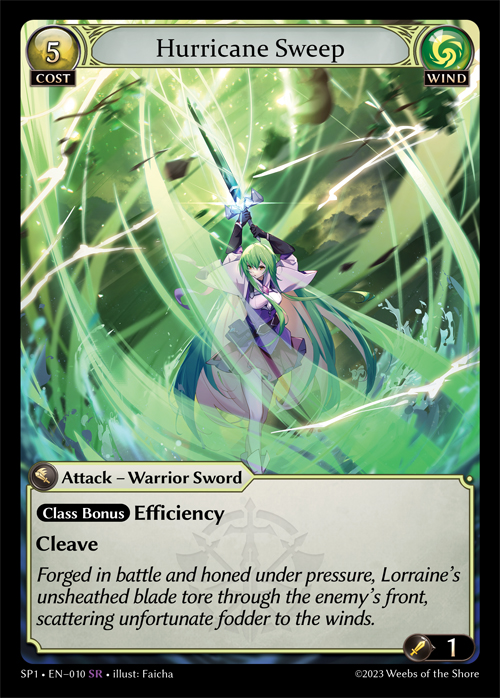 {% endhint %} 5. An attack with Cleave may be retaliated against by each defending unit. 6. Attacks with cleave involve only one combat step; damage is done simultaneously to each assigned defending unit. 1. Each damage calculation is done independently. 7. Damage done as a result of an attack with Cleave only causes the loss of one durability counter on a weapon if that weapon is wielded for the attack. 8. Multiple instances of Cleave are redundant. #### Critical N 1. Critical N is a static ability which means “If this would deal combat damage, instead double that damage unless an opponent discards N cards.” 2. Any opponent may discard N cards even if a unit they control is not receiving the damage. 3. Multiple instances of critical stack from a single source additively. E.g. An ally with both Critical 2 and Critical 3 will require opponents to, in any combination, discard 2 and 3 cards, otherwise the damage is doubled. Damage will only be doubled once, regardless of how many instances of Critical are involved. #### Command 1. Command is a static ability on Command Attacks which means "An ally you control performs this attack." 1. Commands have a replaced additional cost of resting an awake ally rather than a champion. The command ability may include a subtype that specifies which ally type must be rested. This replacement cost removes the cost of resting a champion to activate an attack card. 1. Allies with zero power (or less) may be selected to attack using Command cards. 2. You do not rest your champion to activate attacks with the command ability. 3. A command that was played with its additional cost of resting ally waived in some form, such as by effects that specify to "activate without paying its costs," the attack must still select a valid attacker to resolve properly; the controller must have an ally. This will not rest the ally during the attack if it is awake, and the controller may also choose a rested ally for a command activated this way. 2. After an attack with command resolves, a combat phase will begin with the rested ally as the attacker rather than a chosen champion. The attack card added to the rested ally's intent for the combat phase. 1. Commands that resolve without a valid target will not create a combat phase; the rested ally will not enter combat. 2. The ally must still obey its controller to attack. This means if a condition such as Pride is not met, the attack will fail to begin, no combat phase will start, and the attack card will enter the graveyard. The ally would remain rested. 3. If an attack card with the command ability were to be placed into an intent, the attacker's object typing will be checked against any specified subtypes for the ability as a state-based action. If the specified subtype for the command ability is not met and the command in the intent is not a legal attack for the attacker, the attack card will be placed in the graveyard as a result of state-based effects. {% hint style="success" %} Damage will be dealt by a unit according to its damage stat and the damage stats of any cards in its intent. {% endhint %} #### Commanded Will N 1. Commanded Will is a static ability of Chessman units which means "As long as this unit is attacking using a Command card, it gets +N power." 1. The ability's condition is fullfilled if there is a Command attack card in its Intent zone. #### Divine Relic 1. Divine Relic is a static ability which means “You can only have one card with this keyword in your material deck.” #### Efficiency 1. Efficiency is a cost-modifying static ability for a card or ability which means “This card costs LV less to activate” ([LV](/glossary/game-terms.md#lv) refers to your champion’s level). 2. Efficiency functions only while a card is being placed onto the Effects Stack. #### Element Bonus 1. Element Bonus is a restriction ability that defines a bonus effect or replacement effect for a card that is enabled if and only if the player’s champion’s element(s) matches the element of the card or object. 2. Element Bonus functions in all zones. #### Elysian Aura 1. Elysian Aura is a static ability which means "As long as you control at least one object with this ability, Aenean Spell cards you own activate and resolve as if your champion has +2 level." 1. This effect will not stack additively for each object with Elysian Aura; only one Elysian Aura effect will be active regardless of how many objects with Elysian Aura that player controls. 2. Aenean Spell cards activated by a player while they control an object with Elysian Aura will calculate any costs, modes, or other level-dependent information as if that player's champion's LV is 2 higher. E.g., a Level 3 champion card whose controller is activating a card with Efficiency and controls an object with Elysian Aura would pay 5 less to activate that card. 3. If a player gained control of an object with Elysian Aura after a card is already activated, costs that were paid, modes selected, or any other level-dependent information at the point of activation can't be changed. The same is true if a player loses control of all objects with Elysian Aura. 1. However, if the change in LV causes a restricted ability to become restricted, the ability or effects corresponding to that restriction will be lost. This is only considered after state-based checks are performed. If control of all objects with Elysian Aura is lost in the process of resolving a card with a restriction ability, the ability will still consider Elysian Aura as active until the effect fully resolves and state-based checks are performed again. 2. Resolving effects that consider LV in any calculations will consider any changes in the status of the Elysian Aura if the ability is either active or lost during resolution. #### Empower N 1. Empower is a static ability which means "The next Spell card you activate this turn activates and resolves as if your champion got +N level(s)." 1. Empower must take a value greater than 0 to happen; a spell will not be empowered if an effect gave Empower 0. 2. Empower is statically granted to a card in the Effects Stack the next time it would apply. 1. When the next Spell card is activated, it is added to the Effects Stack with the "Empowered" property, and all of its activations (including copies) will treat the resolving activation as being empowered. 3. Multiple instances of Empower stack additively. #### Ephemerate 1. Ephemerate is a static ability which means "You may activate this card from the graveyard by paying its ephemerate cost." 1. The ephemerate cost is separated by an "—". Any modifiers to this cost or ability are listed after this cost. 2. As ephemerate counts as an alternative activation that is not given any special permissions or timing windows (unlike Starcalling), the activation must follow the default speed of the card. 3. Card activations that would become objects as they resolve become Ephemeral as they enter the field, if the card was activated via the Ephemeral ability cost. 1. Ephemeral, as an object property, modifies objects such that the objects are banished whenever they would leave the field. The ephemeral property placed on the object will not be applied to the card that object represents. If the card would move zones, the card does not retain the "ephemeral" property and any subsequent objects represented by that card (unless otherwise specified) will not be ephemeral. 4. Cards activations that would not become an object or an intent, such as Actions, become Ephemeral on the effects stack when activated via the Ephemeral ability cost. 1. Ephemeral, as a property applied to cards in the effects stack, modifies the cards such that they will be banished as they resolve or if they were to be moved from the effects stack. 5. Activations of attacks via ephemerate will resolve and become an Intent. They are considered ephemeral in the Intent zone and will be banished during the end of combat. {% hint style="success" %} If an effect would banish an ephemeral card, that card will still be able to track that object as its destination has not changed. E.g., any form of temporary banishing and then returning to the field, such as suppressing, would allow the card to return to the field. If it is returned this way, it is considered a new object and will not "remember" that it was ephemeral; the new object is not ephemeral. {% endhint %} #### Fast Activation 1. Fast Activation is a static ability which means “You may activate this card at fast speed.” 2. Fast Activation is redundant. #### First Boon 1. First Boon is a static ability of Boons which means "Bestow this boon at the beginning of the game, before Spirits enter." 2. Bestowing a boon using the First Boon ability is a pre-game action. #### Floating Memory 1. Floating Memory is a static ability which means “While paying for a memory cost, you may banish this card from your graveyard to pay for 1 of that cost.” 2. When paying a memory cost, the part of the cost paid with floating memory must be declared before determining the number of cards that are randomly banished as part of paying for memory costs. 3. Floating memory is redundant. #### Foster 1. Foster is a triggered ability which means “At the beginning of your recollection phase, if this ally hasn't been dealt damage since the end of your previous turn, it becomes fostered.” 2. Any unit may become fostered, but units can’t make themselves fostered without the Foster keyword. 3. Foster is redundant. #### Hindered 1. Hindered is a static ability which means, "This object enters the field rested." 2. Hindered is redundant. #### Interdiction 1. Interdiction is a static ability of cards which means, "As long as this card's activation is on the effects stack, players can't have opportunity." 2. When a card with Interdiction is activated, it will remove any Opportunity that a player has and Opportunity will not be transferred or granted to any other player. This means that no players may play any cards, declare attacks, activate abilities, or perform any other player action that would require Opportunity for the sake of timing conventions. 1. Triggered abilities may still be placed on the effects stack. 3. After a card activation with Interdiction resolves, the turn player will gain Opportunity. #### Imbue 1. Imbue is an static ability which means, “You may reserve all cards revealed as you activate this card. If at least N of them are \
#### On Attack 1. On Attack is a triggered ability condition. 1. On units, On Attack means “When this unit attacks.” 2. On cards in the intent, On Attack means "when this is used in an attack." 3. On weapons, On Attack means "when this is wielded." #### On Banish 1. On Banish is a triggered ability condition that means "When this is banished." 2. The unit is only considered to be banished if it goes directly to banishment when it dies; On Banish will not trigger if the unit is sent anywhere else as a result of a replacement effect. 3. On Banish triggers from the field and considers the source of the ability as the object that was banished, not the card itself that is placed in banishment. #### On Charge N 1. On Charge is a triggered ability condition which means "The first time this object has N charge counters on it." 1. The triggered ability will only trigger once, the first time it has N charge counters. It will not trigger again regardless of whether the charge counters are removed and it regains charge counters in some way. 2. At the beginning of a player's recollection step as a turn-based action (TBA), that player puts a charge counter on each of their objects with an untriggered On Charge ability. #### On Death 1. On Death is a triggered ability condition that means “When this dies.” 1. Only units can die. Non-units are still considered destroyed, but are not considered to have died. 2. The unit is only considered to have died if it goes directly to the graveyard when it dies; On Death will not trigger if the unit is sent to banishment as a replacement for being sent to the graveyard. 3. On Death triggers from the field and considers the source of the ability as the object that died, not the card itself that is placed in the graveyard. #### On Enter 1. On Enter is a triggered ability condition of objects that means “When this enters the field.” 2. For champions, On Enter will consider the card entering the Lineage as the topmost champion card as if that card had entered the field (it is not a new object). #### On Foster 1. On Foster is a triggered ability condition which means “Whenever this unit becomes fostered.” #### On Hit 1. On Hit is a triggered ability condition. 2. On units, On Hit means “When this deals combat damage to an attackable object.” 1. On Hit will trigger off of hitting a Siegeable domain with damage dealt in the form of loss of durability counters from that domain. 3. On intents and weapons, On Hit means “When an attack or retaliation using this deals combat damage to an attackable object” {% hint style="info" %} E.g. On Hit triggers on any unit being dealt combat damage, typically through attacks or retaliations. On Ally Hit triggers only when the combat damage is dealt to an ally unit. On Champion Hit triggers only when the combat damage is dealt to a champion unit. {% endhint %} 4. If an On Hit ability specifies an effect that specifies “that opponent” or\ “that player,” this language will specify the opponent or player controlling the object that was hit. #### On Kill 1. On Kill is a triggered ability condition when attacked units are killed by an attack. 1. Units are killed as a result of having 0 or less life as a state-based effect. 2. Siegeable domains are destroyed as a result of having 0 or less durability as a state-based effect but will not trigger On Kill as they are not considered units. 2. On units, On Kill means “When a unit is killed as a result of being dealt combat damage by this.” 3. On intents and weapons, On Kill means “When a unit is killed as a result of being dealt combat damage in an attack using this.” {% hint style="success" %} See [killed](/glossary/game-terms.md#dies): "A unit is only considered to... have died or to have been **killed** if and only if it enters the graveyard directly from play." This means that On Kill will only trigger if the unit went to the graveyard directly due to the combat damage dealt, and not through any secondary effects, such as On Hit abilities that then would kill the unit. {% endhint %} #### On Leave 1. On Leave is a triggered ability condition that means “When this leaves the field.” 2. On Leave triggers from the field and considers the source of the ability as the object that left play, not the card itself that is moved to another zone. #### Prepare N 1. Prepare is an optional cost-modifying static ability of some cards which means, “As an additional cost to activate \[CARDNAME], you may remove N Preparation counters from your champion. If you do, \[CARDNAME] becomes prepared as it’s activated.” 2. If the Prepare cost was paid, the card becomes “prepared.” #### Preserve/Preserved 1. Preserve on objects is a triggered ability that means, “When \[CARDNAME] is destroyed, put it into its owner’s material deck revealed and Preserved. You may return a Preserved card from your material deck to your hand instead of materializing when you would materialize.” Objects with Preserve will have a trigger when they are destroyed which will cause the object’s card to be sent from the graveyard to the material deck “Preserved.” 1. If a card is banished instead of going to the graveyard, it will not be in the graveyard to trigger Preserve. 2. Preserve on non-objects is a static ability that means, “As \[CARDNAME] resolves and would be placed into the graveyard, instead put it into its owner’s material deck revealed and Preserved. You may return a Preserved card from your material deck to your hand instead of materializing when you would materialize.” Non-objects will have a replacement effect generated which will send the card to the material deck “Preserved” as it resolves rather than entering the graveyard. 1. If a non-object card with Preserve would be banished instead of going to the graveyard as it resolves, the card’s controller may choose whether the card is Preserved or is banished. 3. Every card that is Preserved is added to the material deck face-up and remains face-up until it moves to the hand, memory, or other zone considered as private information. 4. “Preserved” is a card property that allows the card to be added back to a player’s hand when they would materialize instead of materializing a card. 1. This will not count as a materialization. 2. Preserved cards must stay revealed for as long as they remain Preserved. 3. Returning a Preserved card to replace a materialization only requires that a player is given an opportunity to materialize, regardless of whether or not the player has a card they are able to materialize. 1. *"No Double Dipping"*: If a permission would be given to "play" a card, only the materialization choice would be able to be replaced and the player can't also activate a card while replacing the option to materialize. #### Pride N 1. Pride is a static ability, which means “This ally won’t obey you unless your champion is level N or higher.” (Refer to [Obedience](/glossary/game-terms.md#obedience).) 2. If an object has multiple instances of pride, only the highest value is taken into consideration for obedience. #### Ranged N 1. Ranged N is a static ability for units which means “As long as this unit is distant, its attacks get +N power.” 2. Multiple instances of Ranged stack additively. #### Renewable 1. Renewable is a static ability of Regalia which means “If this card would be banished from the field or an intent, put it into its owner’s material deck instead.” 2. Renewable will not function from any other zones, such as the object-specific zone of loaded cards (See [Object-Specific Zones](/game-mechanics/game-mechanics-game-zones/game-zones-object-specific-zones.md)). 3. Renewable is redundant. #### Reservable 1. Reservable is a static ability of objects which means “While paying for a reserve cost, you may rest this object to pay for 1 of that cost.” 2. Reservable can pay for any costs that require a reserve cost, including activation costs, added or extra reserve costs, or taxed reserve costs. 3. Reservable is redundant. #### Retort N 1. Retort is a static ability which means "As long as this ally is retaliating, it gets +N power." #### Spellshroud 1. Spellshroud is a static ability of objects which means “This can't be targeted by spells,” where Spells are cards, effects, or sources that have or are granted the Spell subtype. 1. Triggers generated by a Spell object are themselves of the Spell subtype and therefore cannot target objects with Spellshroud. 2. If an object receives Spellshroud while being targeted by a spell, that target would be considered illegal. 1. If that target was the only specified necessary target for the spell, the spell will fizzle. 3. Spellshroud is redundant. #### Starcalling 1. Starcalling is a static ability of cards which means “As you’re looking at this card while glimpsing, you may activate it by paying this cost. If you do, put all other cards you’re looking at on the bottom of your deck in any order.” 1. Activating a card this way can ignore the default play speed. 2. Starcalling is an alternative cost for activating cards. 3. When a player activates a card using the Starcalling cost, that player will put all other cards seen while glimpsing at the bottom of the deck in any order; they may not choose to put any cards on the top of the deck. 4. Starcalling costs can still be modified by activation cost modifiers. 5. Starcalling only functions from the Main Deck and cards activated by paying for Starcalling costs are considered as activated from the Main Deck and no other zones. 6. Once a card is activated via Starcalling, it will be placed onto the effects stack but will not begin to resolve until any and all currently resolving effects are fully resolved. #### Steadfast 1. Steadfast is a static ability which means “This ally can retaliate while rested and doesn’t rest to do so.” 2. Steadfast is redundant. #### Stealth 1. Stealth is a static ability of units which means "This can't be targeted by attacks unless permitted by True Sight." 2. Objects that were declared as retaliating against an attack before receiving stealth will still retaliate against their retaliation target and will deal damage accordingly during the combat phase. 3. If an object receives stealth while being the target of an attack, that target is considered illegal for the attack, and the attack is fizzled unless the attacking object has true sight. The defending object stops being a defending object. 4. Stealth is redundant. #### Taunt 1. Taunt is a static ability of units which means "While awake, this must be targeted before other objects you control during your opponents' attack declarations, if able." 2. When declaring target(s) for an attack, a player must target awake units with Taunt over other attackable objects, if able. 1. Attacks may be redirected or changed from the ally with taunt after initial attack declarations. 3. If multiple objects with Taunt are in play, the attacking player can choose which of those units to attack. 4. Taunt is redundant. An object with multiple instances of Taunt does not have to be attacked with higher priority over an object with a single instance of Taunt. #### True Sight 1. True Sight is a static ability. 1. On units, True Sight means "This unit's attacks can target units with stealth." 2. On weapons, True Sight means "Attacks using this weapon can target units with stealth." 3. On attacks, True Sight means "This attack can target units with stealth." 2. True Sight is redundant. #### Unblockable 1. Unblockable is a static ability which means "This unit's attacks can't be intercepted and ignore taunt." 2. Attack target(s) from an unblockable unit can still be changed (See [redirect](/glossary/game-terms.md#redirect).) 3. Unblockable is redundant. #### Vigor 1. Vigor is a triggered ability of units which means "This unit wakes up at the beginning of your end step." 2. Multiple instances of Vigor will create separate triggers during the end step. --- Local source: submodules/grand-archive/.agents/skills/grand-archive-rules/references/grand-archive-comprehensive-rules/glossary/game-terms.md Publisher's current source: [Weebs of the Shore](https://rules.gatcg.com/glossary/game-terms) # Game Terms #### Activate/Activating 1. To activate a card is to take the card from the zone it is currently in (usually the hand), pay its costs, and put it onto the Effects Stack for resolution. A player may activate a card if they have Opportunity and are legally allowed to activate the card. 2. To activate an ability is to indicate the ability being activated, pay the costs, and put the ability onto the Effects Stack for resolution. A player may activate a given ability if they have Opportunity and are legally allowed to activate the ability. #### Awake 1. A card on the field is considered awake if it is in an upright position. 2. Abilities of that card that require resting, such as attacking or as a cost of activation, can only be activated if that card is awake. 3. Cards enter the field awake. #### Banish 1. To banish a card is to take a card from the zone it is currently in and put that card into its owner’s Banishment zone. 2. A banished card is a card that has been put into the Banishment zone. 3. An object banished is not considered to have been destroyed or to have died when leaving the field this way. #### Buff Counters 1. Buff counters increase an object’s power and life stats by +1 for each buff counter on that object. 2. Stat modifications due to buff counters are static. #### Control and Ownership 1. Control of an object or card activation is given to the player who activated the corresponding card by default. 2. The player that controls a specified object is referred to as that object’s controller. 3. If control of a card, object, effect, or ability is not specified, control defaults to the owner. E.g., if an ally is [suppressed](/glossary/game-terms.md#suppress), the new object ally will be under the control of the owner of that ally card. 4. If a triggered ability is placed onto the Effects Stack from a card or object, control of that ability is granted to the controller of that card or object as the ability was placed onto the Effects Stack; changes in control of that object will not retroactively change the player in control of that ability. 5. The owner of the card does not necessarily always control the card. 6. Ownership of a card (within a game of Grand Archive) is designated to the player that began the game with that card in their main deck, material deck, or sideboard. 7. The player that owns a specified card is referred to as the owner of that card. 8. Change in control does not change ownership of the card. #### Copy 1. Copy can refer to both the effect of copying an object or card activation or the copied object or card. 2. When an object is copied, the copy object becomes a clone of the printed face of the card disregarding any modifiers such as extra counters or status conditions (awake/rested, will not wake up, etc). 3. When a card activation is copied, the copy activation becomes a copy of the card in the Effects Stack with all modes, activation choices, and otherwise modified activation attributes being identical to the original. 4. If an effect is copied, it is effectively put onto the Effects Stack a second time with any relevant modes or activation choices and parameters copied from the original. #### Damage Counters 1. Damage counters are marked on champions to track a champion’s life. 2. Counters can tick upwards from 0 and a champion is considered defeated when the damage counters reach or exceed the life stat of the champion. 3. Damage counters can be removed by effects that recover. #### Destruction 1. Destroy is an effect that can affect any object(s) on the field. 2. To destroy an object, move that object from the field to its owner’s Graveyard. If that card is a token, it will be removed from the game. 1. Destroyed units are considered to have died when they go to the graveyard. They are not considered to have died if they would be banished, put on top/bottom of the deck, or put into the hand instead. 3. An object is destroyed if and only if: it is destroyed by an effect that specifically instructs to destroy it, if it is destroyed as a result of state-based effects, or if it has been sacrificed. A card entering the graveyard or being placed into the graveyard for any other reason does not mean it has been destroyed. 4. A non-regalia weapon is considered destroyed as from the state-based effects if the number of durability counters on that weapon is 0, either by combat or other means. 5. A unit is destroyed from the state-based effect of having 0 or less life or from having damage marked (temporary or via damage counters) equal to or greater than its life. 6. A siegeable domain is destroyed from the state-based effect of the number of durability counters on it reaching 0. 7. An effect or card that specifies an object to be destroyed only causes that object to die if and only if that card immediately enters the graveyard upon resolution of effects. {% hint style="warning" %} Banishment as a result of a destruction effect does not allow effects dependent upon that object dying or being sent to the graveyard to happen as there is not a time during the game in which that card can be considered to have entered the graveyard. {% endhint %} #### Died/Dies and Kills/Killed 1. Dies is a term used to denote when a unit on the field would enter the graveyard. Units on the field die when they are either destroyed directly by an effect or by state-based effects, such as having 0 or less life. 1. A sacrificed unit is considered to have died and been destroyed. 2. Non-units do not die but they are still considered destroyed. {% hint style="warning" %} E.g., a destruction or destroy effect kills an ally and that ally is considered to have died. A siegeable domain being destroyed as a result of falling to 0 durability counters does not die. This means effects like On Kill will not trigger when it comes to non-units. {% endhint %} 2. A unit is only considered to have died or to have been killed if and only if it enters the graveyard directly from play. {% hint style="danger" %} If it would be banished instead of being sent to the graveyard, the card is, by definition, not considered to have died. {% endhint %} #### Discard 1. When a player discards a card, they must move a card from the specified zone to their Graveyard. If no zone is specified, cards are discarded from hand by default. 2. Discarding a card can be required as an additional or alternative cost to playing a card or activating an ability. As with the normal steps in paying costs, discarding must be done before the card or ability is fully played or activated. 3. Generally, effects that cause players to discard or require discarding as a cost allow them to choose which card or cards are discarded. Some effects may require that discarding is done randomly. #### Distant 1. Distant is a property of units. 2. After a unit becomes distant, it will stay distant until the end of its controller’s turn. 3. The distant property ends at the same time as other end of turn effects. #### Durability Counters 1. Weapons have durability counters that represent how many times they may be successfully wielded for an attack. 1. A weapon being wielded will only cause it to lose durability during the [Damage Step](/game-mechanics/game-mechanics-turn-order/turn-order-combat-phase/combat-phase-damage-step.md) of combat. 2. Durability counters can be added to exceed the durability stat of a weapon. 3. Weapons are destroyed when durability reaches 0. #### Element 1. The element of a card is represented by a name and symbol on the top right of its card face. 2. Elements apply a restriction on players from playing cards unless that element is within the element identity of one of their champions. 3. Elements fall under three categories: Norm, Basic, a d Advanced. 1. Norm is a default element without any restrictions; players always have access to playing cards of this element. 2. Basic elements are Water, Fire, and Wind, and are typically unlocked by the Level 0 champion that is put into play during the start of a game. Other effects can enable these elements as well. 3. Advanced elements are any elements that do not fall under either Norm or the Basic element categories. These elements are typically unlocked either after a champion reaches level 3 in its lineage or under special circumstances. 1. Exalted is a special advanced element that is enabled by default for a player as long as they control a champion that enables another advanced element for them. #### Enlighten Counters 1. Enlighten counters confer the following ability to objects they're placed on: “Remove 3 enlighten counters from \[CARDNAME]: Draw a card.” 2. Enlighten counters placed on champions persist through level-ups of a player’s champion.
#### Ephemeral 1. Ephemeral is a property that can modify card activations in the effects stack, objects on the field, or intents. 1. Ephemeral objects will be banished if they were to leave the field. 2. Ephemeral card activations will be banished when they resolve or leave the effects stack. 1. If an ephemeral card activation is negated or fizzles, it will be banished instead of going to the graveyard. 3. Ephemeral intents are banished during the end of combat. 1. Any On Hit abilities will reference the source of the ability in Banishment according to last-known information of the Intent. #### Fast 1. Fast is an attribute of action cards that determines when that card may be activated. See the section on timing for further detail. 2. Player actions or cards with the fast modifier may be activated while that player has Opportunity to act or during that player’s main phase if they are the turn player. #### Fizzle 1. Fizzle refers to card activations/materializations or abilities failing to resolve normally as a result of a game state where targets or game conditions made the activation illegal. When a card's activation or an ability (triggered or activated) fizzles, it will not resolve its effects and will cease to exist from the Effects Stack. 1. Cards can't fizzle; if all activations/materializations of a card either resolve or fail to resolve, the card that was activated/materialized will then resolve from the Effects Stack and be placed in its default resolution zone. (As a reminder, non-object Regalia and other Material Deck cards will resolve to Banishment, while non-object Main Deck cards with reserve costs will resolve to the Graveyard. Cards whose activations/materializations become objects will instead resolve by sending their respective card to the field where it represents the played card.) 2. For champion materializations, a champion card's materialization can fizzle if its lineage or leveling requirements become illegal before it can resolve (e.g., deleveling the champion card while its leveled-up champion card materialization is pending resolution). 3. If a source card for activations/materializations is removed from the Effects Stack while there are still instances of those activations/materializations pending resolution, those instances will fizzle as a result of not having the source card to activate/materialize from. 4. A card activations/materialization or ability being fizzled is not the same as being [negated](#negated); fizzling is due to a result of state-based checks while negating is the action of removing it from the Effects Stack. #### Fostered 1. Fostered is a property of allies. 2. Units are unfostered by default. 3. Allies can be made to be fostered by other cards or as a state-based check generated by the Foster keyword ability. 4. An ally can only become fostered once. #### Gather 1. Gather defines the player action of gathering. 2. To gather, a player selects an ingredient at random from among six different token items and summons it. The six ingredients are Blightroot, Fraysia, Manaroot, Razorvine, Silvershine, and Springleaf. Each ingredient has two characteristic subtypes used in conjunction with the Brew ability: Adjuvants or Catalysts, and Root, Leaf, or Flower. 3. If a player uses the gather token board, they may use dice or other counting tokens to denote the quantities of each ingredient. Each is still considered an individual object on the field and can be interacted with normally. #### Generate 1. Generate defines the player action of generating cards, or adding cards from outside the game permanently for the remainder of a game of Grand Archive. Generated cards do not persist after the conclusion of a game; any generated cards will be removed from the play area and corresponding zones after a game has ended. 2. Generating a card adds the specified generated card to the effect’s controller’s hand by default. If a zone is specified for the generate effect, the card will be added in the specified zone for the duration of the game. If that zone is no longer present, it will regress to the default case of being added to the hand. 3. Generated cards can exceed the quantity limits imposed by deckbuilding constraints. 4. Players must own physical copies of each of the cards they wish to generate in a game. 5. If a player attempts to generate a card but does not have the physical card to represent the generated card, the card generation fails; the player fails to generate the card. 6. Cards are added to the hand by default if no zone is specified or a zone that it would be placed into does not exist when a player would be instructed to put a generated card there. #### Glimpse 1. Glimpse defines the player action of glimpsing, usually worded as glimpse N. 2. To Glimpse N, a player looks at the top N cards of their deck and places any number of those cards to the top of their deck in any order and the remainder on the bottom of their deck in any order. #### Hit 1. Hit will typically be considered in relation to On Hit triggered abilities. 2. A unit is hit when it is dealt combat damage. 3. If no damage is dealt or damage dealt is zero, a unit is not considered hit. 4. Non-Combat damage sources will not cause the unit to be considered hit. {% hint style="warning" %} Combat damage is any damage dealt directly by units during combat based on attacking and retaliation actions; retaliating or attacking units will deal combat damage and be considered to have hit their attack/retaliation targets. {% endhint %} #### Influence 1. A player’s influence is equal to the total number of cards in their hand and memory zones. #### Inner Lineage 1. The inner lineage of a champion is all cards in a champion's lineage other than the top-most card, i.e., the champion itself. 2. The inner lineage can contain any cards and a card must be in the inner lineage to be able to use a Lineage Release ability. #### Label Keywords 1. Label keywords exist as bolded and italicized text followed by a long hyphen on cards that do not function as normal keywords. Rather, they will refer to a broad class of similar mechanics with individual cards differing in the wording or conditions of the keyword. 2. Label keywords can be referenced by abilities or effects and do count as a characteristic of the card. 3. List of Label keywords: * Balance: This keyword represents that a card will offer additional effects based on whether the player has an equal amount of cards in their hand and memory. * Cardistry: This keyword reflects abilities that reference the number of differently-costed Suited allies under a player's control. Typically, these abilities will have an activation cost reduction of 1 reserve for each Suited ally with a different reserve cost under a player's control. * Deluge N: This keyword represents a static ability around the condition of having N or more water cards in the graveyard. * Harmonize: This keyword represents that a card will offer additional effects based on whether a Melody subclass card was activated previously during this turn during the resolution of the card. * Upkeep: This keyword presents a cost or condition that must be fulfilled each turn, usually with the adverse effect of not fulfilling the upkeep condition. * Equestrian: This keyword reflects abilities that function in conjunction with controlling a Horse ally. The Horse ally may have any typing so long as "Horse" exists as a subtype and "Ally" exists as a type. #### Last-Known Information 1. [Last-known information](/game-mechanics/game-mechanics-card-and-object-information.md) is information such as status, characteristics, or stats of an object or card that is tracked when that card changes zones. 2. Some effects are reliant on information while a card or object was in a specific zone and will use the information as if that card was still in that zone for determination of effects. 3. Last-known information only considers the last zone change that happened and not any information carried from zone changes prior to that. #### Leave/Leaves 1. These are interchangeable terms used to denote when a non-Champion object on the field would leave the field and move to another zone. #### Level (base) 1. The base level of a champion is the printed level of the champion card in the top left corner. This level determines the leveling sequence of a champion and does not include any level stat modifiers such as “your champion gets +X levels.” The base level is a static characteristic of the champion card. The base level is typically only considered for leveling up champions rather than meeting level restrictions for abilities and effects. #### Level Counters 1. Level counters represent +1 LV for each level counter on the champion. 2. These counters do not modify the base level of the champion. #### Level Up 1. A level up or the act of leveling up is when a player adds the next level champion onto one of the champion’s lineages. This does not use the effects stack. Leveling up will cause any “On Enter” abilities of the card being placed onto the lineage to trigger. 2. Leveling up itself is not considered a materialization but can be the result of materializing a champion card. 3. Leveling up is not based on any level modifications from other effects in the game and is solely based on the printed (base) level of the champion card. #### Lineage (term) 1. A lineage is the entire group of cards dedicated to representing a champion. A lineage includes all cards including the [inner lineage](/game-mechanics/game-mechanics-game-zones/game-zones-object-specific-zones.md#inner-lineage) as well as the topmost card (i.e. the representative champion). 2. The name of a lineage follows the name (excluding titles or monikers) of the topmost card and any leveling restrictions or champion restriction abilities will use that name as a basis. #### Load 1. "Load" is a player action that means to take a card from the zone it is currently in and move it underneath another card. The card on top is considered "loaded" with that card and the card that is being put underneath becomes part of the "loaded cards" underneath that card. #### Loaded 1. Loaded is a property of objects. 2. Cards are unloaded by default. 3. Cards are considered loaded when an object has cards in its [Loaded Cards ](/game-mechanics/game-mechanics-game-zones/game-zones-object-specific-zones.md#loaded-cards)zone. #### LV 1. "LV" refers to the level of your champion as a sum of the level denoted on your champion card in addition to level modifying effects in the game. 2. LV is generally used for effects or rules text requiring a calculation or a referential variable. 3. LV can take on negative values. If being used to calculate cost reductions (such as with Efficiency), a negative LV value will increase costs. When being used to count or select cards, counters, or objects, a negative LV is considered 0 (you can't select negative amounts of cards or objects). #### Modes 1. Modes are effects that are listed on a card or effect that give two or more effect options. Modes may be set or changed depending on the game state, or may require a player to choose one or more modes if a card or effect were to resolve. Cards and abilities with these modes can be called modal. 1. Any modes chosen or selected by a player are made before a card is placed onto the Effects Stack pending resolution. 2. Modes that define game-state dependencies are not selected by the player, but are selected during the resolution of the effect. #### Negate 1. Some effects may specify to "negate" a certain card activation/materialization, game action, or effect. "Negate" is a player action which means to remove that instance of the described negate target from the Effects Stack. The removed activation/materialization or ability instance is considered "negated." It does not resolve; it does not happen. Any effects that would otherwise have occurred as a result of the resolution of the negated copy (original or otherwise) do not occur. 1. A card's activation that has been negated does not remove the source card of that activation from the effects stack; a card that is in the effects stack is not directly removed via negation. The card is only removed as a result of state-based checks where the card no longer has any pending activations/materializations. 2. Paid costs are not refunded when something is negated. E.g., If a card activation is negated, the costs paid to activate a card and move it to the effects stack do not undo those costs paid, and the card will remain in the Effects Stack until state-based checks remove it from that zone. #### Negated 1. An activation/materialization or ability is negated when a player negates it through an effect. 2. If a card's activation is negated, it is removed from the Effects Stack. 1. Any triggered abilities that were put on the Effects Stack as a result of the activation will remain triggered; they are not also removed from the Effects Stack. #### Obedience 1. A player can’t attack with or activate the abilities of an ally that does not obey that player. They may still have that ally retaliate. 2. Allies obey their controlling players by default. 3. Static abilities and triggered abilities of an ally will always happen regardless of obedience, but ownership of the abilities depends on the control of that ally. Some abilities may require obedience of the source object to resolve properly. 4. An attacking ally will continue performing the attack even after it no longer obeys the player who originally declared the attack. This is included when pride conditions are suddenly not fulfilled or if control of the object changes during an attack. #### Opportunity 1. Opportunity is defined as the time in which a player has the chance to act in response to player actions taken by either themselves or by another player, in response to an effect or player action pending resolution, or in response to a phase change. 2. When Opportunity arises, it first is given to the turn player and proceeds to other players in turn order. 3. Phases apart from the main phase end according to when no players have Opportunity and no events are pending resolution. #### Play/Played 1. A card is considered played after it is either materialized or activated. 2. Materializing or activating a card counts as playing the card. #### Player Action 1. Player actions are distinct actions in the game a player can take. E.g., activating or materializing cards, attacking, activating abilities, etc. 2. Player action order is the order in which players may take actions during a turn when they would receive Opportunity. After a player action is taken or Opportunity is granted, it is first given to the turn player. The turn player may act first, after which non-turn players may each take a turn performing player actions as allowed by the game. This can be called the Turn Player / Non-turn Player order. #### Players 1. A player is an individual taking part in a game of Grand Archive. The “turn player” is the player in control of the current turn and its progression and “non-turn players” are any players that are not the turn player. #### Preparation Counters 1. Preparation counters are a type of counter that may be placed on a champion. 2. Preparation counters may be paid as an additional cost when activating a card with the keyword Prepare. #### Recover 1. Recover defines the player action of recovering damage, usually worded as recover N. 2. To recover N, a player removes N damage counters from their champion. 1. If a player attempts to recover more than the number of damage counters on their champion, they instead remove all damage counters from the champion. 1. A player that is instructed to recover a non-zero amount while their champion(s) have no damage counters on them will still trigger abilities whose condition is "whenever you recover." 2. A player can’t remove more than the number of damage counters present on a champion, e.g. if a champion has two damage counters and the player recovers 3, only 2 damage counters are removed. {% hint style="warning" %} E.g., For a card that says, "As an additional cost to activate this card, Recover 10," a player activating that card must have a champion with at least 10 damage counters that must be removed. {% endhint %} #### Redirect 1. Redirect means to change the target of a card or ability to another valid target. 2. If an effect specified to choose rather than to target, it cannot be redirected. #### Reflexive Trigger 1. A reflexive trigger is a trigger found within an effect or ability that is placed onto the Effects Stack only if the condition for that trigger is fulfilled and after the initial part of the ability or effect is fully resolved. 2. The source of a reflexive trigger is considered the original source of the effect or ability that generated the reflexive trigger. {% hint style="info" %} \ \ E.g., Umbra Sight optionally allows a player to draw a card into their memory and put Umbra Sight on the bottom of their champion's lineage. The remainder of the text from "When you do, ..." is a reflexive trigger; It is a triggered ability that is put onto the effects stack after Umbra Sight resolves and the second card is optionally drawn with Umbra Sight put on the bottom of the champion's lineage. {% endhint %} #### Reserve 1. Reserve refers to the player action of taking a card from their hand and placing it into their Memory zone. 2. Reserved cards are returned to the player's hand during the [Recollection](/game-mechanics/game-mechanics-turn-order/turn-order-recollection-phase.md) phase. #### Rest/Rested 1. To rest an object on the field, that object is turned from the upright (awake) orientation to the horizontal (rested) orientation. 2. Rest Symbol: The rest symbol will appear on a card as a black-bordered arrow turning 180 degrees to the right. 3. The rest symbol will usually indicate resting as a cost for activating an ability. 4. An object on the field is considered rested if it is in a horizontal orientation. 5. Objects that are already rested can’t rest; players cannot rest objects that are rested. If an effect attempts to rest an object that is rested, nothing will happen. #### Retaliate/Retaliation 1. To retaliate, the defending player may rest a defending unit during the retaliation step of the combat phase to represent it as retaliating during combat. 2. Resting is a cost to retaliate; already-rested units cannot retaliate. 3. A retaliating unit will deal damage according to its power against the attacking unit during the damage step. 4. When retaliation is declared, the retaliating unit causes the attacking unit to become the retaliation target, which is maintained even if the attacking unit stops attacking during the combat phase. 5. Units without a power stat or have a power of 0 cannot retaliate. 6. Retaliation is the act of a defending unit resting to deal damage according to its power against a unit attacking it. 7. A unit can only retaliate if it was an object on the field “before retaliation” (see [Retaliation Step](/game-mechanics/game-mechanics-turn-order/turn-order-combat-phase/combat-phase-retaliation-step.md) of combat). 8. A unit that gains stealth after being declared as retaliating during the combat phase will still retaliate against its attacker during the damage step and deal damage accordingly. #### Reveal 1. An ability, effect, or game rule may tell a player to reveal a card or a group of cards in a game zone. 2. To reveal a card, a player takes the specified card(s) in that zone and presents them to all players in the game face-up as public information. 3. Cards remain revealed until the next discrete game state, until a player takes a player action, or until the next time state-based effects are checked. 4. Revealed cards may be written down or recorded however a player wishes to do so but may not ask that the revealed cards stay revealed; the information state of the revealed card (private vs public) reverts to the original state before it was revealed after the card stops being revealed. 5. Cards revealed from a private zone ought to be shuffled or randomized among the other cards in the zone after those cards stop being revealed. 6. A card that is already public information or already known can be revealed any number of times. #### Sacrifice 1. Sacrificing an object is a player action. 2. To sacrifice means to remove an object from the field or in play and put it into the graveyard, or, if the object was a regalia or champion, into banishment. 1. The type of object to be sacrificed will be characterized by the effect or cost. 2. If an object is sacrificed as a cost to pay for an effect, ability, or activation, that object is sacrificed at the same time all other costs are paid. 3. Players can only sacrifice objects they control. 4. An object is still considered sacrificed if a replacement effect would cause the object to go to a zone other than the graveyard. 3. If the object has an On Death trigger or would trigger an ability due to that object being sacrificed in order to activate a card or ability, the ability will be placed onto the Effects Stack on top of that card or ability and resolved first. 4. If the object has an On Death trigger or would trigger an ability due to that object being sacrificed as a result of an effect, the ability will be placed onto the Effects Stack after all effects of the original ability specifying the sacrifice have resolved. #### Scavenge N 1. Scavenge N is a instructional word that means to reveal cards from the top of the deck until either the card with a described characteristic or until N cards have been revealed. The card that is found that fits the criteria of the scavenge is referred to as the scavenged card. After the player reveals the scavenged card, they put it into their hand. The rest of the revealed cards will be put to the bottom of the deck in a random order. If no card is scavenged after N cards are revealed, the player will take all of the revealed cards and put them to the bottom of the deck in a random order. #### Search 1. Search is an instructional word in some effects that tell a player to look through a set of cards in a zone, typically with the intended result of choosing one or more cards out of that set to perform an action on them, such as moving them to another zone. #### Shuffling 1. Shuffling a set of cards is to make that set of cards sufficiently randomized such that any player in a game cannot uniquely identify any one card and has no reasonable knowledge as to the location of any of those cards from among the set. 2. Effects may instruct a player or players to shuffle a set of cards. If this is done, those players must take the specified cards or set of cards and mix them in a random manner suitable for them until those cards are sufficiently randomized. #### Slow 1. Slow is an attribute of action cards that determines when that card may be activated. See the section on timing for further detail. 2. Attacks and ally cards innately have a slow timing modifier, only being able to be activated by the turn player during their main phase when no effects are on the Effects Stack. #### Source 1. A source is considered the object or card from which damage, ability, or effect originates. #### Suppress 1. Suppress is a keyworded action that can target an object which means for the controller of the ability to “banish it and return it to the field under its owner’s control at the beginning of the next end phase.” The return of the object is caused by a delayed trigger created by Suppress. 1. The controller of the source that suppressed the object(s) controls the trigger. If simultaneous triggers are instanced, the controller may choose the order in which the triggers are placed onto the Effects Stack. 2. If a card banished with suppress were to leave banishment before the delayed trigger were to resolve, the delayed trigger will not return that card to the field from wherever it currently is; the card in banishment must be the same card that was initially banished. 3. If more than one object is simultaneously suppressed, an independent delayed trigger will be instance for each object, separate of the others. If one suppress trigger is negated, it will not negate any of the other suppress triggers. #### Summon 1. Summon defines the player action of summoning objects into play. 2. A summoned object is treated as a token that only exists while it is on the field. 3. Summoned objects (tokens) can be represented by any outside game object such that it is easy to distinguish tokens apart from other objects and such that the characteristics of that token are easily tracked or referenceable. #### Timestamp 1. A timestamp is a chronological marker tied to an object on the field placed when it entered play or tied to a continuous effect when it began in the game. Timestamps are used to keep track of recency of effects and to determine which effects would supersede another if they modify the same value(s). 2. Effects with timestamps are applied in order of oldest effects to newest effects. #### Token 1. A token is an object put into play through an effect instructing a player to summon that object. 2. Tokens are treated as regular objects while in play but will cease to exist when they move to another zone. 3. A token moving to another zone will still complete any state-based checks, triggers, and any necessary actions to resolve the game state, and the token will cease to exist as Opportunity is passed to the next player. #### Transform 1. Transform defines the player action of flipping a double-faced card (as an object) over to its other face. Only cards that have a valid side to transform into may transform. 1. If a player attempts to transform a card that cannot be transformed, nothing will happen. This includes any attempts at having a card enter the field transformed if the card is not a double-faced card. 2. Transforming a card will retain any counters that were initially placed on the object. It will also retain any applied continuous effects, such as Links, if legal. #### Unit 1. Units are champions and ally objects. 2. Units can typically be attack targets during attack declarations. #### Wake Up 1. To wake up an object on the field, that object is turned from the horizontal (rested) orientation to the upright (awake) orientation. 2. Objects that are already awake can’t wake up; players cannot wake up objects that are awake. If an effect attempts to wake up an object that is awake, nothing will happen. #### Wield 1. Wield means to use a weapon during an attack declaration. 2. A weapon used during an attack is said to be "wielded" and becomes wielded when it is announced as being wield in combat. 3. Champions can wield weapons to declare attacks. 4. Some weapons with [functional subtypes](/general-rules/general-rules-card-types/card-types-functional-subtypes.md) can't be wielded unless they are loaded. --- Local source: submodules/grand-archive/.agents/skills/grand-archive-rules/references/grand-archive-comprehensive-rules/glossary/type-list.md Publisher's current source: [Weebs of the Shore](https://rules.gatcg.com/glossary/type-list) # Type List This section is dedicated to listing all valid options of categorical characteristics of cards (excluding play speeds of Fast and Slow. Stat-based characteristics are also excluded). #### Elements * Special Elements: Norm, Exalted * Basic Elements: Fire, Water, Wind * Advanced Elements: Arcane, Astra, Crux, Exalted, Exia, Luxem, Neos, Tera, Umbra #### Types * Action, Ally, Attack, Champion, Domain, Item, Mastery, Phantasia, Weapon, Status * Pantheon Specific: Greater Boon, Lesser Boon * Supertypes: Regalia, Unique #### Subtypes * Accessory, Adjuvant, Aenean, Aethercharge, Aetherwing, Angel, Animal, Antelope, Ape, Apparition, Armor, Arrow, Artifact, Ascendant, Assassin Automaton, Avatar, Axe, Bauble, Bear, Beast, Bird, Bishop, Boar, Book, Boots, Bow, Bull, Butterfly, Castle, Cat, Cataclysm, Catalyst, Chessman, Cleric, Cloak, Command, Component, Construct, Craft, Crossroads, Crystal, Curse, Dagger, Deer, Device, DisCorp, Distortion, Dog, Dolphin, Dragon, Dryad, Elemental, Elysian, Factory, Fairy, Fan, Farm, Fatebound, Fatestone, Fist, Flower, Flowerbud, Flute, Food, Fox, Fractal, Gate, Gloves, Golem, Guardian, Gun, Hammer, Harmony, Herb, Horn, Horse, Human, Instrument, Isle, King, Kingdom, Kitchen, Lash, Leaf, Lion, Mage, Map, Market, Maul, Melody, Monkey, Mouse, Mushroom, Obelisk, Otter, Pangolin, Pawn, Phoenix, Phone, Polearm, Potion, Powercell, Queen, Rabbit, Raccoon, Reaction, Resonator, Rhino, Ring, River, Robe, Rook, Root, Ruins, Scepter, Scripture, Selkie, Serpent, Settlement, Shadow, Shard, Sheep, Shenju, Shield, Siegeable, Skill, Slime, Snake, Solvent, Specter, Spell, Spire, Spirit, Squirrel, Staff, Suited, Sword, Tamer, Throne, Tiger, Trial, Turtle, Ultimate, Unicorn, VelTech, Wand, Warrior, Weasle, Whale, Whip, Wolf * Class Subtypes: Assassin, Cleric, Guardian, Mage, Ranger, Spirit, Tamer, Warrior, Anomaly * Functional Subtypes: Aetherwing, Aethercharge, Arrow, Bow, Bullet, Gun, Siegeable ## Glossary (Keywords & Abilities, Game Terms) # Glossary (Keywords & Abilities, Game Terms) Source: submodules/grand-archive/.agents/skills/grand-archive-rules/references/grand-archive-comprehensive-rules/glossary/keywords-and-abilities.md, submodules/grand-archive/.agents/skills/grand-archive-rules/references/grand-archive-comprehensive-rules/glossary/game-terms.md --- Local source: submodules/grand-archive/.agents/skills/grand-archive-rules/references/grand-archive-comprehensive-rules/glossary/keywords-and-abilities.md Publisher's current source: [Weebs of the Shore](https://rules.gatcg.com/glossary/keywords-and-abilities) # Keywords and Abilities In this section, \[CARDNAME] refers to the implied name of the card itself. Redundant keyworded abilities will ignore any mentions of that ability on a card or effect beyond the first. {% hint style="warning" %} Reminder text for abilities on card printings may not exactly reflect the entry of the rules text within the comprehensive rules. Reminder text is used for the convenience of short-handing rules for clarity and the player experience. Modifications of reminder text may be done in card printings to trim unnecessary rules text for broader abilities. Please refer to this section for exact rules. {% endhint %} #### Aenean Progression * Aenean Progression is a static ability of cards that says "this card costs 2 more to activate for each time you've resolved a card with Aenean Progression this game." * The cost of the card will not increase if the card was activated but not resolved. #### Aethercalling 1. Aethercalling is a static ability of cards which means "As you’re looking at this card while glimpsing, you may load it into an Aetherwing weapon you control." 2. Loading a card with Aethercalling is performed as a special game action and does not use the Effects stack. #### Agility N 1. Agility N is a triggered ability that means "Return N cards from your memory to your hand at the beginning of the end phase." 1. An ability that grants agility to a player means that the player gains the agility property for a characterized duration. The default duration is a turn. 1. A player can gain multiple instances of an agility trigger. 2. A player's agility property is lost as a state-based action during the Clean-Up Phase. 2. At the beginning of each end phase, if a player has agility, the ability will trigger for each instance of agility they possess. The player may order the resolution of the agility triggers if multiple triggers were placed on the stack simultaneously. 1. Gaining an instance of Agility on an opponent's turn will allow it to trigger during that turn's end phase. 2. Each player picks which cards are returned to their hand. 3. If a player has fewer cards in their memory than they can return to their hand from Agility, you return as many cards to your hand as you can. 4. Multiple instances of Agility on a card will generate separate triggers during the end phase.
#### Ambush 1. Ambush is a static ability of units which means "This unit may retaliate against attackers while it isn't defending." 1. Ambush allows a player to retaliate with that unit when: 1. Another unit or domain they control is being attacked by an opponent. 2. An opponent is attacking a unit or domain that another opponent controls. 2. Ambush will not function when your unit is attacking another object you control. 2. The unit must still be awake to retaliate against attackers. #### Brew 1. Brew is a static ability that allows cards to be activated using an alternative cost involving sacrificing ingredients (typically summoned by[ gathering](/glossary/game-terms.md#gather)). The Brew keyword will list the objects needed for the alternative cost. 2. Brew means "You may sacrifice the listed objects rather than pay this card's reserve cost." 3. A card activated by paying the alternative brew cost will cause the activation to become brewed. 4. Activating a card using the Brew cost can still be modified by additional activation cost modifiers. Effects that modify the reserve cost are ignored when Brewing cards. #### Bulwark 1. Bulwark is a static ability of objects, which means "This object enters the field with a [bulwark](/game-mechanics/game-mechanics-counters.md#bulwark) counter." 2. If a card has multiple instances of the Bulwark ability, each instance will place a bulwark counter on that object. #### Cascade 1. Cascade is a keyword for modal abilities that selects a corresponding effect to place onto the effect stack depending on the number of times the ability has been either triggered or activated for triggered abilities and activated abilities, respectively. 1. Cascade does not use counters and only tracks the number of times the ability has been triggered/activated. 2. The selected effect considers the number of times activated/triggered, including the current activation/trigger. I.e., the first trigger or activation will always have cascade at 1. 3. Only the effect corresponding to the correct cascade effect is put onto the stack. If the effect requires any selections, such as targets, they are made as the effect is put on the stack. 2. If that ability does not resolve for any reason, the ability is still activated, and the cascade ability will advance to the next count on the subsequent activation or trigger. 3. Copying a cascade ability will not advance the count of times the ability has been activated or triggered and will place an additional instance of the pending effect on the Effects Stack for resolution. 4. Cascade abilities are instanced per object; if that object were to leave the field, the new object of that card will have new cascade abilities that will not track how many times the old object had triggered or activated its cascade ability. #### Champion Bonus 1. Champion bonuses are restriction abilities that define a bonus effect or replacement effect for a card that is enabled if and only if the player’s champion’s lineage name matches the specified champion name of the restriction ability. 2. Champion Bonuses function in all zones. 3. If a card with a champion bonus ability lists a champion whose name differs from the name of the champion(s) controlled by a player such that the condition for a class bonus is not met, the keywords and effects associated with the bonus are ignored as part of the rules text in every zone. #### Class Bonus 1. Class Bonus is a restriction ability that defines a bonus effect or replacement effect for a card that is enabled if and only if a player’s champion’s class matches the class of the card or object. 2. To unlock a class bonus, a player’s champion must match at least one of the classes on the card with class bonus that player controls. 3. Class Bonus functions in all zones. 4. If a card with class bonus and a champion differ such that the condition for a class bonus is not met, the keywords and effects associated with the bonus are ignored as part of the rules text in every zone. {% hint style="info" %} E.g., Merlin, Memory Thief banishing a Flame-Rune Swordsman from the graveyard of a player controlling Tristan, Grim Stalker does not gain a level counter upon resolving Merlin’s ability.  {% endhint %} #### Class Locked 1. Class Locked is a restriction ability that disallows the player from playing that card unless that player’s champion’s class matches the class of the card. 2. To unlock the card, a player’s champion must match at least one of the classes on the card with class bonus that player controls. 3. Class Locked functions in all zones. 4. If a card that is class locked and a champion differ such that the class condition is not met, that card can't be played. 1. If a card has multiple Class Locked abilities that define different classes, each restriction must be met simultaneously for the card to be allowed to be played. 5. Unlike Class Bonus or other ability-tied restriction abilities, Class Locked does not disable rules text on a card. #### Cleave 1. Cleave is a static ability of attacks, weapons, and units which means "Attack all attackable objects a chosen player controls. This attack can't be intercepted." 1. Attackable objects include Siegeable domains. 2. Rather than selecting an attack target during declarations, an attack with Cleave is declared by selecting a player. Defending objects are assigned based on all legal, attackable objects controlled by the chosen player. Any units that enter the field under the defending player’s control will not be designated as defenders and will not be involved in combat as defenders. 2. Cleave attacks can’t be intercepted or redirected. {% hint style="info" %} E.g., For 1.b., a player chosen for a Cleave attack activates and resolves Blanche, Sheltering Saint at the beginning of the retaliation step of combat. Blanche would not be considered a defending unit and would not be able to retaliate nor would be dealt damage during the damage step.  {% endhint %} 5. An attack with Cleave may be retaliated against by each defending unit. 6. Attacks with cleave involve only one combat step; damage is done simultaneously to each assigned defending unit. 1. Each damage calculation is done independently. 7. Damage done as a result of an attack with Cleave only causes the loss of one durability counter on a weapon if that weapon is wielded for the attack. 8. Multiple instances of Cleave are redundant. #### Critical N 1. Critical N is a static ability which means “If this would deal combat damage, instead double that damage unless an opponent discards N cards.” 2. Any opponent may discard N cards even if a unit they control is not receiving the damage. 3. Multiple instances of critical stack from a single source additively. E.g. An ally with both Critical 2 and Critical 3 will require opponents to, in any combination, discard 2 and 3 cards, otherwise the damage is doubled. Damage will only be doubled once, regardless of how many instances of Critical are involved. #### Command 1. Command is a static ability on Command Attacks which means "An ally you control performs this attack." 1. Commands have a replaced additional cost of resting an awake ally rather than a champion. The command ability may include a subtype that specifies which ally type must be rested. This replacement cost removes the cost of resting a champion to activate an attack card. 1. Allies with zero power (or less) may be selected to attack using Command cards. 2. You do not rest your champion to activate attacks with the command ability. 3. A command that was played with its additional cost of resting ally waived in some form, such as by effects that specify to "activate without paying its costs," the attack must still select a valid attacker to resolve properly; the controller must have an ally. This will not rest the ally during the attack if it is awake, and the controller may also choose a rested ally for a command activated this way. 2. After an attack with command resolves, a combat phase will begin with the rested ally as the attacker rather than a chosen champion. The attack card added to the rested ally's intent for the combat phase. 1. Commands that resolve without a valid target will not create a combat phase; the rested ally will not enter combat. 2. The ally must still obey its controller to attack. This means if a condition such as Pride is not met, the attack will fail to begin, no combat phase will start, and the attack card will enter the graveyard. The ally would remain rested. 3. If an attack card with the command ability were to be placed into an intent, the attacker's object typing will be checked against any specified subtypes for the ability as a state-based action. If the specified subtype for the command ability is not met and the command in the intent is not a legal attack for the attacker, the attack card will be placed in the graveyard as a result of state-based effects. {% hint style="success" %} Damage will be dealt by a unit according to its damage stat and the damage stats of any cards in its intent. {% endhint %} #### Commanded Will N 1. Commanded Will is a static ability of Chessman units which means "As long as this unit is attacking using a Command card, it gets +N power." 1. The ability's condition is fullfilled if there is a Command attack card in its Intent zone. #### Divine Relic 1. Divine Relic is a static ability which means “You can only have one card with this keyword in your material deck.” #### Efficiency 1. Efficiency is a cost-modifying static ability for a card or ability which means “This card costs LV less to activate” ([LV](/glossary/game-terms.md#lv) refers to your champion’s level). 2. Efficiency functions only while a card is being placed onto the Effects Stack. #### Element Bonus 1. Element Bonus is a restriction ability that defines a bonus effect or replacement effect for a card that is enabled if and only if the player’s champion’s element(s) matches the element of the card or object. 2. Element Bonus functions in all zones. #### Elysian Aura 1. Elysian Aura is a static ability which means "As long as you control at least one object with this ability, Aenean Spell cards you own activate and resolve as if your champion has +2 level." 1. This effect will not stack additively for each object with Elysian Aura; only one Elysian Aura effect will be active regardless of how many objects with Elysian Aura that player controls. 2. Aenean Spell cards activated by a player while they control an object with Elysian Aura will calculate any costs, modes, or other level-dependent information as if that player's champion's LV is 2 higher. E.g., a Level 3 champion card whose controller is activating a card with Efficiency and controls an object with Elysian Aura would pay 5 less to activate that card. 3. If a player gained control of an object with Elysian Aura after a card is already activated, costs that were paid, modes selected, or any other level-dependent information at the point of activation can't be changed. The same is true if a player loses control of all objects with Elysian Aura. 1. However, if the change in LV causes a restricted ability to become restricted, the ability or effects corresponding to that restriction will be lost. This is only considered after state-based checks are performed. If control of all objects with Elysian Aura is lost in the process of resolving a card with a restriction ability, the ability will still consider Elysian Aura as active until the effect fully resolves and state-based checks are performed again. 2. Resolving effects that consider LV in any calculations will consider any changes in the status of the Elysian Aura if the ability is either active or lost during resolution. #### Empower N 1. Empower is a static ability which means "The next Spell card you activate this turn activates and resolves as if your champion got +N level(s)." 1. Empower must take a value greater than 0 to happen; a spell will not be empowered if an effect gave Empower 0. 2. Empower is statically granted to a card in the Effects Stack the next time it would apply. 1. When the next Spell card is activated, it is added to the Effects Stack with the "Empowered" property, and all of its activations (including copies) will treat the resolving activation as being empowered. 3. Multiple instances of Empower stack additively. #### Ephemerate 1. Ephemerate is a static ability which means "You may activate this card from the graveyard by paying its ephemerate cost." 1. The ephemerate cost is separated by an "—". Any modifiers to this cost or ability are listed after this cost. 2. As ephemerate counts as an alternative activation that is not given any special permissions or timing windows (unlike Starcalling), the activation must follow the default speed of the card. 3. Card activations that would become objects as they resolve become Ephemeral as they enter the field, if the card was activated via the Ephemeral ability cost. 1. Ephemeral, as an object property, modifies objects such that the objects are banished whenever they would leave the field. The ephemeral property placed on the object will not be applied to the card that object represents. If the card would move zones, the card does not retain the "ephemeral" property and any subsequent objects represented by that card (unless otherwise specified) will not be ephemeral. 4. Cards activations that would not become an object or an intent, such as Actions, become Ephemeral on the effects stack when activated via the Ephemeral ability cost. 1. Ephemeral, as a property applied to cards in the effects stack, modifies the cards such that they will be banished as they resolve or if they were to be moved from the effects stack. 5. Activations of attacks via ephemerate will resolve and become an Intent. They are considered ephemeral in the Intent zone and will be banished during the end of combat. {% hint style="success" %} If an effect would banish an ephemeral card, that card will still be able to track that object as its destination has not changed. E.g., any form of temporary banishing and then returning to the field, such as suppressing, would allow the card to return to the field. If it is returned this way, it is considered a new object and will not "remember" that it was ephemeral; the new object is not ephemeral. {% endhint %} #### Fast Activation 1. Fast Activation is a static ability which means “You may activate this card at fast speed.” 2. Fast Activation is redundant. #### First Boon 1. First Boon is a static ability of Boons which means "Bestow this boon at the beginning of the game, before Spirits enter." 2. Bestowing a boon using the First Boon ability is a pre-game action. #### Floating Memory 1. Floating Memory is a static ability which means “While paying for a memory cost, you may banish this card from your graveyard to pay for 1 of that cost.” 2. When paying a memory cost, the part of the cost paid with floating memory must be declared before determining the number of cards that are randomly banished as part of paying for memory costs. 3. Floating memory is redundant. #### Foster 1. Foster is a triggered ability which means “At the beginning of your recollection phase, if this ally hasn't been dealt damage since the end of your previous turn, it becomes fostered.” 2. Any unit may become fostered, but units can’t make themselves fostered without the Foster keyword. 3. Foster is redundant. #### Hindered 1. Hindered is a static ability which means, "This object enters the field rested." 2. Hindered is redundant. #### Interdiction 1. Interdiction is a static ability of cards which means, "As long as this card's activation is on the effects stack, players can't have opportunity." 2. When a card with Interdiction is activated, it will remove any Opportunity that a player has and Opportunity will not be transferred or granted to any other player. This means that no players may play any cards, declare attacks, activate abilities, or perform any other player action that would require Opportunity for the sake of timing conventions. 1. Triggered abilities may still be placed on the effects stack. 3. After a card activation with Interdiction resolves, the turn player will gain Opportunity. #### Imbue 1. Imbue is an static ability which means, “You may reserve all cards revealed as you activate this card. If at least N of them are \
#### On Attack 1. On Attack is a triggered ability condition. 1. On units, On Attack means “When this unit attacks.” 2. On cards in the intent, On Attack means "when this is used in an attack." 3. On weapons, On Attack means "when this is wielded." #### On Banish 1. On Banish is a triggered ability condition that means "When this is banished." 2. The unit is only considered to be banished if it goes directly to banishment when it dies; On Banish will not trigger if the unit is sent anywhere else as a result of a replacement effect. 3. On Banish triggers from the field and considers the source of the ability as the object that was banished, not the card itself that is placed in banishment. #### On Charge N 1. On Charge is a triggered ability condition which means "The first time this object has N charge counters on it." 1. The triggered ability will only trigger once, the first time it has N charge counters. It will not trigger again regardless of whether the charge counters are removed and it regains charge counters in some way. 2. At the beginning of a player's recollection step as a turn-based action (TBA), that player puts a charge counter on each of their objects with an untriggered On Charge ability. #### On Death 1. On Death is a triggered ability condition that means “When this dies.” 1. Only units can die. Non-units are still considered destroyed, but are not considered to have died. 2. The unit is only considered to have died if it goes directly to the graveyard when it dies; On Death will not trigger if the unit is sent to banishment as a replacement for being sent to the graveyard. 3. On Death triggers from the field and considers the source of the ability as the object that died, not the card itself that is placed in the graveyard. #### On Enter 1. On Enter is a triggered ability condition of objects that means “When this enters the field.” 2. For champions, On Enter will consider the card entering the Lineage as the topmost champion card as if that card had entered the field (it is not a new object). #### On Foster 1. On Foster is a triggered ability condition which means “Whenever this unit becomes fostered.” #### On Hit 1. On Hit is a triggered ability condition. 2. On units, On Hit means “When this deals combat damage to an attackable object.” 1. On Hit will trigger off of hitting a Siegeable domain with damage dealt in the form of loss of durability counters from that domain. 3. On intents and weapons, On Hit means “When an attack or retaliation using this deals combat damage to an attackable object” {% hint style="info" %} E.g. On Hit triggers on any unit being dealt combat damage, typically through attacks or retaliations. On Ally Hit triggers only when the combat damage is dealt to an ally unit. On Champion Hit triggers only when the combat damage is dealt to a champion unit. {% endhint %} 4. If an On Hit ability specifies an effect that specifies “that opponent” or\ “that player,” this language will specify the opponent or player controlling the object that was hit. #### On Kill 1. On Kill is a triggered ability condition when attacked units are killed by an attack. 1. Units are killed as a result of having 0 or less life as a state-based effect. 2. Siegeable domains are destroyed as a result of having 0 or less durability as a state-based effect but will not trigger On Kill as they are not considered units. 2. On units, On Kill means “When a unit is killed as a result of being dealt combat damage by this.” 3. On intents and weapons, On Kill means “When a unit is killed as a result of being dealt combat damage in an attack using this.” {% hint style="success" %} See [killed](/glossary/game-terms.md#dies): "A unit is only considered to... have died or to have been **killed** if and only if it enters the graveyard directly from play." This means that On Kill will only trigger if the unit went to the graveyard directly due to the combat damage dealt, and not through any secondary effects, such as On Hit abilities that then would kill the unit. {% endhint %} #### On Leave 1. On Leave is a triggered ability condition that means “When this leaves the field.” 2. On Leave triggers from the field and considers the source of the ability as the object that left play, not the card itself that is moved to another zone. #### Prepare N 1. Prepare is an optional cost-modifying static ability of some cards which means, “As an additional cost to activate \[CARDNAME], you may remove N Preparation counters from your champion. If you do, \[CARDNAME] becomes prepared as it’s activated.” 2. If the Prepare cost was paid, the card becomes “prepared.” #### Preserve/Preserved 1. Preserve on objects is a triggered ability that means, “When \[CARDNAME] is destroyed, put it into its owner’s material deck revealed and Preserved. You may return a Preserved card from your material deck to your hand instead of materializing when you would materialize.” Objects with Preserve will have a trigger when they are destroyed which will cause the object’s card to be sent from the graveyard to the material deck “Preserved.” 1. If a card is banished instead of going to the graveyard, it will not be in the graveyard to trigger Preserve. 2. Preserve on non-objects is a static ability that means, “As \[CARDNAME] resolves and would be placed into the graveyard, instead put it into its owner’s material deck revealed and Preserved. You may return a Preserved card from your material deck to your hand instead of materializing when you would materialize.” Non-objects will have a replacement effect generated which will send the card to the material deck “Preserved” as it resolves rather than entering the graveyard. 1. If a non-object card with Preserve would be banished instead of going to the graveyard as it resolves, the card’s controller may choose whether the card is Preserved or is banished. 3. Every card that is Preserved is added to the material deck face-up and remains face-up until it moves to the hand, memory, or other zone considered as private information. 4. “Preserved” is a card property that allows the card to be added back to a player’s hand when they would materialize instead of materializing a card. 1. This will not count as a materialization. 2. Preserved cards must stay revealed for as long as they remain Preserved. 3. Returning a Preserved card to replace a materialization only requires that a player is given an opportunity to materialize, regardless of whether or not the player has a card they are able to materialize. 1. *"No Double Dipping"*: If a permission would be given to "play" a card, only the materialization choice would be able to be replaced and the player can't also activate a card while replacing the option to materialize. #### Pride N 1. Pride is a static ability, which means “This ally won’t obey you unless your champion is level N or higher.” (Refer to [Obedience](/glossary/game-terms.md#obedience).) 2. If an object has multiple instances of pride, only the highest value is taken into consideration for obedience. #### Ranged N 1. Ranged N is a static ability for units which means “As long as this unit is distant, its attacks get +N power.” 2. Multiple instances of Ranged stack additively. #### Renewable 1. Renewable is a static ability of Regalia which means “If this card would be banished from the field or an intent, put it into its owner’s material deck instead.” 2. Renewable will not function from any other zones, such as the object-specific zone of loaded cards (See [Object-Specific Zones](/game-mechanics/game-mechanics-game-zones/game-zones-object-specific-zones.md)). 3. Renewable is redundant. #### Reservable 1. Reservable is a static ability of objects which means “While paying for a reserve cost, you may rest this object to pay for 1 of that cost.” 2. Reservable can pay for any costs that require a reserve cost, including activation costs, added or extra reserve costs, or taxed reserve costs. 3. Reservable is redundant. #### Retort N 1. Retort is a static ability which means "As long as this ally is retaliating, it gets +N power." #### Spellshroud 1. Spellshroud is a static ability of objects which means “This can't be targeted by spells,” where Spells are cards, effects, or sources that have or are granted the Spell subtype. 1. Triggers generated by a Spell object are themselves of the Spell subtype and therefore cannot target objects with Spellshroud. 2. If an object receives Spellshroud while being targeted by a spell, that target would be considered illegal. 1. If that target was the only specified necessary target for the spell, the spell will fizzle. 3. Spellshroud is redundant. #### Starcalling 1. Starcalling is a static ability of cards which means “As you’re looking at this card while glimpsing, you may activate it by paying this cost. If you do, put all other cards you’re looking at on the bottom of your deck in any order.” 1. Activating a card this way can ignore the default play speed. 2. Starcalling is an alternative cost for activating cards. 3. When a player activates a card using the Starcalling cost, that player will put all other cards seen while glimpsing at the bottom of the deck in any order; they may not choose to put any cards on the top of the deck. 4. Starcalling costs can still be modified by activation cost modifiers. 5. Starcalling only functions from the Main Deck and cards activated by paying for Starcalling costs are considered as activated from the Main Deck and no other zones. 6. Once a card is activated via Starcalling, it will be placed onto the effects stack but will not begin to resolve until any and all currently resolving effects are fully resolved. #### Steadfast 1. Steadfast is a static ability which means “This ally can retaliate while rested and doesn’t rest to do so.” 2. Steadfast is redundant. #### Stealth 1. Stealth is a static ability of units which means "This can't be targeted by attacks unless permitted by True Sight." 2. Objects that were declared as retaliating against an attack before receiving stealth will still retaliate against their retaliation target and will deal damage accordingly during the combat phase. 3. If an object receives stealth while being the target of an attack, that target is considered illegal for the attack, and the attack is fizzled unless the attacking object has true sight. The defending object stops being a defending object. 4. Stealth is redundant. #### Taunt 1. Taunt is a static ability of units which means "While awake, this must be targeted before other objects you control during your opponents' attack declarations, if able." 2. When declaring target(s) for an attack, a player must target awake units with Taunt over other attackable objects, if able. 1. Attacks may be redirected or changed from the ally with taunt after initial attack declarations. 3. If multiple objects with Taunt are in play, the attacking player can choose which of those units to attack. 4. Taunt is redundant. An object with multiple instances of Taunt does not have to be attacked with higher priority over an object with a single instance of Taunt. #### True Sight 1. True Sight is a static ability. 1. On units, True Sight means "This unit's attacks can target units with stealth." 2. On weapons, True Sight means "Attacks using this weapon can target units with stealth." 3. On attacks, True Sight means "This attack can target units with stealth." 2. True Sight is redundant. #### Unblockable 1. Unblockable is a static ability which means "This unit's attacks can't be intercepted and ignore taunt." 2. Attack target(s) from an unblockable unit can still be changed (See [redirect](/glossary/game-terms.md#redirect).) 3. Unblockable is redundant. #### Vigor 1. Vigor is a triggered ability of units which means "This unit wakes up at the beginning of your end step." 2. Multiple instances of Vigor will create separate triggers during the end step. --- Local source: submodules/grand-archive/.agents/skills/grand-archive-rules/references/grand-archive-comprehensive-rules/glossary/game-terms.md Publisher's current source: [Weebs of the Shore](https://rules.gatcg.com/glossary/game-terms) # Game Terms #### Activate/Activating 1. To activate a card is to take the card from the zone it is currently in (usually the hand), pay its costs, and put it onto the Effects Stack for resolution. A player may activate a card if they have Opportunity and are legally allowed to activate the card. 2. To activate an ability is to indicate the ability being activated, pay the costs, and put the ability onto the Effects Stack for resolution. A player may activate a given ability if they have Opportunity and are legally allowed to activate the ability. #### Awake 1. A card on the field is considered awake if it is in an upright position. 2. Abilities of that card that require resting, such as attacking or as a cost of activation, can only be activated if that card is awake. 3. Cards enter the field awake. #### Banish 1. To banish a card is to take a card from the zone it is currently in and put that card into its owner’s Banishment zone. 2. A banished card is a card that has been put into the Banishment zone. 3. An object banished is not considered to have been destroyed or to have died when leaving the field this way. #### Buff Counters 1. Buff counters increase an object’s power and life stats by +1 for each buff counter on that object. 2. Stat modifications due to buff counters are static. #### Control and Ownership 1. Control of an object or card activation is given to the player who activated the corresponding card by default. 2. The player that controls a specified object is referred to as that object’s controller. 3. If control of a card, object, effect, or ability is not specified, control defaults to the owner. E.g., if an ally is [suppressed](/glossary/game-terms.md#suppress), the new object ally will be under the control of the owner of that ally card. 4. If a triggered ability is placed onto the Effects Stack from a card or object, control of that ability is granted to the controller of that card or object as the ability was placed onto the Effects Stack; changes in control of that object will not retroactively change the player in control of that ability. 5. The owner of the card does not necessarily always control the card. 6. Ownership of a card (within a game of Grand Archive) is designated to the player that began the game with that card in their main deck, material deck, or sideboard. 7. The player that owns a specified card is referred to as the owner of that card. 8. Change in control does not change ownership of the card. #### Copy 1. Copy can refer to both the effect of copying an object or card activation or the copied object or card. 2. When an object is copied, the copy object becomes a clone of the printed face of the card disregarding any modifiers such as extra counters or status conditions (awake/rested, will not wake up, etc). 3. When a card activation is copied, the copy activation becomes a copy of the card in the Effects Stack with all modes, activation choices, and otherwise modified activation attributes being identical to the original. 4. If an effect is copied, it is effectively put onto the Effects Stack a second time with any relevant modes or activation choices and parameters copied from the original. #### Damage Counters 1. Damage counters are marked on champions to track a champion’s life. 2. Counters can tick upwards from 0 and a champion is considered defeated when the damage counters reach or exceed the life stat of the champion. 3. Damage counters can be removed by effects that recover. #### Destruction 1. Destroy is an effect that can affect any object(s) on the field. 2. To destroy an object, move that object from the field to its owner’s Graveyard. If that card is a token, it will be removed from the game. 1. Destroyed units are considered to have died when they go to the graveyard. They are not considered to have died if they would be banished, put on top/bottom of the deck, or put into the hand instead. 3. An object is destroyed if and only if: it is destroyed by an effect that specifically instructs to destroy it, if it is destroyed as a result of state-based effects, or if it has been sacrificed. A card entering the graveyard or being placed into the graveyard for any other reason does not mean it has been destroyed. 4. A non-regalia weapon is considered destroyed as from the state-based effects if the number of durability counters on that weapon is 0, either by combat or other means. 5. A unit is destroyed from the state-based effect of having 0 or less life or from having damage marked (temporary or via damage counters) equal to or greater than its life. 6. A siegeable domain is destroyed from the state-based effect of the number of durability counters on it reaching 0. 7. An effect or card that specifies an object to be destroyed only causes that object to die if and only if that card immediately enters the graveyard upon resolution of effects. {% hint style="warning" %} Banishment as a result of a destruction effect does not allow effects dependent upon that object dying or being sent to the graveyard to happen as there is not a time during the game in which that card can be considered to have entered the graveyard. {% endhint %} #### Died/Dies and Kills/Killed 1. Dies is a term used to denote when a unit on the field would enter the graveyard. Units on the field die when they are either destroyed directly by an effect or by state-based effects, such as having 0 or less life. 1. A sacrificed unit is considered to have died and been destroyed. 2. Non-units do not die but they are still considered destroyed. {% hint style="warning" %} E.g., a destruction or destroy effect kills an ally and that ally is considered to have died. A siegeable domain being destroyed as a result of falling to 0 durability counters does not die. This means effects like On Kill will not trigger when it comes to non-units. {% endhint %} 2. A unit is only considered to have died or to have been killed if and only if it enters the graveyard directly from play. {% hint style="danger" %} If it would be banished instead of being sent to the graveyard, the card is, by definition, not considered to have died. {% endhint %} #### Discard 1. When a player discards a card, they must move a card from the specified zone to their Graveyard. If no zone is specified, cards are discarded from hand by default. 2. Discarding a card can be required as an additional or alternative cost to playing a card or activating an ability. As with the normal steps in paying costs, discarding must be done before the card or ability is fully played or activated. 3. Generally, effects that cause players to discard or require discarding as a cost allow them to choose which card or cards are discarded. Some effects may require that discarding is done randomly. #### Distant 1. Distant is a property of units. 2. After a unit becomes distant, it will stay distant until the end of its controller’s turn. 3. The distant property ends at the same time as other end of turn effects. #### Durability Counters 1. Weapons have durability counters that represent how many times they may be successfully wielded for an attack. 1. A weapon being wielded will only cause it to lose durability during the [Damage Step](/game-mechanics/game-mechanics-turn-order/turn-order-combat-phase/combat-phase-damage-step.md) of combat. 2. Durability counters can be added to exceed the durability stat of a weapon. 3. Weapons are destroyed when durability reaches 0. #### Element 1. The element of a card is represented by a name and symbol on the top right of its card face. 2. Elements apply a restriction on players from playing cards unless that element is within the element identity of one of their champions. 3. Elements fall under three categories: Norm, Basic, a d Advanced. 1. Norm is a default element without any restrictions; players always have access to playing cards of this element. 2. Basic elements are Water, Fire, and Wind, and are typically unlocked by the Level 0 champion that is put into play during the start of a game. Other effects can enable these elements as well. 3. Advanced elements are any elements that do not fall under either Norm or the Basic element categories. These elements are typically unlocked either after a champion reaches level 3 in its lineage or under special circumstances. 1. Exalted is a special advanced element that is enabled by default for a player as long as they control a champion that enables another advanced element for them. #### Enlighten Counters 1. Enlighten counters confer the following ability to objects they're placed on: “Remove 3 enlighten counters from \[CARDNAME]: Draw a card.” 2. Enlighten counters placed on champions persist through level-ups of a player’s champion.
#### Ephemeral 1. Ephemeral is a property that can modify card activations in the effects stack, objects on the field, or intents. 1. Ephemeral objects will be banished if they were to leave the field. 2. Ephemeral card activations will be banished when they resolve or leave the effects stack. 1. If an ephemeral card activation is negated or fizzles, it will be banished instead of going to the graveyard. 3. Ephemeral intents are banished during the end of combat. 1. Any On Hit abilities will reference the source of the ability in Banishment according to last-known information of the Intent. #### Fast 1. Fast is an attribute of action cards that determines when that card may be activated. See the section on timing for further detail. 2. Player actions or cards with the fast modifier may be activated while that player has Opportunity to act or during that player’s main phase if they are the turn player. #### Fizzle 1. Fizzle refers to card activations/materializations or abilities failing to resolve normally as a result of a game state where targets or game conditions made the activation illegal. When a card's activation or an ability (triggered or activated) fizzles, it will not resolve its effects and will cease to exist from the Effects Stack. 1. Cards can't fizzle; if all activations/materializations of a card either resolve or fail to resolve, the card that was activated/materialized will then resolve from the Effects Stack and be placed in its default resolution zone. (As a reminder, non-object Regalia and other Material Deck cards will resolve to Banishment, while non-object Main Deck cards with reserve costs will resolve to the Graveyard. Cards whose activations/materializations become objects will instead resolve by sending their respective card to the field where it represents the played card.) 2. For champion materializations, a champion card's materialization can fizzle if its lineage or leveling requirements become illegal before it can resolve (e.g., deleveling the champion card while its leveled-up champion card materialization is pending resolution). 3. If a source card for activations/materializations is removed from the Effects Stack while there are still instances of those activations/materializations pending resolution, those instances will fizzle as a result of not having the source card to activate/materialize from. 4. A card activations/materialization or ability being fizzled is not the same as being [negated](#negated); fizzling is due to a result of state-based checks while negating is the action of removing it from the Effects Stack. #### Fostered 1. Fostered is a property of allies. 2. Units are unfostered by default. 3. Allies can be made to be fostered by other cards or as a state-based check generated by the Foster keyword ability. 4. An ally can only become fostered once. #### Gather 1. Gather defines the player action of gathering. 2. To gather, a player selects an ingredient at random from among six different token items and summons it. The six ingredients are Blightroot, Fraysia, Manaroot, Razorvine, Silvershine, and Springleaf. Each ingredient has two characteristic subtypes used in conjunction with the Brew ability: Adjuvants or Catalysts, and Root, Leaf, or Flower. 3. If a player uses the gather token board, they may use dice or other counting tokens to denote the quantities of each ingredient. Each is still considered an individual object on the field and can be interacted with normally. #### Generate 1. Generate defines the player action of generating cards, or adding cards from outside the game permanently for the remainder of a game of Grand Archive. Generated cards do not persist after the conclusion of a game; any generated cards will be removed from the play area and corresponding zones after a game has ended. 2. Generating a card adds the specified generated card to the effect’s controller’s hand by default. If a zone is specified for the generate effect, the card will be added in the specified zone for the duration of the game. If that zone is no longer present, it will regress to the default case of being added to the hand. 3. Generated cards can exceed the quantity limits imposed by deckbuilding constraints. 4. Players must own physical copies of each of the cards they wish to generate in a game. 5. If a player attempts to generate a card but does not have the physical card to represent the generated card, the card generation fails; the player fails to generate the card. 6. Cards are added to the hand by default if no zone is specified or a zone that it would be placed into does not exist when a player would be instructed to put a generated card there. #### Glimpse 1. Glimpse defines the player action of glimpsing, usually worded as glimpse N. 2. To Glimpse N, a player looks at the top N cards of their deck and places any number of those cards to the top of their deck in any order and the remainder on the bottom of their deck in any order. #### Hit 1. Hit will typically be considered in relation to On Hit triggered abilities. 2. A unit is hit when it is dealt combat damage. 3. If no damage is dealt or damage dealt is zero, a unit is not considered hit. 4. Non-Combat damage sources will not cause the unit to be considered hit. {% hint style="warning" %} Combat damage is any damage dealt directly by units during combat based on attacking and retaliation actions; retaliating or attacking units will deal combat damage and be considered to have hit their attack/retaliation targets. {% endhint %} #### Influence 1. A player’s influence is equal to the total number of cards in their hand and memory zones. #### Inner Lineage 1. The inner lineage of a champion is all cards in a champion's lineage other than the top-most card, i.e., the champion itself. 2. The inner lineage can contain any cards and a card must be in the inner lineage to be able to use a Lineage Release ability. #### Label Keywords 1. Label keywords exist as bolded and italicized text followed by a long hyphen on cards that do not function as normal keywords. Rather, they will refer to a broad class of similar mechanics with individual cards differing in the wording or conditions of the keyword. 2. Label keywords can be referenced by abilities or effects and do count as a characteristic of the card. 3. List of Label keywords: * Balance: This keyword represents that a card will offer additional effects based on whether the player has an equal amount of cards in their hand and memory. * Cardistry: This keyword reflects abilities that reference the number of differently-costed Suited allies under a player's control. Typically, these abilities will have an activation cost reduction of 1 reserve for each Suited ally with a different reserve cost under a player's control. * Deluge N: This keyword represents a static ability around the condition of having N or more water cards in the graveyard. * Harmonize: This keyword represents that a card will offer additional effects based on whether a Melody subclass card was activated previously during this turn during the resolution of the card. * Upkeep: This keyword presents a cost or condition that must be fulfilled each turn, usually with the adverse effect of not fulfilling the upkeep condition. * Equestrian: This keyword reflects abilities that function in conjunction with controlling a Horse ally. The Horse ally may have any typing so long as "Horse" exists as a subtype and "Ally" exists as a type. #### Last-Known Information 1. [Last-known information](/game-mechanics/game-mechanics-card-and-object-information.md) is information such as status, characteristics, or stats of an object or card that is tracked when that card changes zones. 2. Some effects are reliant on information while a card or object was in a specific zone and will use the information as if that card was still in that zone for determination of effects. 3. Last-known information only considers the last zone change that happened and not any information carried from zone changes prior to that. #### Leave/Leaves 1. These are interchangeable terms used to denote when a non-Champion object on the field would leave the field and move to another zone. #### Level (base) 1. The base level of a champion is the printed level of the champion card in the top left corner. This level determines the leveling sequence of a champion and does not include any level stat modifiers such as “your champion gets +X levels.” The base level is a static characteristic of the champion card. The base level is typically only considered for leveling up champions rather than meeting level restrictions for abilities and effects. #### Level Counters 1. Level counters represent +1 LV for each level counter on the champion. 2. These counters do not modify the base level of the champion. #### Level Up 1. A level up or the act of leveling up is when a player adds the next level champion onto one of the champion’s lineages. This does not use the effects stack. Leveling up will cause any “On Enter” abilities of the card being placed onto the lineage to trigger. 2. Leveling up itself is not considered a materialization but can be the result of materializing a champion card. 3. Leveling up is not based on any level modifications from other effects in the game and is solely based on the printed (base) level of the champion card. #### Lineage (term) 1. A lineage is the entire group of cards dedicated to representing a champion. A lineage includes all cards including the [inner lineage](/game-mechanics/game-mechanics-game-zones/game-zones-object-specific-zones.md#inner-lineage) as well as the topmost card (i.e. the representative champion). 2. The name of a lineage follows the name (excluding titles or monikers) of the topmost card and any leveling restrictions or champion restriction abilities will use that name as a basis. #### Load 1. "Load" is a player action that means to take a card from the zone it is currently in and move it underneath another card. The card on top is considered "loaded" with that card and the card that is being put underneath becomes part of the "loaded cards" underneath that card. #### Loaded 1. Loaded is a property of objects. 2. Cards are unloaded by default. 3. Cards are considered loaded when an object has cards in its [Loaded Cards ](/game-mechanics/game-mechanics-game-zones/game-zones-object-specific-zones.md#loaded-cards)zone. #### LV 1. "LV" refers to the level of your champion as a sum of the level denoted on your champion card in addition to level modifying effects in the game. 2. LV is generally used for effects or rules text requiring a calculation or a referential variable. 3. LV can take on negative values. If being used to calculate cost reductions (such as with Efficiency), a negative LV value will increase costs. When being used to count or select cards, counters, or objects, a negative LV is considered 0 (you can't select negative amounts of cards or objects). #### Modes 1. Modes are effects that are listed on a card or effect that give two or more effect options. Modes may be set or changed depending on the game state, or may require a player to choose one or more modes if a card or effect were to resolve. Cards and abilities with these modes can be called modal. 1. Any modes chosen or selected by a player are made before a card is placed onto the Effects Stack pending resolution. 2. Modes that define game-state dependencies are not selected by the player, but are selected during the resolution of the effect. #### Negate 1. Some effects may specify to "negate" a certain card activation/materialization, game action, or effect. "Negate" is a player action which means to remove that instance of the described negate target from the Effects Stack. The removed activation/materialization or ability instance is considered "negated." It does not resolve; it does not happen. Any effects that would otherwise have occurred as a result of the resolution of the negated copy (original or otherwise) do not occur. 1. A card's activation that has been negated does not remove the source card of that activation from the effects stack; a card that is in the effects stack is not directly removed via negation. The card is only removed as a result of state-based checks where the card no longer has any pending activations/materializations. 2. Paid costs are not refunded when something is negated. E.g., If a card activation is negated, the costs paid to activate a card and move it to the effects stack do not undo those costs paid, and the card will remain in the Effects Stack until state-based checks remove it from that zone. #### Negated 1. An activation/materialization or ability is negated when a player negates it through an effect. 2. If a card's activation is negated, it is removed from the Effects Stack. 1. Any triggered abilities that were put on the Effects Stack as a result of the activation will remain triggered; they are not also removed from the Effects Stack. #### Obedience 1. A player can’t attack with or activate the abilities of an ally that does not obey that player. They may still have that ally retaliate. 2. Allies obey their controlling players by default. 3. Static abilities and triggered abilities of an ally will always happen regardless of obedience, but ownership of the abilities depends on the control of that ally. Some abilities may require obedience of the source object to resolve properly. 4. An attacking ally will continue performing the attack even after it no longer obeys the player who originally declared the attack. This is included when pride conditions are suddenly not fulfilled or if control of the object changes during an attack. #### Opportunity 1. Opportunity is defined as the time in which a player has the chance to act in response to player actions taken by either themselves or by another player, in response to an effect or player action pending resolution, or in response to a phase change. 2. When Opportunity arises, it first is given to the turn player and proceeds to other players in turn order. 3. Phases apart from the main phase end according to when no players have Opportunity and no events are pending resolution. #### Play/Played 1. A card is considered played after it is either materialized or activated. 2. Materializing or activating a card counts as playing the card. #### Player Action 1. Player actions are distinct actions in the game a player can take. E.g., activating or materializing cards, attacking, activating abilities, etc. 2. Player action order is the order in which players may take actions during a turn when they would receive Opportunity. After a player action is taken or Opportunity is granted, it is first given to the turn player. The turn player may act first, after which non-turn players may each take a turn performing player actions as allowed by the game. This can be called the Turn Player / Non-turn Player order. #### Players 1. A player is an individual taking part in a game of Grand Archive. The “turn player” is the player in control of the current turn and its progression and “non-turn players” are any players that are not the turn player. #### Preparation Counters 1. Preparation counters are a type of counter that may be placed on a champion. 2. Preparation counters may be paid as an additional cost when activating a card with the keyword Prepare. #### Recover 1. Recover defines the player action of recovering damage, usually worded as recover N. 2. To recover N, a player removes N damage counters from their champion. 1. If a player attempts to recover more than the number of damage counters on their champion, they instead remove all damage counters from the champion. 1. A player that is instructed to recover a non-zero amount while their champion(s) have no damage counters on them will still trigger abilities whose condition is "whenever you recover." 2. A player can’t remove more than the number of damage counters present on a champion, e.g. if a champion has two damage counters and the player recovers 3, only 2 damage counters are removed. {% hint style="warning" %} E.g., For a card that says, "As an additional cost to activate this card, Recover 10," a player activating that card must have a champion with at least 10 damage counters that must be removed. {% endhint %} #### Redirect 1. Redirect means to change the target of a card or ability to another valid target. 2. If an effect specified to choose rather than to target, it cannot be redirected. #### Reflexive Trigger 1. A reflexive trigger is a trigger found within an effect or ability that is placed onto the Effects Stack only if the condition for that trigger is fulfilled and after the initial part of the ability or effect is fully resolved. 2. The source of a reflexive trigger is considered the original source of the effect or ability that generated the reflexive trigger. {% hint style="info" %} \ \ E.g., Umbra Sight optionally allows a player to draw a card into their memory and put Umbra Sight on the bottom of their champion's lineage. The remainder of the text from "When you do, ..." is a reflexive trigger; It is a triggered ability that is put onto the effects stack after Umbra Sight resolves and the second card is optionally drawn with Umbra Sight put on the bottom of the champion's lineage. {% endhint %} #### Reserve 1. Reserve refers to the player action of taking a card from their hand and placing it into their Memory zone. 2. Reserved cards are returned to the player's hand during the [Recollection](/game-mechanics/game-mechanics-turn-order/turn-order-recollection-phase.md) phase. #### Rest/Rested 1. To rest an object on the field, that object is turned from the upright (awake) orientation to the horizontal (rested) orientation. 2. Rest Symbol: The rest symbol will appear on a card as a black-bordered arrow turning 180 degrees to the right. 3. The rest symbol will usually indicate resting as a cost for activating an ability. 4. An object on the field is considered rested if it is in a horizontal orientation. 5. Objects that are already rested can’t rest; players cannot rest objects that are rested. If an effect attempts to rest an object that is rested, nothing will happen. #### Retaliate/Retaliation 1. To retaliate, the defending player may rest a defending unit during the retaliation step of the combat phase to represent it as retaliating during combat. 2. Resting is a cost to retaliate; already-rested units cannot retaliate. 3. A retaliating unit will deal damage according to its power against the attacking unit during the damage step. 4. When retaliation is declared, the retaliating unit causes the attacking unit to become the retaliation target, which is maintained even if the attacking unit stops attacking during the combat phase. 5. Units without a power stat or have a power of 0 cannot retaliate. 6. Retaliation is the act of a defending unit resting to deal damage according to its power against a unit attacking it. 7. A unit can only retaliate if it was an object on the field “before retaliation” (see [Retaliation Step](/game-mechanics/game-mechanics-turn-order/turn-order-combat-phase/combat-phase-retaliation-step.md) of combat). 8. A unit that gains stealth after being declared as retaliating during the combat phase will still retaliate against its attacker during the damage step and deal damage accordingly. #### Reveal 1. An ability, effect, or game rule may tell a player to reveal a card or a group of cards in a game zone. 2. To reveal a card, a player takes the specified card(s) in that zone and presents them to all players in the game face-up as public information. 3. Cards remain revealed until the next discrete game state, until a player takes a player action, or until the next time state-based effects are checked. 4. Revealed cards may be written down or recorded however a player wishes to do so but may not ask that the revealed cards stay revealed; the information state of the revealed card (private vs public) reverts to the original state before it was revealed after the card stops being revealed. 5. Cards revealed from a private zone ought to be shuffled or randomized among the other cards in the zone after those cards stop being revealed. 6. A card that is already public information or already known can be revealed any number of times. #### Sacrifice 1. Sacrificing an object is a player action. 2. To sacrifice means to remove an object from the field or in play and put it into the graveyard, or, if the object was a regalia or champion, into banishment. 1. The type of object to be sacrificed will be characterized by the effect or cost. 2. If an object is sacrificed as a cost to pay for an effect, ability, or activation, that object is sacrificed at the same time all other costs are paid. 3. Players can only sacrifice objects they control. 4. An object is still considered sacrificed if a replacement effect would cause the object to go to a zone other than the graveyard. 3. If the object has an On Death trigger or would trigger an ability due to that object being sacrificed in order to activate a card or ability, the ability will be placed onto the Effects Stack on top of that card or ability and resolved first. 4. If the object has an On Death trigger or would trigger an ability due to that object being sacrificed as a result of an effect, the ability will be placed onto the Effects Stack after all effects of the original ability specifying the sacrifice have resolved. #### Scavenge N 1. Scavenge N is a instructional word that means to reveal cards from the top of the deck until either the card with a described characteristic or until N cards have been revealed. The card that is found that fits the criteria of the scavenge is referred to as the scavenged card. After the player reveals the scavenged card, they put it into their hand. The rest of the revealed cards will be put to the bottom of the deck in a random order. If no card is scavenged after N cards are revealed, the player will take all of the revealed cards and put them to the bottom of the deck in a random order. #### Search 1. Search is an instructional word in some effects that tell a player to look through a set of cards in a zone, typically with the intended result of choosing one or more cards out of that set to perform an action on them, such as moving them to another zone. #### Shuffling 1. Shuffling a set of cards is to make that set of cards sufficiently randomized such that any player in a game cannot uniquely identify any one card and has no reasonable knowledge as to the location of any of those cards from among the set. 2. Effects may instruct a player or players to shuffle a set of cards. If this is done, those players must take the specified cards or set of cards and mix them in a random manner suitable for them until those cards are sufficiently randomized. #### Slow 1. Slow is an attribute of action cards that determines when that card may be activated. See the section on timing for further detail. 2. Attacks and ally cards innately have a slow timing modifier, only being able to be activated by the turn player during their main phase when no effects are on the Effects Stack. #### Source 1. A source is considered the object or card from which damage, ability, or effect originates. #### Suppress 1. Suppress is a keyworded action that can target an object which means for the controller of the ability to “banish it and return it to the field under its owner’s control at the beginning of the next end phase.” The return of the object is caused by a delayed trigger created by Suppress. 1. The controller of the source that suppressed the object(s) controls the trigger. If simultaneous triggers are instanced, the controller may choose the order in which the triggers are placed onto the Effects Stack. 2. If a card banished with suppress were to leave banishment before the delayed trigger were to resolve, the delayed trigger will not return that card to the field from wherever it currently is; the card in banishment must be the same card that was initially banished. 3. If more than one object is simultaneously suppressed, an independent delayed trigger will be instance for each object, separate of the others. If one suppress trigger is negated, it will not negate any of the other suppress triggers. #### Summon 1. Summon defines the player action of summoning objects into play. 2. A summoned object is treated as a token that only exists while it is on the field. 3. Summoned objects (tokens) can be represented by any outside game object such that it is easy to distinguish tokens apart from other objects and such that the characteristics of that token are easily tracked or referenceable. #### Timestamp 1. A timestamp is a chronological marker tied to an object on the field placed when it entered play or tied to a continuous effect when it began in the game. Timestamps are used to keep track of recency of effects and to determine which effects would supersede another if they modify the same value(s). 2. Effects with timestamps are applied in order of oldest effects to newest effects. #### Token 1. A token is an object put into play through an effect instructing a player to summon that object. 2. Tokens are treated as regular objects while in play but will cease to exist when they move to another zone. 3. A token moving to another zone will still complete any state-based checks, triggers, and any necessary actions to resolve the game state, and the token will cease to exist as Opportunity is passed to the next player. #### Transform 1. Transform defines the player action of flipping a double-faced card (as an object) over to its other face. Only cards that have a valid side to transform into may transform. 1. If a player attempts to transform a card that cannot be transformed, nothing will happen. This includes any attempts at having a card enter the field transformed if the card is not a double-faced card. 2. Transforming a card will retain any counters that were initially placed on the object. It will also retain any applied continuous effects, such as Links, if legal. #### Unit 1. Units are champions and ally objects. 2. Units can typically be attack targets during attack declarations. #### Wake Up 1. To wake up an object on the field, that object is turned from the horizontal (rested) orientation to the upright (awake) orientation. 2. Objects that are already awake can’t wake up; players cannot wake up objects that are awake. If an effect attempts to wake up an object that is awake, nothing will happen. #### Wield 1. Wield means to use a weapon during an attack declaration. 2. A weapon used during an attack is said to be "wielded" and becomes wielded when it is announced as being wield in combat. 3. Champions can wield weapons to declare attacks. 4. Some weapons with [functional subtypes](/general-rules/general-rules-card-types/card-types-functional-subtypes.md) can't be wielded unless they are loaded. ## Official Rules Changelog # Official Rules Changelog Source: submodules/grand-archive/.agents/skills/grand-archive-rules/references/grand-archive-comprehensive-rules/changelog.md --- Local source: submodules/grand-archive/.agents/skills/grand-archive-rules/references/grand-archive-comprehensive-rules/changelog.md Publisher's current source: [Weebs of the Shore](https://rules.gatcg.com/) # Changelog IMPORTANT LINKS: * [Tournament Rules and Guidelines](https://trg.gatcg.com/) * [Infraction Policy Guide](https://ipg.gatcg.com/) * [Index Database](https://index.gatcg.com/) * [Judge Handbook](https://jh.gatcg.com) \ To download the full PDF of the rulebook, [click here](https://rules.gatcg.com/~gitbook/pdf?limit=150). To check out the rulebook and the full list of changes via GitHub, [click here](https://github.com/weebsoftheshore/gitbook-rules). \ August 21st, 2026 * Various small fixes * Slight changes to attack legality on weapons (or any wielded objects) and Commands for attack legality with having 0 power. * Corrected Static counter ability to be only for combat damage. * Added missing Sheen X+ restriction ability reference * Added clarification rule for Tokens: an object classified as a token will always be a token, regardless of any other property/characteristic changes. * Intercept clarification with Multistrike, general redirect clarifications. Added a small section for [Redirect](/game-mechanics/game-mechanics-objects-and-targeting.md) \ \ August 17th, 2026 * Updated rules for .asphodel/paradise * New Keywords: [Link Shield](/glossary/keywords-and-abilities.md#link-shield), [Elysian Aura](/glossary/keywords-and-abilities.md#elysian-aura), [Aenean Progression](/glossary/keywords-and-abilities.md#aenean-progression), [Multistrike](/glossary/keywords-and-abilities.md#multistrike-n), [Cascade](/glossary/keywords-and-abilities.md#cascade) * For Multistrike + Cleave, combat will require that the Cleaved opponent is designated and that Multistrike additional targets pick other targets that are not or would not be defending units at the time the attack is declared. This only practically has considerations for Pantheon; the result would be that one opponent is cleaved while units controlled by another opponent may be selected for additional targets. * New Counter: Static. These counters are non-generic and grant an ability. * Updated definition: Wield. (The rules around Wielding are not new; this is to simplify the language syntax surrounding weapons being used for attacks.) There are no functional changes as a result of this being defined; however, cards will be errata'd to match the game term. * Other changes: * The following updates do not involve any intended functional rules changes: * Updated verbiage on "gets," "gains," "has/have," "become," etc. This involves a clarification for [Curtain of Shadows](https://index.gatcg.com/edition/curtain-of-shadows-rdo1e) where the Shadow tokens that are currently in play will get +1 power for the rest of the game; however, the tokens created after Curtain resolves will not have this. Both currently controlled and future tokens will statically have the On Hit ability. * Moved section on continuous effect syntax from game terms to the continuous effect section. See [get/becomes/has/are](/game-mechanics/game-mechanics-types-of-effects/types-of-effects-continuous-effects.md#static-effects). * Added more clarity to the language of [whenever vs whenever one or more](/game-mechanics/game-mechanics-miscellaneous-topics/effects.md). * Amended Ambush to include the case when a Domain is an attack target * Amended attacker/defender roles to be retained during type changes * The same is true for wielded objects * Slight amendment for Ending the Game for clarity * Clarified what happens in multiplayer games when the active player loses with respect to the phases in the game. * Updated definition of Fizzling and Negation to keep up to date with recent Effects Stack and Card Activation/Resolution changes. No functional changes, although the wording has seen somewhat significant changes to improve clarity and consistency.
May 21st, 2026 * Everflame (and et. al.) ability tracking for Spell sources is now correctly supported within the rules. Rule 17 in Abilities has been expanded to support the intended design. While there were a couple of potential solutions for resolving this bug, including an errata to Everflame, we opted for the more persistent fix that extends to "as a Spell" interactions across the board. * In brief, the Everflame will trigger if a non-Spell source deals damage "as a Spell." This is the intended design, but was not supported by the then-justification within the rules. With some (poor) judgement, the example for "as a Spell" rules for Everflame was removed, with an explanation that a fix would be instated at a later time. This update covers the fix. * The fix: Borrowing from the example of Spirit Blade: Ensoul that allows Weapons to temporarily function as Allies without the "downside" of having an Ally type, "as a Spell" abilities allow a non-Spell source of the ability to act as if it were a Spell for the duration of the ability's resolution. This allows Spell source-dependent conditions to be fulfilled without any hardcoding of type-changing that may cause issues with subtype-based interactions around state-based checks and continuous/static effects. We believe this to be a cleaner fix than any other alternatives we considered. We apologize if handling the fix this way caused any apprehension among our players and judges. While the course we took to correct the fix has been standard for similar impactful cases, the temporary suspension of the example was too hasty. * Other: Fixed Agility's outdated "delayed" trigger specification. May 12th, 2026 * Added a new section to better define types of player actions and explicitly added a default rule for actions with a value of 0 (E.g., glimpse 0, recover 0, empower 0). * Various fixes * Agility bug fixed * Missing text for fracturize example added (someone ate it) * Imbue subnote added for clarity with exalted * Phantasmagoria incorrectly specifying reflexive trigger was amended * Replacement effects in a resolving player action + resolution checks (if you do, when you do, etc.) note added for clarification * Timestamps for boons/masteries clarified * Restructured End of Combat step to be better in line with other sections * Added clarity to preserve objects + banishment interaction * Reworded Attacking 2.c. for better resolution of edge-case interactions * Typos and other stuff fixed, QOL * Kinda functional change for Everflame Staff: From the last update, " 'as a spell' now counts as a spell subtype for abilities. E.g., Everflame Staff will trigger if a triggered or activated ability does damage "as a spell." This is covered as rule 17 in [Abilities](/game-mechanics/game-mechanics-abilities.md).' -> This ruling is incorrect. While this is kind of the intention, the rules don't support a simple way to resolve this interaction, so it is being tabled for now. The changes in Abilities.17 are still valid otherwise. April 20th, 2026 * Functional rewrite/rework regarding card activations/materializations/bestowments. * This rework affects the structure of the Effect Stack (kind of) as well as how activations/materializations/bestowments are placed on the stack. The "old" effects stack treated each played card as a uniquely defined instance from which all information to resolve effects, create objects, or instance further copies of that activation was sourced. This meant that any properties of that activation were identically copied but treated as separate instances, so restriction abilities were applied independently in each instance of an activation copy. This was also true for creating copies of objects on the field, which copied over activation-linked properties, but did not do the same for other effects (e.g., copying a rested object did not also make the new object rested). * The updated system for the effects stack will function like so: When there is a card activation, materialization, etc., placed on the effects stack, the card source is given a timestamp for when it enters the stack, and its activation is placed at a new index created at the top-most part of the effects stack (treated as an empty placeholder for new cards and effects). * This card source is treated as a template for the activation of the card, which is its own instance and refers to the card source. * For ability activations, the card source is treated as wherever the card currently is (it isn't moved to the effects stack), and last-known information rules will apply for resolving effects. The "activation" is one of the instances where, in essence, the game is given instructions to read off the template source card to generate effects, objects, or copies. * This way, any effects ascribed to the card, such as Imbued, Brewed, or Prepared will still be copied over. This also has the effect of allowing instances to copy over the state of restriction abilities from the controller of that card source. E.g., if my opponent activates a card with a restriction ability that says Level 10+ and meets this requirement, a copy of that card activation I create (and control) will *also* have that restriction ability unlocked, even if I do not meet the Level 10+ requirement. This will apply to class bonuses, champion bonuses, etc. The change will also now apply to things such as Empower and also track additional cost payment information. * This change also specifically affects Empower, which we've changed to reflect the functional changes and moved it to a property of cards on the effects stack. Copies of activations of empowered cards will thereby also be empowered. * The second effect this change will have is the following: Regarding negation effects, negations that target a card activation target specifically an activation instance, not the card itself. The card remains in the effect stack and is removed as a state-based check for when the last activation instance is resolved, fizzles, or is removed from the stack. If the card itself is removed, then all above or pending activations will fizzles due to not having the card reference for the card activation. E.g., Frostbind will banish the card of the activation, moving it from the Effects Stack to Banishment. Any remaining activations of that card fizzle since there is no card to "read" and activate. * While the cards that are added to the effects stack are naturally timestamped, the cards themselves don't follow a specific ordering or placement in the stack. The activations, however, do, and will still follow the structured first-in-last-out ordering for resolution, regardless of what time point their corresponding card was given. * The wording in the [Copy](/game-mechanics/game-mechanics-copy.md) section has been slightly reworded with these changes in mind. * Other: * Bug regarding play permissions fixed * Split ability resolution and card resolution sections to allow us greater ability to be specific and explicit when discussing one or the other, since "activation" can be ascribed to both cards and abilities. There are no functional changes pertaining to how abilities are activated, tracked, and represented in this update. * ~~"As a spell" now counts as a spell subtype for abilities. E.g., Everflame Staff will trigger if a triggered or activated ability does damage "as a spell." This is covered as rule 17 in~~ [~~Abilities~~](/game-mechanics/game-mechanics-abilities.md)~~.~~ * Regarding "modal" triggers: To cover any ambiguities and accommodate future design space, modal triggers will have the mode be determined during resolution, rather than when they are placed on the effects stack. This will clear up interactions with Ciel's Servile Possessions mastery, where, after the triggered ability is added to the Effects Stack during combat, players will be given Opportunity to affect the amount of Omens in banishment before the ability resolves. See [Triggered Abilities](/game-mechanics/game-mechanics-abilities/abilities-triggered-abilities.md), rule 5.b. April 9th, 2026 * Further spring cleaning for the rulebook... * Mainly QOL, edge-case conflicts and rules, typos, etc. * Suppress written to explicitly be under the control of the trigger's controller for discerning resolution and order in the case of multiple resolving suppress triggers. * Agility now is also a given to a player as a property that expires during Clean-Up. Recollecting cards with agility does not remove "having agility" until the turn ends. April 4th, 2026 * Rulebook cleanups: * Fixed pantheon format rules issue * Added [Ordering and Tracking](/game-mechanics/game-mechanics-miscellaneous-topics/ordering-and-tracking.md) section. This applies to card ordering, typically for the main deck, and applies to effects like Glimpse, as well. * Various QOL, "implied mechanics" clarifications * Other fixes March 28th, 2026 * Rulebook updated in anticipation of Radiant Origins: * Added section on [Boons](/general-rules/general-rules-card-types/card-types-boons.md) and how to [Bestow](/game-mechanics/game-mechanics-playing-cards/playing-cards-bestowing-boons.md) Boons. * Added Pantheon rules in [Starting the Game](/general-rules/general-rules-starting-the-game.md#pantheon-games) * Added [Pantheon](/game-mechanics/game-mechanics-game-zones/game-zones-pantheon.md) to Zones * Included Pantheon tag in border information * Added section on [Statuses](/game-mechanics/game-mechanics-statuses.md) * Added section on [Dice Results / D Effects](/game-mechanics/game-mechanics-miscellaneous-topics/die-results-d-effects.md) for "D6" rolls. * Added ruling for Recovering while having 0 damage counters. E.g., Recover 1 while having 0 damage counters will still trigger "whenever you recover" abilities. * Added note that counters can be placed on card activations. * Modified [Names](/general-rules/general-rules-parts-of-a-card/parts-of-a-card-name.md) section for clarity regarding restrictions, lineages, and conventions of champion names * Reorganized [Imbue](/glossary/keywords-and-abilities.md#imbue) keyword to be more comprehensive/combine Imbue types * Added [First Boon](/glossary/keywords-and-abilities.md#first-boon) as a keyword, as well as [Level Locked](/glossary/keywords-and-abilities.md#level-locked-n), and [Class Locked](/glossary/keywords-and-abilities.md#class-locked). * Updated type masterlist January 22nd, 2026 * Revised Turn Orders for consistency. Highlighted breakdowns of phase steps, mostly in categories of "Turn-based Action," "Opportunity," or "State-based checks." * This revision has no significant bearing on the game except for one difference; triggered abilities generated from the act of recollecting will be handled during the recollection phase as opposed to being put on the Effects Stack in the phase and resolved during the Draw Phase. * This breakdown should help communicate when players are receiving opportunity and when state-based checks happen for the generation of triggers or other effects. * Addressed the implied hole regarding resolution of champion materializations: An N+1 champion materialization that becomes an N+2 champion (due to deleveling while the champion card is pending resolution) fizzles, however, this was not explicitly stated. This is not a functional change. December 4th, 2025 * Entries added for Phantom Monarchs Release * Fractured Memories and Phantasmagoria added as Masteries * Interdiction is added to Keywords * MAJOR RULE CHANGE!!! - Each player now begins the game with their starting Lv 0 champion in play and resolves each of the On Enter abilities in turn order before the first turn player takes their turn. Read more in [Starting the Game](/general-rules/general-rules-starting-the-game.md) and [Turn Order](/game-mechanics/game-mechanics-turn-order.md). This rule change is effective on December 5th, 2025 with the launch of Phantom Monarchs. * (This rule change also cleans up the Eternal Magistrate issue \*whew\*) * Masteries can get counters (kind of implied, but rules are a little more explicit now) * Broadened language regarding the Ephemeral property (applies to card activations as well as objects; activations that would become objects are only ephemeral when they hit the field, whilst Actions (or non-object) and like card activations become ephemeral on the stack. * Addendum 12/12/25 * Correctly added Anomaly under master type list * Ammended Attack Declarations to be more explicit with a breakdown of timings for payments and options associated with attack declarations * Corrected slight bug with Turn One under start of game procedures * Corrected slight bug with X cost verbiage. X costs for objects are counted as 0 for effects like Unbroken Mustang. For cards (not objects, not on the effects stack) value-wise, still counts as 0 when under a non-discrete set (e.g., "less than 3") but will need to match "X" when part of a discrete set. E.g., specified as "card with cost X" is valid. Finding a "card with cost 0" will not allow selecting a card with X cost while "cards with cost 2 or less" and "cards with cost 0 or X" will be valid for finding an X cost card). (edited) \ \ October 24th, 2025 * Non-functional changes * Various fixes, consistency changes, organizational changes, etc. Completed remainder of rules formatting according to earlier sections. * Slight fix for reorganizing timing of state-based checks during combat to cleanup role and card-based permanence for correctly determining result of combat effects.\
September 26th, 2025 * Slightly expanded rules under [Copying](/game-mechanics/game-mechanics-copy.md) regarding classification type of copied cards (they are also cards for the purpose of the copying). While this was true before and could be interpreted as such by the rules, it should now be explicit. No functional changes. * Cleaned up [Effects](/game-mechanics/game-mechanics-miscellaneous-topics/effects.md), [Abilities](/game-mechanics/game-mechanics-abilities.md), [Masteries](/game-mechanics/game-mechanics-mastery.md), and many other sections * Continued to reorganize/reserialize the rulebook for consistency and indexed/addressed rulings. * Correctly added missing Commanded Will ability entry. August 8th, 2025 * Fixed inconsistency in rules with Ciel's mastery. Matches Index entry now. This isn't a functional change but rather fixing entry errors in the rules. * Readability/Syntax improvements * Slightly more clarity to ephemerate, added additional clarity support to On Kill, Immortality, Spellshroud * Added definition of intrinsic ability explicitly, reworded how "instrinsic abilities" are referenced in ability rules * Reminder to check the GitHub commit history for exact changes July 28th, 2025 * Fixy things * Further amendment to abilities operating from the intent; properly includes static abilities (was missing) * Added missing TOC links and reorganized the hierarchy of sections within game mechanics * Added Load as a gamer term. Split "Negated" from Negate as a game term; they are now listed as separate terms in the Glossary * Added section on simultaneous selection rules * Will start to reorganize rules such that each entry, if it is not a general description within a section, will be itemized under subchapter headings to give better indexing of rules. E.g., A chapter flow should read starting with a broad description (if applicable), followed by General Rules, and then subsequent specific subchapters delineating specific areas of those rules. This reformatting will be trialed and prone to feedback. The first section to undergo this change is General Rulesm, which has also received reorganization and clarification changes in each section * Consolidated Durability, Life, Power, and Speed under [Stats](/general-rules/general-rules-parts-of-a-card/parts-of-a-card-stats.md) section * Revamped [Object and Targeting](/game-mechanics/game-mechanics-objects-and-targeting.md) section * Other various changes (have fun) * Integrated with [GitHub](https://github.com/weebsoftheshore/gitbook-rules) via GitSync. Now any changes will be reflected on GitHub, along with diffs of the changes. This patch will troubleshoot this feature July 18th, 2025 * Rulebook update in anticipation of DTR: * Aethercharge/Aetherwing is described under functional subtypes * Aetherwings are loaded with Aethercharge cards in the same way Guns are loaded with Bullets or Bows are loaded with Arrows. Aethercharge cards are Spells with power stats that allow the player to load them into an Aetherwing as they resolve * [Aethercalling](/glossary/keywords-and-abilities.md#aethercalling) Added to keywords * [Cardistry](/glossary/game-terms.md#label-keywords) added as a label keyword * Section on special continuous effects added, which includes [time distortion](/game-mechanics/game-mechanics-types-of-effects/types-of-effects-continuous-effects/special-continuous-effects.md) * [Ephemerate](/glossary/keywords-and-abilities.md#ephemerate) and [On Charge](/glossary/keywords-and-abilities.md#on-charge-n) added to keywords * [Ephemeral](/glossary/game-terms.md#ephemeral) added as a property * [Exalted element](/game-mechanics/game-mechanics-special-elements.md#exalted) added * [Servile Possessions](/game-mechanics/game-mechanics-mastery.md) mastery added * Amended conditions for attacker roles in combat. Previously, the attacker's role ended simultaneously with the loss of all defending units. The attacker role will be preserved until the end of combat, and its attack target can be redirected or reselected from a legal/null target/no target to a valid target * [Amended rules for ability activations from the intent](/game-mechanics/game-mechanics-abilities.md). Cards in the intent can activate abilities as if they were objects, with the exception of costs such as resting and sacrificing (since you can't rest or sacrifice an intent, you can only do these actions with objects) * Additional rule for Command attack cards added regarding the intent * Various fixes * Added missing keywords June 25th, 2025 * No functional changes. * Added missing section describing tokens. No functional changes to how tokens are treated. (Oopsie) * Various clarity and consistency fixes. May 29th, 2025 * Rulebook revisions for MRC Alter * Added [Command](/glossary/keywords-and-abilities.md#command) as a keyword ability of attacks * Continued to clarify language in public vs private section. * Wording fixed for On Kill * Searching and Finding section updated for clarity on instructions to Put or move cards across zones (e.g., Incarnate Majesty, Slime King) * Section on copying clarified, additional support for considerations like Imbue. * Phase ending ruling added (regarding not self-banishing) * Empower 0 ruling added, stacking clause added * Revised section on card/ability resolutions with "default choice" on optional resolving modes added March 14th, 2025 * Slightly cleaned up [this section on combat](/game-mechanics/game-mechanics-turn-order/turn-order-combat-phase/combat-phase-attacking-and-the-combat-phase.md). * Added missing sub-layers to layer E regarding power/life modification orders ([sorry](https://tenor.com/view/sprinkle-chef-chris-cho-onion-cooking-dancing-gif-22681225)). * Moved siegeable to [Functional Subtypes](/general-rules/general-rules-card-types/card-types-functional-subtypes.md) and reorganized this section. * Cleaned up the language consistency for double-faced cards. * Other minor fixes...
March 5th, 2025 * Added comprehensive [typing list ](/glossary/type-list.md)in the Glossary. * Added keywords and counters new to HVN: Siegeable, Kindle, as keywords and Wither as a new functional counter. * Siegeable has required that some sections of the rulebook including On Hit, On Kill, Dies/Destroy, Cleave, and other combat-based rules to be modified to be inclusive of domains as attackable objects while not being considered units. * Added section on [double-faced cards](/general-rules/general-rules-card-characteristics/double-faced-cards.md) and the player action transform. * Modifed rules regarding setting stat characteristics: If an effect sets a value that the object previously did not have, such as setting a champion's power to 3, the effect will concurrently "give" that object stat which is set to a default of 0 for as long as that effect applies. * Slightly expanded public vs private information concerning previously-public or previously-private information and play permissions. * Clarified damage events from the perspective of damage sources. * Clarified Opportunity context in the Materialize phase * Updated typing and characteristics of triggers to inherit those of their sources. This is important for Strategem triggers vs Spellshroud and other similar cases. The definition of Spellshroud has been updated accordingly. * Updated Format Conventions regarding draft to match the TRG (and fixed a minor duplicated numbered list bug) * Cleaned up the section regarding the intent, now should read as intended. * Fixed bug in logic regarding leveling/playing champion requirements (now explicitly have to satisfy legal conditions). * Expanded "discrete events" regarding drawing cards to other similar classes of deck interaction, e.g. banishing, putting into graveyard, etc. \ \ February 7th, 2025 * Slightly modified rules regarding steps for play methods. There is now a second mode selection step during reserve cost payment in the case of payment method either modifying or adding additional modes or selections. This is essentially a "hotfix" for Imbue. February 3rd, 2025 * Expanded section for resolving [dependencies](/game-mechanics/game-mechanics-types-of-effects/types-of-effects-continuous-effects.md#dependencies). December 4th, 2024 * Added clause to Preserve mechanic: You can return a Preserved card if you are given an option or opportunity to materialize, regardless if you have something to materialize (e.g. your material deck only consists of Preserved cards or a non-regalia card is underneath Quicksilver Grail. You would not have to reveal the card that was underneath Grail except for during the end of game procedures. * Added clause regarding multiple retaliating units and order of damage assignment. Additional rule set regarding a "killing blow" rule where only the unit inflicting lethal damage will trigger its On Kill ability. Subsequent units after the "lethal" unit can still trigger On Hit abilities if the damage dealt is in excess. * Corrected previous addendum to mode and target selection regarding In-line restriction abilities. * Fixed consistencies regarding On Attack triggers. * Shifted obedience clause on Intercept in the ability definitions rather than under obedience definitions for clarity. * Various fixes, QOL improvements (such as download link at the top of this page) October 17th, 2024 * Various fixes * Explicit addition of In-line vs Static Restriction Abilities and mode/target selection regarding these effects on the Effects Stack. October 8th, 2024 * Updated rulebook for Mortal Ambition release * Added keywords [Empower](/glossary/keywords-and-abilities.md#empower), and [Retort](/glossary/keywords-and-abilities.md#retort-n) * Equestrian is added as a [Label Keyword](/glossary/game-terms.md#label-keywords) * Added [Mastery](/game-mechanics/game-mechanics-mastery.md) * Clarified rules for information across zones and last-known information * Expanded section and added in dedicated page to detailing tracking of card and object information across zones: [Card and Object Information](/game-mechanics/game-mechanics-card-and-object-information.md) * Functional change to Dusklight Communion (now the effect will apply and persist even if Dusklight Communion leaves the field) September 23rd, 2024 * Miscelaneous clarifications and fixes. No functional changes. * Cost payment order codified (such as the interaction between Powercell tokens, Cordelia, and payment for Overlord) * "Up to X" wording includes other similar wordings for optional targeting requirements in resolution. * Clarification on default opportunity after activations and materializations. * Clarified what happens if an attack card is activated during active combat (it fizzles) * And that a resolved attack card must choose a valid target (can't opt to not pick and let it fizzle) * State checks will test for loss/win conditions first (now explicit) August 27th, 2024 * Clarified [Timestamp](/game-mechanics/game-mechanics-types-of-effects/types-of-effects-continuous-effects.md#timestamps) rules for cards in champion lineage. * Slightly clarified negate wording * Added clarified language on permission-based clauses (e.g. "you may") to [Resolution](/game-mechanics/game-mechanics-playing-cards/playing-cards-resolution.md) page August 23rd, 2024 * Sacrificing an object counts as the object being destroyed (mainly to ensure intended interaction between sacrifice and Preserve) * Slightly expanded wording of negated zone destination rules August 22nd, 2024 * Cleaned up [Special Game Actions](/game-mechanics/game-mechanics-miscellaneous-topics/special-game-actions-and-turn-based-actions.md) section (Drawing cards removed, rules text of cards excludes special game actions. This is mostly out of consideration for the Eternal Magistrate interaction on turn 1 for Spirit champions.) * Modified [negation](/glossary/game-terms.md#negate) rules (negating will send things to the graveyard by default, but if the resolution of a negated card were to change the zone it would be placed in, negating will send it to the same place it would have gone upon resolution) * Cleaned up section on [Searching and Finding](/game-mechanics/game-mechanics-miscellaneous-topics/searching-and-finding.md) with respect to failure to find among public cards * Reconciled language on Enlighten counters across various sections on the rulebook * Fixed [On Hit ](/glossary/keywords-and-abilities.md#on-hit)being unclear with regards to combat damage sources (applies to retaliation as well) * Adjusted negative [LV](/glossary/game-terms.md#lv) rules (split cases for when negative values don't apply.) * Clarified [Brew](/glossary/keywords-and-abilities.md#brew) ruling for additional activation costs * Cleaned up [Ending the Game](/general-rules/general-rules-ending-the-game.md) section \ July 31st, 2024 * Added leveling clause (rule #8) to [Champions](/general-rules/general-rules-card-types/card-types-champion.md) * Corrected language around default power stats of Champions * Slightly modified language in [Triggered Abilities](/game-mechanics/game-mechanics-abilities/abilities-triggered-abilities.md) for clarity * Expanded [Naming](/game-mechanics/game-mechanics-miscellaneous-topics/naming.md) section for clarity in consideration of cards like Nia July 9th, 2024 * Cleaned up inconsistency between verbiage in Attack Declarations and Retaliation Step for opportunity and timing for resolving effects * (Re)Added hindered * Brew rules are now more explicit July 1st, 2024 * Slightly changed language in Champion Types to make rules clearer * Enlighten counters have been changed from an innate champion ability to an ability of the enlighten counters themselves. Therefore, champions can still draw cards through enlighten counters under effects such as Caliburn's * Expanded section on Play Timings with a section on Special Permissions that describe explicitly when and how players can play cards when instructed to do so or when they are given special permissions (Quicksilver Grail, Beseech, Naia, etc.) June 28th, 2024 * Various bugfixes/clarity changes * Sacrifice now correctly specifies that you can only sacrifice things you control * Added negative values clause for LV May 31st, 2024 * Slightly reworded Materialize phase to clarify when/if Opportunity is given. No functional changes * Clarified copies being activations/materializations themselves May 17th, 2024 (MRC Launch) * Added entries for [Imbue](/glossary/keywords-and-abilities.md#imbue-n), [Ambush](/glossary/keywords-and-abilities.md#ambush), [Debuff Counters](/game-mechanics/game-mechanics-counters.md#debuff-counter), [Agility](/glossary/keywords-and-abilities.md#agility-n), [Unblockable](/glossary/keywords-and-abilities.md#unblockable) * Added entries for [Redirect](/glossary/game-terms.md#redirect), [Have/Gain/Get/Are](/glossary/game-terms.md#have-gain-get-become-are), [Reflexive Triggers](/glossary/game-terms.md#reflexive-trigger) * Reorganized and realphabetized Glossary and Game Terms * Broadened language around discarding (any zone can be discarded from, the hand is default) * Reworked properties section. Intrinsic properties has been relabeled to [Card Characteristics ](/general-rules/general-rules-card-characteristics.md)and is now its own section under General Rules. * Reworked section on Properties and States to be more explicit/straightforward * Added note on copying object activations * Fixed card types only specifying activation at slow speed (playing at slow speed is default) * [Vigor](/glossary/keywords-and-abilities.md#vigor) is now a triggered ability instead of being part of the turn-based actions during End Step procedures, in line with the intended triggered effect of Agility. This also means that Vigor is no longer redundant. [End Phase](/game-mechanics/game-mechanics-turn-order/turn-order-end-phase.md) steps have been adjusted accordingly * Updated [Sideboard](/general-rules/general-rules-format-conventions.md) rules. April 28th, 2024 * Imported rule book *(v1.0.23)* from the original document to GitBook for soft launch * Polished wording, fixed various typos, and restructured the rulebook *** ## Grand Archive Tournament Rules and Guidelines # Grand Archive Tournament Rules and Guidelines Source: submodules/grand-archive/.agents/skills/grand-archive-rules/references/tournament-policy (71 tournament-policy files) --- Local source: submodules/grand-archive/.agents/skills/grand-archive-rules/references/tournament-policy/card-legality.md Publisher document: [Weebs of the Shore](https://trg.gatcg.com/card-legality) # Card Legality The pages following this general section will cover the following topics in detail: * [Substitutions and Proxies](/card-legality/substitutions-and-proxies.md) * [Card and Sleeve Markings](/card-legality/card-and-sleeve-markings.md) * [Bans](/card-legality/bans.md) Only authorized cards may be used in tournaments of Grand Archive. These cards cannot be grossly physically altered in any way and cannot be counterfeit or “fake” versions of the represented card. If a fake/counterfeit card is used unknowingly and a player is made aware of this fact either by another player or a judge, that player must cease using that card and replace it with an authorized card. Tournament Organizers, judges, and other personnel do not have the authority to confiscate fake/counterfeit cards, and doing so is illegal. Judges reserve the right to determine whether a card is acceptable for tournament use or not. This may be appealed. Authorized cards have the official Grand Archive TCG card back, standard round-cut corners, and are those that have been officially printed via Weebs of the Shore for Grand Archive. Miscut cards that do not conform to the standard authorized card dimensions and appearance are not permissible. Similarly, cards from an uncut sheet must be prepared to be identical to the standard cut Grand Archive cards. If a card is otherwise modified or exists in a non-standard state, it will not be considered permissible for tournament use. Cards that are excessively damaged such that they might be uniquely identifiable from other authorized cards are not permitted for use. Otherwise, Authorized cards must be legal for the format of tournament play it is intended to be used for. Misprinted cards are acceptable for use provided that a full and clearly represented name, correct matching element, and correct matching cost appear together on the card, correlated with the appropriate card in the Index. Any artistic alterations to cards are permissible only if such an alteration does not cause the card to be uniquely identifiable from other standard Grand Archive cards or does not produce a significant degree of physical alteration to the card. Cards may also not be marked in a distinguishable manner on any side or edge of the card. If sleeves are used, the sleeves must not be marked or damaged in a distinguishable manner, as well. The following elements must be completely visible and may not be obscured in any way: * Card name * Reserve/Memory Costs * Champion card level indicators * Element name AND symbol * Card type symbol * Card stat symbols AND text (life, power, durability, speed, etc) If any of the above items are covered, hidden, or made to be unclear, the card is not permitted for use in tournament play. Items permissible for artistic obstruction/alteration: * Border/Border information (such as set ID, artist, rarity symbol, etc.) * Typeline text (Symbol MUST be completely visible) * Art box * Any/all of the rules text box. Additionally, the artistic content of alters cannot depict obscene or offensive elements. Artistic content should also not make the card unrecognizable. Again, judges may determine if a given card is permissible, and any rejections can be appealed to the Head Judge. {% hint style="info" %} E.g., A Rai, Spellcrafter, altered such that a giant, fluffy bunny is depicted might not be permissible; however, art depicting Rai dressed as a giant, fluffy bunny may. {% endhint %} --- Local source: submodules/grand-archive/.agents/skills/grand-archive-rules/references/tournament-policy/card-legality/bans.md Publisher document: [Weebs of the Shore](https://trg.gatcg.com/card-legality/bans) # Bans Bans of cards are format-specific and govern which cards may be included in any part of a decklist for a given deck (Main Deck, Material Deck, Sideboard). If a card is banned in a format, it can't be included in a decklist for that format in any quantity. Bans will not affect the player's ability to play the card if the card is introduced into a match through means such as Generate. {% hint style="success" %} As a reminder, rule 1 of Generate, per the comprehensive rules, states the following:\ \ Generate defines the player action of generating cards, or adding cards from outside the game permanently for the remainder of a game of Grand Archive. Generated cards do not persist after the conclusion of a game; any generated cards will be removed from the play area and corresponding zones after a game has ended. {% endhint %} --- Local source: submodules/grand-archive/.agents/skills/grand-archive-rules/references/tournament-policy/card-legality/card-and-sleeve-markings.md Publisher document: [Weebs of the Shore](https://trg.gatcg.com/card-legality/card-and-sleeve-markings) # Card and Sleeve Markings Players should ensure that their cards and sleeves are not marked during the course of the tournament. Any discernable scratch, discoloration, bend, or other manifested change in the card or sleeve is considered to be a marking. Players may not roughly handle another player’s cards and should be respectful when handling them to avoid inadvertently marking or damaging the card. Intentional damage or destruction of a player’s cards or property is illegal. --- Local source: submodules/grand-archive/.agents/skills/grand-archive-rules/references/tournament-policy/card-legality/substitutions-and-proxies.md Publisher document: [Weebs of the Shore](https://trg.gatcg.com/card-legality/substitutions-and-proxies) # Substitutions and Proxies Judges reserve the authority to distribute proxy cards for use if a card becomes damaged or unusable as an authorized card during the course of a tournament. Judges may either issue a proxy replacement for a card requiring replacement or may ask that a player replace the card with another legal card from their sideboard (if the card needing replacement was in the main deck). Players may ask judges to issue them proxies if they feel there is a compelling reason for a judge to do so, however, it is at the discretion of the judge/head judge to provide such a proxy. Judges may use an inconsequential Grand Archive card (such as a Spirit of Fire or Spirit of Wind) and mark over the card using a permanent marker or pen to indicate the name/cost/element of the intended card being proxied. --- Local source: submodules/grand-archive/.agents/skills/grand-archive-rules/references/tournament-policy/card-legality/substitutions-and-proxies/proxias-vault.md Publisher document: [Weebs of the Shore](https://trg.gatcg.com/card-legality/substitutions-and-proxies/proxias-vault) # Proxia's Vault Cards within Proxia’s Vault are excluded from most rules regarding proxies. Any card printed from the Vault as a tournament proxy must be printed in full color with all of the text easily identifiable and legible. If a player uses a proxied card in their Material Deck during a tournament, their entire material deck must be sleeved with identical sleeves. If thin or typical printer paper is used to print the proxy cards, they must be held in the sleeve with another Grand Archive card (to provide a stiffer backing). Proxied versions of the card must follow the same guidelines with respect to card alters, as well.\ \ All cards in Proxia's Vault can be proxied indefinitely as long as the card is in Proxia's Vault. --- Local source: submodules/grand-archive/.agents/skills/grand-archive-rules/references/tournament-policy/changelog.md Publisher document: [Weebs of the Shore](https://trg.gatcg.com/changelog) # Changelog IMPORTANT LINKS: * [Comprehensive Rules](https://rules.gatcg.com/) * [Infraction Policy Guide](https://ipg.gatcg.com/) * [Index Database](https://index.gatcg.com/) * [Judge Handbook](https://jh.gatcg.com) {% hint style="info" %} These links can be found at the bottom of each page while browsing this document under "additional resources." {% endhint %} [Link to printable version](https://trg.gatcg.com/~gitbook/pdf?limit=150)\ \ If you would like to see the exact changes to any version of the rulebook, please check the GitBook commit history [here](https://github.com/weebsoftheshore/gitbook-trg/commits/main/). September 23rd, 2026 * Properly updated Pantheon/Team Standard legality list for PRD Season * Updated commentary on stream judging guidelines and recommendations * Expanded upon specific advisements and recommendations for procedures to carry out video reviews, when necessary, for stream judging. * Updated commentary on Judge Calls and the Appeal process. * IMPORTANT: Head Judge rulings will no longer be able to be appealed to a congress with this update. As the judge program is growing and seasoned judges are populating the GA scenes, we believe it is time to establish and reinforce a stronger hierarchy for arbitration at evens. Typically, an appeal of a ruling resulted in the Head Judge discussing a call with the attending judges anyway where a further request for congress would not change the result. Additionally, Head Judges should both be confident and take responsibility for their say in the position. Functionally, a Head Judge that attends a ruling and is the de facto attending judge can deliver a final ruling which would not be appeal-able. This change is to cement further accountability among our more senior judges and those that step up to the plate to Head Judge events. * Updated guidelines for top cut round formatting * Updated general formatting of sanctioned events section. * Various fixes for organization and readability \ August 21st, 2026 * Updated TRG to support .asphodel/paradise * Ban list updated August 13th, 2026 * Updated Limited Format rules to support 4-pack drafts. * Updated rules to accommodate procedural time extensions (deck checks). May 12, 2026 * "New" changelog date formatting to be consistent with rulebook changelog * Fixed missing product entries for format legality * Addendum for team events where the higher seed team "drafts" the player turn order. * Small note to affirm the first turn player selection in the cases when a game loss was issued before the match began. 3/31/26 * Added policy guidelines on [hygiene & health](/tournament-mechanics/hygiene-and-health-standards.md) standards for attendees of Grand Archive events. These guidelines apply to staff, players, and other attendees equally. Please review and ensure that you are complying with these guidelines before arriving at an event. 3/28/26 * Updated product legality and added Pantheon-specific banlist section in anticipation of Radiant Origins release. Reminder that Radiant Origins will be officially legal only on launch. Any cards obtained prior to launch may not be used in tournaments before the launch date. * Expanded [Start of Game Procedures](/tournament-mechanics/start-of-game-procedures.md) for Pantheon-specific rules. Correctly modified Start of Game Procedures to reflect entry of Lv 0 Champions. * Added placeholder section for Pantheon ban list (there are no cards there right now). But please check your format-specific ban list before entering the fray! 3/18/26 * Added policy guidelines regarding use of personal audio equipment (such as earbuds and headphones) in the scope of Outside Assistance under [Use of Electronic Devices](/tournament-mechanics/use-of-electronic-devices.md) * Expanded rules for allowed [intentional draws](/tournament-mechanics/intentional-draws-and-concessions.md) (IDs) for stuck/stalemate/looping/locked games. This policy sits in line with our philosophy on allowable IDs and to not allow draws to be abused to circumvent fair play. 1/22/26 * Addendum to Sleeves and Plastic Protectors section for the context of events of higher tiers than Store Championships. Players will be required to use sleeves for their decks in these tournaments. Simultaneously, we are disallowing clear/transparent sleeves for these tournaments. This will be effective for enforcement on 1/26/26. Rationale for further context below: * Unsleeved cards are too easily marked/damaged/frayed from regular and extensive play during a tournament, thereby making them marked and prone to frequent inspection/replacement. Clear sleeves double the efforts for deck checks since it adds the step of inspecting card backs for markings. For the sake of tournament promptness and fairness, we are making the above requirements for premier play. Store Championships and Local events are not bound to this requirement to maintain the barrier of entry for new players and community participation. 12/4/25 * Updated legal products list, changed naming conventions of product on the list to shorten (does not change product legality; all legality rules are available on the Index, link at the top). * Phantom Monarchs and related products will become legal on December 5th (tomorrow) for tournament play for the official release. * Additional commentary for [Stream Judging](/media-coverage/stream-judging.md) * Addendum 12/5/25 - Added brief section on [Bans](/card-legality/bans.md) 9/26/25 * Correctly updated ban list to include Rile the Abyss, as discussed in prior B\&R article. 9/11/25 * Expanded upon Player Communication chapter, adding in section [Prize Splits](/player-communication/prize-splits.md) and [Judge Calls](/player-communication/judge-call-ettiquette.md), as well as Media Coverage with [Stream Judging](/media-coverage/stream-judging.md). * Prize Split discussions are now explicitly not to be public. This is mostly to avoid situations where players may inadvertently use language that may suggest bribery or collusion without the intent of doing so (where it otherwise would be permissible). Matches are always expected to result only from victory, concession (achieved in-game), or an intentional draw. The result can't be decided any other way. * Judge Calls has been expanded to give a more detailed view of how players are expected to handle judge calls and pitfalls to avoid during judge calls. It is our hope that these guidelines can curb either unwarranted or unintentional misuse of the judging system. * Slightly more depth given to expectations regarding Stream Judging. For judge-specific information, more detail is always available in the official [Judge Handbook](https://jh.gatcg.com/). 8/18/25 * Reorganized and expanded section on [In-game Notation.](/tournament-mechanics/in-game-notation.md) Additional support and guidance has been explored in the context of revealed information. \ 7/17/25 * Added a section regarding [violations in team settings](/tournament-violations/team-violations.md) 6/17/25 * Added special case clarification for ID rules. * Various fixes 5/30/25 * Added Mercurial Heart Alter Edition to tournament format legal product lists * Added clarity for resolution of attack cards and the intended result for overtime * Minor consistency fixes 5/22/25 * Added a small section regarding practices for ending matches during overtime if players are still performing player actions. 3/14/25 * Further revision to [start of game procedures](/tournament-mechanics/start-of-game-procedures.md) regarding first vs second declarations after sideboarding for clarity 3/7/2025 * Abyssal Heaven Release Update! * [Double-faced cards](/tournament-mechanics/double-faced-cards.md) has a section regarding tournament guidelines * Legal product lists have been updated * Added section detailing philosophy and [guidelines on concessions and intentional draws](/player-communication/concession-and-intentional-draws.md) (IDs) * Slight addition to deck check guidelines as a suggested action. * Other minor, indescript fixes \ \ 1/23/2025 * Minor revisions to draft format regarding deck constraints. Construction rules follow standard deck construction rules regarding allowable numbers of copies of a card in addition to requiring only up to a single copy of a card in the material deck. The original rules were put in place early during DOA as a draft format with variations on the rules taking place for subsequent drafts. The intention is to standardize all base draft rules to the now-changed version and allow for any format-specific rules to be enumerated within the format. * Updated section on drafting procedure for limited tournaments, detailing inclusion of sealed draft packs. Also modified language regarding suggested time constraints. * Updated card legality section. * Slightly changed wording in the player equipment section regarding inappropriate materials. * Correctly updated policy on Proxia's Vault (no time limitation clause for proxy eligibility duration) * Added slight wording for Start of Game procedures to account for "False starts" when players begin before a round timer has begun. * Added brief section covering Media regulations. This covers basic rules for media coverage at higher-tier competitive events (e.g. Ascent, National). Each event will detail media policies in greater detail and, as such, this section will not be exhaustive in content and policy guidelines. 12/4/2024 * Slight fixes 10/9/2024 * Updated format legality to include Mortal Ambition products * Added section for additional guidance on Deck Checks 9/23/2024 * Added section for current ban list(s) * Various typo and redundancy fixes 8/22/2024 * Various fixes and clarifications, mainly typos. 7/22/2024 * Added rulings on handling face-down cards in [webcam events](/format-conventions/online-webcam-formats.md). 4/28/2024 * Tournament Rules & Guidelines Document has been migrated to GitBook * Rules enforcement tiers have been temporarily removed. * End of Match Procedures were slightly reworded to better mesh with sideboarding rules. * Added 3v3 format to rulebook 5/17/2024 (MRC Launch) * Updated format product legalities * Updated [sideboard rules for standard constructed format](/format-conventions/standard-constructed.md). --- Local source: submodules/grand-archive/.agents/skills/grand-archive-rules/references/tournament-policy/format-conventions.md Publisher document: [Weebs of the Shore](https://trg.gatcg.com/format-conventions) # Format Conventions The following pages will cover these topics: * [Standard Constructed](/format-conventions/standard-constructed.md) * [Team Standard Constructed](/format-conventions/team-standard-constructed.md) * [Pantheon](/format-conventions/pantheon.md) * [Limited Formats](/format-conventions/limited-formats.md) * [Tournament Byes](/format-conventions/tournament-byes.md) * [Match Results](/format-conventions/match-results.md) * [Round Times](/format-conventions/round-times.md) * [Ban Lists](/format-conventions/ban-lists.md) --- Local source: submodules/grand-archive/.agents/skills/grand-archive-rules/references/tournament-policy/format-conventions/ban-lists.md Publisher document: [Weebs of the Shore](https://trg.gatcg.com/format-conventions/ban-lists) # Ban Lists This page will contain all lists of cards banned across the various formats. Keep in mind that cards generated with the same name as cards listed in the ban list are legal to play within a game; ban lists only govern deck construction. #### Standard Constructed Standard Constructed (All variants, including Online and team Standard. Limited formats are excluded) * Baby Gray Slime * Carpsong Coda * Corhazi Outlook * Crystal of Empowerment * Dissonant Fractal * Erupting Rhapsody * Icebound Slam * Lost in Thought * Sword of Avarice * Ranger Strides * Reckless Conversion * Rile the Abyss * Unmake Duality #### Standard Season Bans * **PRD Season**: Baleful Oblation, Fabled Azurite Fatestone/Seiryuu, and Spirit Blade: Ascension In addition, Standard Constructed excludes cards specific to draft formats and Pantheon-exclusive cards. Pantheon-exclusive cards will have a PANTHEON tag at the bottom right of the card border. #### Pantheon There are no cards on the Pantheon ban list at this time. Consult the [Index](https://index.gatcg.com) to see any specific ban or restricted information for any card. --- Local source: submodules/grand-archive/.agents/skills/grand-archive-rules/references/tournament-policy/format-conventions/limited-formats.md Publisher document: [Weebs of the Shore](https://trg.gatcg.com/format-conventions/limited-formats) # Limited Formats For any formats described as limited (typically draft and sealed events), players will construct their decks during the event; they will not provide their own preconstructed decks for matches. Main decks must have a minimum of 30 cards and material decks will have a maximum of 10 cards. * Material decks have the same restrictions as material decks in Standard; players may only have one copy of a card in the material deck. * Main decks follow the same restrictions as main decks in Standard; players may only have up to 4 copies of any card in the Main Deck. * Any cards obtained during construction that are not in either the main or material decks are considered a player’s sideboard. Players will be able to exchange cards from their sideboard with cards in their main or material decks between games before drawing an opening hand and may change the composition of their deck at any time between rounds. It is recommended that players only play against others in their draft pod, but tournament organizers may choose to ignore this recommendation, especially for larger tournaments, or may combine players from different pods during top cuts. [See how to organize a draft.](/tournament-proceedings/limited-tournaments.md) --- Local source: submodules/grand-archive/.agents/skills/grand-archive-rules/references/tournament-policy/format-conventions/match-results.md Publisher document: [Weebs of the Shore](https://trg.gatcg.com/format-conventions/match-results) # Match Results Match results cannot be determined by coin tosses, rolling of dice, playing sub-games, playing other games, or any other method that deviates from the normal course of gameplay. Wins, losses, and draws may only be determined from the course of events in a game in the tournament and cannot be based on external factors. Intentional draws are allowed if they do not involve bribery or wagers and only if they occur before the first game of a match. --- Local source: submodules/grand-archive/.agents/skills/grand-archive-rules/references/tournament-policy/format-conventions/online-webcam-formats.md Publisher document: [Weebs of the Shore](https://trg.gatcg.com/format-conventions/online-webcam-formats) # Online (Webcam) Formats This section will contain any rulings to be used specifically for the context of webcam games. In webcam events, players can look at cards they own face-down in banishment if they are considered private to any other player. Card legality for Online formats follows the convention rules for the respective format, unless otherwise stated for the tournament. --- Local source: submodules/grand-archive/.agents/skills/grand-archive-rules/references/tournament-policy/format-conventions/pantheon.md Publisher document: [Weebs of the Shore](https://trg.gatcg.com/format-conventions/pantheon) # Pantheon For Pantheon events, each player should provide their own main deck, material deck, and boons for the event. \ Main decks must be, at minimum, 60 cards with no more than one copy of any card. Material decks must have exactly 12 cards with at least one Lv 0 champion, and cannot contain more than one copy of any one card. There is no sideboard for Pantheon. In addition, there is a Pantheon Zone for which players must provide a Lesser and a Greater Boon to put into the Pantheon Zone at the start of the game. \ Pantheon allows cards from the following sets and/or products, with set name legality extending to any editions of that set unless otherwise noted: *Dawn of Ashes* *Dawn of Ashes Starter Decks and Prelude Starter Kit* *Fractured Crown and Fractured Crown: Armaments* *Supporter Packs 1, 2, 3, 4* *Alchemical Revolution* *Alchemical Revolution Starter Decks* *LGS Demo 2022/2023* *Mercurial Heart* *Re:Collections, Shadowdancer and Slime Sovereign* *Mortal Ambition* *Mortal Ambition Starter Decks* *Abyssal Heaven* *Re:Collections Heaven's Favored and Idyll Corsage* *Distorted Reflections* *Distorted Reflection Starter Decks* *Promotional 2022, 2023, 2024, 2025, 2026* *Phantom Monarchs* *Phantom Monarchs EVP* *Phantom Monarchs: Looking Glass Sighs* *Re:Collection Brilliant Vestige* *Radiant Origins* *Radiant Origins EVP* *Radiant Origins Pantheon Decks* *Re:Collection Aurelian Regent* *Pantheon Pack 1* *.asphodel/paradise* *.asphodel/paradise Starter Decks* \ Any cards with the same name as a card printed for the listed sets is legal for tournament play; the exact printing does not have to match those printed in the above products. Additionally, [Proxia’s Vault ](https://index.gatcg.com/cards?prefix=PRXY)provides cards legal for proxied tournament use. Pantheon has a ban list separate from other formats; please check Index for up to date card legality. --- Local source: submodules/grand-archive/.agents/skills/grand-archive-rules/references/tournament-policy/format-conventions/round-times.md Publisher document: [Weebs of the Shore](https://trg.gatcg.com/format-conventions/round-times) # Round Times For all tournament matches, the first game may not begin until the official match timer has begun. BO3 matches of Grand Archive are recommended to be played with 60-minute round time limits (excluding time or round extensions for any reason). Single-elimination match of Grand Archive should follow the same round time limits. For drafting, the same standard for 60-minute round time limits is recommended. BO1 matches may use the full 60-minute round setting, if necessary, though it is likely that all matches in a round will conclude before this duration. If this is the case, the round can be ended prematurely and the next round can begin. Team Standard Constructed will use 50 minutes for the round times. Judges may extend matches by up to 5 minutes (when appropriate) and end of round procedures follow the regular 3 turns or 5 minute extension, whichever comes first. --- Local source: submodules/grand-archive/.agents/skills/grand-archive-rules/references/tournament-policy/format-conventions/standard-constructed.md Publisher document: [Weebs of the Shore](https://trg.gatcg.com/format-conventions/standard-constructed) # Standard Constructed For Standard Constructed tournaments, each player should provide their own main deck, material deck, and sideboard for the tournament. \ Main decks must have a minimum of 60 cards with no more than four copies of any card. There is no maximum deck size, however, players must be able to shuffle their main decks unassisted. Players can request assistance from a judge with shuffling if they feel there is a compelling reason to receive such assistance. * Material decks have a 12-card limit, must have at least one Lv 0 champion, and cannot contain more than one copy of any one card. * Sideboards can contain a maximum of 15 cards. Sideboards use a 15 point system where cards in the Main Deck are worth 1 point and Regalia/Champion cards are worth 3 points. Sideboards can consist of any combination of Main Deck cards and Regalia/Champion cards that does not exceed 15 points or 15 cards for the Sideboard. Players can access their sideboard and move cards between it and their main or material decks between games before both players are ready to present their shuffled decks and before any starting hands have been drawn. \ The current standard constructed allows cards from the following sets and/or products, with set name legality extending to any editions of that set unless otherwise noted: *Dawn of Ashes* *Dawn of Ashes Starter Decks and Prelude Starter Kit* *Fractured Crown and Fractured Crown: Armaments* *Supporter Packs 1, 2, 3* *Alchemical Revolution* *Alchemical Revolution Starter Decks* *LGS Demo 2022/2023* *Mercurial Heart* *Re:Collections, Shadowdancer and Slime Sovereign* *Mortal Ambition* *Mortal Ambition Starter Decks* *Abyssal Heaven* *Re:Collections Heaven's Favored and Idyll Corsage* *Distorted Reflections* *Distorted Reflection Starter Decks* *Promotional 2022, 2023, 2024, 2025* *Phantom Monarchs* *Phantom Monarchs EVP* *Phantom Monarchs: Looking Glass Sighs* *Re:Collection Brilliant Vestige* *Radiant Origins* *Radiant Origins EVP* *Re:Collection Aurelian Regent* *.asphodel/paradise* *.asphodel/paradise Starter Decks* \ Any cards with the same name as a card printed for the listed sets is legal for tournament play; the exact printing does not have to match those printed in the above products. Additionally, [Proxia’s Vault ](https://index.gatcg.com/cards?prefix=PRXY)provides cards legal for proxied tournament use. Note: Pantheon-specific cards found in any above products are not legal for Standard Constructed --- Local source: submodules/grand-archive/.agents/skills/grand-archive-rules/references/tournament-policy/format-conventions/team-standard-constructed.md Publisher document: [Weebs of the Shore](https://trg.gatcg.com/format-conventions/team-standard-constructed) # Team Standard Constructed For Team Standard Constructed, players play on teams of 3 where each player is designated as player A, B, or C. Each player should provide their own main deck and material deck. There is no sideboard for this format. \ Main decks must have a minimum of 60 cards with no more than four copies of any card. The four-copy restriction also applies across each team. E.g. Players A, B, and C can't each have 4 Refurbish cards in their main decks. The same applies to material decks and copies across material decks on a team, i.e., no more than one copy. There is no maximum deck size, however, players must be able to shuffle their main decks unassisted. Players can request assistance from a judge with shuffling if they feel there is a compelling reason to receive such assistance. * Material decks have a 12-card limit, must have at least one Lv 0 champion, and cannot contain more than one copy of any one card. * Players can't use the same Lv 0 Spirit champions in their Material decks. Named spirit cards are treated as an alias of their counterparts. {% hint style="info" %} E.g. Player A and player B in a team cannot simultaneously use Spirit of Fire and Aithne, Spirit of Fire in a Team Standard Constructed event.  {% endhint %} In this format, games are played in a setting of three simultaneous matches between players A, B, and C from one team against corresponding players from another team. Seating arrangements will consistently be A-B-C and each player will only play against the other team's matching player in seating order. A plays A, B plays B, etc. Only one game is played per paired player and each game win awards a team a point. The winner of a match in Team Standard constructed is the team with the most points after the three games conclude. A win is worth 3 points, a loss is worth 0 points, and a draw is worth 1 point. * When Team tournaments are played, the higher-seeded top cut follows a modified structure for choosing which player in each pair plays the match. Starting with the higher seed team, they will select one of their player's matches and select the first turn player. Then, the lower seed team will pick from the remaining two player pairs and select the first turn player for those pairs. Last, the higher seed will pick the turn player for the last pair of players. Teams must decide and declare their seating arrangement before the tournament begins. This seating arrangement will be kept constant for the entire tournament. {% hint style="info" %} Player A, B, and C cannot change positions such that player A becomes seated in B's or C's position, player B becomes seated in player A's or C's position, etc. {% endhint %} Players may communicate with the closest teammate(s) in their seating arrangement. Such communication will not be considered outside assistance. Player A may not communicate with Player C in seating arrangements by any means. Other rules surrounding player communication still apply regarding appropriate and respectful communication. \ The current Team Standard Constructed allows cards from the following sets and/or products: *Dawn of Ashes* *Dawn of Ashes Starter Decks and Prelude Starter Kit* *Fractured Crown and Fractured Crown: Armaments* *Supporter Packs 1, 2, 3* *Alchemical Revolution* *Alchemical Revolution Starter Decks* *LGS Demo 2022/2023* *Mercurial Heart* *Re:Collections, Shadowdancer and Slime Sovereign* *Mortal Ambition* *Mortal Ambition Starter Decks* *Abyssal Heaven* *Re:Collections Heaven's Favored and Idyll Corsage* *Distorted Reflections* *Distorted Reflection Starter Decks* *Promotional 2022, 2023, 2024, 2025* *Phantom Monarchs* *Phantom Monarchs EVP* *Phantom Monarchs: Looking Glass Sighs* *Re:Collection Brilliant Vestige* *Radiant Origins* *Radiant Origins EVP* *Re:Collection Aurelian Regent* *.asphodel/paradise* *.asphodel/paradise Starter Decks* \ Any cards with the same name as a card printing for the listed sets are legal for tournament play; the exact printing does not have to match the above products. Additionally, [Proxia’s Vault](https://index.gatcg.com/cards?prefix=PRXY) provides cards legal for proxied tournament use. Note: Pantheon-specific cards found in any of the above products are not legal for Team Standard Constructed --- Local source: submodules/grand-archive/.agents/skills/grand-archive-rules/references/tournament-policy/format-conventions/tournament-byes.md Publisher document: [Weebs of the Shore](https://trg.gatcg.com/format-conventions/tournament-byes) # Tournament Byes Byes in a tournament can occur whenever a player either received an exemption from playing the round (such as with some invitation-style tournaments) or by not having been paired with an opponent during a round, usually due to odd player counts or playing having dropped. In these situations, the player who received a round bye will be noted as having won their match for the round, scored 2-0-0 (W-L-D for BO3), and then reported to the event recorder. --- Local source: submodules/grand-archive/.agents/skills/grand-archive-rules/references/tournament-policy/general-structure.md Publisher document: [Weebs of the Shore](https://trg.gatcg.com/general-structure) # General Structure The following pages will cover these topics: * [Formats](/general-structure/formats.md) * [Roles](/general-structure/roles.md) * [Registration and Participation](/general-structure/registration-and-participation.md) * [Judge Calls and Appeals](/general-structure/judge-calls-and-appeals.md) --- Local source: submodules/grand-archive/.agents/skills/grand-archive-rules/references/tournament-policy/general-structure/formats.md Publisher document: [Weebs of the Shore](https://trg.gatcg.com/general-structure/formats) # Formats Tournament formats fall into two broad categories: Constructed and Limited. Constructed formats require players to provide their own decks for tournament play, while Limited formats involve players constructing their decks at the tournament venue from sealed products. Constructed * [Standard](/format-conventions/standard-constructed.md): Players provide their own minimum 60-card Main Deck, maximum 12-card Material Deck, and maximum 15-card Sideboard ([see sideboard rules in detail here](/format-conventions/standard-constructed.md)). No more than 4 copies of a card can be present in the Main Deck at the start of a match. * [Team Standard](/format-conventions/team-standard-constructed.md): In a team of three players, each player will bring their own minimum 60-card Main Deck and a maximum 12-card Material Deck. Team Standard does not use a sideboard. Card restrictions, including the 4-copy limit, are shared across the entire team. Each player plays against a corresponding player on the other team (i.e. best-of-one). * [Pantheon](/format-conventions/pantheon.md): This mode of Grand Archive is played as a free-for-all for games involving more than 2 players (typically 4). This mode features a different construction restriction that disallowed more than any 1 copy of a card in the main deck. Limited * [Draft](/format-conventions/limited-formats.md): Players are placed in pods of up to 8 players and packs are randomly distributed from a single Main Set booster box such that each player has 6 packs. Cards are drafted one at a time and players can freely add one Lv 0 spirit champion to complete their deck after drafting is finished. All cards not in either the Main Deck or Material Deck are considered sideboard cards. The Material Deck is limited to a size of 10, unlike Constructed, and Main Decks only have a 30-card minimum size. Full details [here](/format-conventions/limited-formats.md). * [Sealed](/format-conventions/limited-formats.md): Players are each provided a certain amount of products or a Sealed Kit from which they may make a deck. Instructions for constructing sealed event decks may change depending on the product or kit. Full details (HERE) \ --- Local source: submodules/grand-archive/.agents/skills/grand-archive-rules/references/tournament-policy/general-structure/judge-calls-and-appeals.md Publisher document: [Weebs of the Shore](https://trg.gatcg.com/general-structure/judge-calls-and-appeals) # Judge Calls and Appeals Any role participating in a tournament may call for a judge with a question. In between rounds, tournament participants and personnel can approach judges for questions. This should be done in a calm and orderly manner, particularly if multiple people require a judge’s assistance. During games in a round, players should remain seated and may verbally call out for a judge or physically motion or signal to a judge for assistance. Simply requesting a judge suffices; players do not need to yell the reason for the judge call or be disruptive to gather a judge's attention. Judges should be attentive to any player seeking a judge's attention and should attempt to respond in the order in which the calls are made. Judges should also be attentive to player interactions and be proactive in responding to situations that might result in or should involve a judge call, even if a call is not explicitly made. All calls for a judge from tournament participants or personnel should be done calmly and respectfully. Spectators may discreetly request that a judge view a particular game or match. Any player or spectator may interrupt a game to call for a judge if: * A player threatens any tournament attendees * There is an issue or emergency that requires a tournament official * A player needs to leave or has left the table for any reason. In tournaments where there are both appointed Head and Floor judges are present, Floor Judges should be the first ones to respond to a judge call. Players cannot request a specific or different judge to attend a judge call and this applies to both the initial call and any appeals in which a Head Judge is involved. **Before any penalties are applied** from a decision made by the attending judge, the ruling may be appealed. A brief breakdown for the typical process in which a player-initiated judge call begins and finishes is as follows: 1. The player signals (verbally, physically) for a judge, requesting their presence to a match. 2. The player calling the judge briefly explains the context and reason for the call. Please refer to the section on [Player and Judge Calls](/player-communication/judge-call-ettiquette.md) for more advice on judge call etiquette. 3. The attending judge will ask further clarification questions about the call to gather more information. If needed, the judge will interview each player separately and/or in private (if needed), as well as any spectators or nearby players. 4. The judge will deliver a final outcome to the judge call, whether it is answering a generic question (e.g., bathroom break), an interaction question or clarification, or an infraction that is being penalized. 1. If a violation has occurred, the judge is expected to name the infraction, state the penalty, and explain the intended corrective procedure. 5. In the case that a judge is delivering a ruling on an infraction, the player has the right to **appeal** the call **before** any corrective procedures and penalties are applied. {% hint style="warning" %} After corrective procedures have been applied, they sometimes can't be undone. Appeals should be handled before these procedures so they only happen once! {% endhint %} #### Appealing a Call When a call attended by floor or regular judge is appealed, the next step will be to bring their supervising Assistant Head Judge to the call. There, the Assistant Head Judge will introduce themselves and will ask any other investigational questions they feel are warranted. It is recommended they discuss the context of the call with the attending judge(s) and discuss the intended ruling and corrective action with them before delivering it to the player(s) in the match. After this, the player may still ask for the ruling to be appealed or escalated once more to the Head Judge. When the ruling is escalated to the Head Judge, the Assistant Head Judge and Floor Judge can present the information about the call. The Head Judge should introduce themselves before beginning their own investigation to clarify or ask any other questions. **Any ruling issued by a Head Judge, whether on an initial call or after an appeal, is *****final.*** Any ruling and procedures applied by the Head Judge can't be appealed any further in the context of the tournament. Calls will typically be attended by floor or regular judges initially while the presence of an Assistant Head Judge and Head Judge are reserved for any escalations or appeals. The Assistant Head Judge should be present any time a game loss is issued to confirm the penalty while the Head Judge must be present for any match loss or higher penalty. The Head Judge should discuss and report and disqualifications with the Tournament Organizer. {% hint style="success" %} Serious violations which might result in match losses or disqualifications are sometimes discussed between the Head Judge and the Tournament Organizer before a final judgement is delivered. {% endhint %} Players are welcome to offer an appeal or escalate a ruling by submitting an email ticket to Weebs if they are acting in good faith and have good cause to believe a final ruling was made in error, was unreasonable, or a gross departure from the philosophies regarding tournament integrity we promote and enforce at our events. --- Local source: submodules/grand-archive/.agents/skills/grand-archive-rules/references/tournament-policy/general-structure/registration-and-participation.md Publisher document: [Weebs of the Shore](https://trg.gatcg.com/general-structure/registration-and-participation) # Registration and Participation TOs may require minimal information from players for registration in events, such as a player’s name. Typically, the player's Omnidex account should be used when registering a player for an event hosted through [Omnidex](https://omni.gatcg.com/). If a player does not have an account, they should be encouraged to create one. Players must be willing and able to provide the identifying information to participate in a tournament. TOs should announce/publish deadlines for tournament registration and players are expected to be aware of the deadlines to arrive on time for registration. Tournament participation as a player is open to any person over 13 years of age or with the approval/permission of their legal guardian/parent. People may be restricted from entry if prohibited by federal/state/local laws, rules enforced by the TO, or by management of a tournament venue. Tournament organizers may assist players in the application process. --- Local source: submodules/grand-archive/.agents/skills/grand-archive-rules/references/tournament-policy/general-structure/roles.md Publisher document: [Weebs of the Shore](https://trg.gatcg.com/general-structure/roles) # Roles Roles for tournament settings that will be discussed include the Tournament Organizer (TO), Head and/or Floor Judge, Event Recorder, Player, and Spectator. The roles officiating an event are the TO, Judges, and Event Recorder. Some events may allow a judge to be appointed as the Event Recorder. #### Tournament Organizer Also commonly abbreviated as a TO, tournament organizers are responsible for organizing the event, including providing a venue, providing tournament staffing for officiating, announcing tournament schedules or dates, advertising or disseminating tournament information, and providing materials required for tournament play. If the tournament is a Limited format, the TO must provide products to players.\ \ Tournament Organizers should apply for an [Omnidex account](https://omni.gatcg.com/) that allows them to create tournaments and manage tournaments through the Omnidex software. #### Judge Judges who officiate tournaments typically have sufficient knowledge and familiarity with the rules of Grand Archive and of the rules and guidelines established in this document. Judges typically resolve tournament disputes, are allowed to interpret rules, answer rules questions, and make other decisions regarding an event. If there are multiple levels of judges at an event, appeals for decisions must go through the highest-tier judge or appointed head judge of the event. Decisions made in the context of appeals in this manner are considered final. Judges must take all steps necessary to deal with game rules, regulations, or policy violations. Judges serve as a resource available to all players and spectators as needed to answer questions, investigate and resolve illegal plays, or assist in reasonable manners as tournament officials. Valid questions that may be answered can be regarding general rules, card interactions, and providing information on cards using the Index. Players may request that questions be answered away from the table but may not ask specific individuals to answer their questions. Judges can’t interfere with a game unless a rules infraction has occurred or if it is done in anticipation of an imminent infraction. Judges may not take any actions for a player unless this is done to provide reasonable assistance (i.e. assisting with completing an intended action if the player is having difficulty doing it). Judges cannot answer hypothetical questions in a game of Grand Archive; players should not ask Judges hypothetical questions during their games. #### Event Recorder The Event Recorder is designated as the person who can enter round scores for players, generate tournament pairings, generate and list standings, solve any problems related to the score reporting by working with the TO or judges, as needed, and ensure that player information matches the tournament registry. Event recorders may answer player questions about tournament scores, standing, or other relevant information. Players may appeal the incorrect entry of their information or round scores to a leading judge for remediation. #### Players Players registered in a tournament are considered to have agreed to adhere to any rules in a tournament, any rules established by the TO, and/or rules of the venue/venue management. Players must be respectful to all persons involved in the tournament including tournament officials, other players, spectators, or other auxiliary staff. Players must uphold sportsmanship at all times and must always play in matches upholding the spirit of the game. Players must be physically present for a tournament in which they are registered. Players should be familiar with both Comprehensive Rules and rules/regulations described in this document. During a game, players must be clear about their board, may not deliberately confuse or misinform their opponent or other players, and must provide any public information correctly to their opponent and judges at any point in time. Players have a shared responsibility to ensure that their games avoid rules infractions and if an infraction or impending infraction is noticed, this should be brought to the attention of a judge for remediation. Players must be aware of and compliant with round timings. Players hold a shared responsibility to communicate with their opponents and the Event Recorder to ensure that proper match results are submitted and entered and that any issues are identified before the start of the next round. Players are responsible for providing material conducive to recording, representing, and maintaining proper and correct game information during an event, as well as providing any necessary supplemental cards/tokens, pen/paper, dice, coins, etc. Depending on the format of an event, players may be required to bring their assembled decks (main, material, and sideboard), decklists, or any other material as required by the TO. If dice are used, their faces must be clearly and easily distinguishable and, if using numerals for the face values, must be easily legible. Players are encouraged to register for an [Omnidex account](https://omni.gatcg.com/) with which they can sign up for events. #### Spectators Any person present at the venue or physical place where a tournament takes place that is not a player or a tournament official is considered a spectator. Spectators must provide a safe and respectful environment for all players and officials in a tournament. They may observe for and report suspected policy or rule infractions to tournament officials. Players reserve the right to ask spectators to respect their space and not spectate them; spectators must respect these requests. Spectators may not offer any assistance to players in the game.\ --- Local source: submodules/grand-archive/.agents/skills/grand-archive-rules/references/tournament-policy/media-coverage.md Publisher document: [Weebs of the Shore](https://trg.gatcg.com/media-coverage) # Media Coverage At Grand Archive tournaments, it is common practice for there to be a component of media coverage, whether in the form of photography, live recordings, streamed events, or streamed gameplay from the tournament. At Ascent-level events or higher, Players participating in the tournament must understand their pictures may be taken in a group setting throughout the event. Individual pictures may be requested of them by tournament staff and officials. Consent is typically obtained by agreement as part of tournament registration, either by purchase of a ticket or acceptance of an invitation, such as at Nationals or Worlds. Any questions regarding the capture of a player's image or likeness should be directed to tournament staff for these events. Media coverage policies for Regional events and lower are not required to adhere to the aforementioned regulations and consent for capturing likeness or other similar media is not automatically collected at registration. Some players in tournaments may be selected to play in a Feature Match zone where the gameplay is digitally recorded and replayed over an internet connection for a live audience and for video replay on official media channels or for ruling arbitration. Players reserve the right to refuse playing in the feature for any reason and this will constitute a concession of the match. Extenuating circumstances may be appealed and separately considered by the TO. Those that are recorded, in addition to their belonging, must follow a generally stricter policy regarding legal materials in the play area, including restricting the use of materials to only that of official art or brand-agnostic materials. Use of materials that are not official art must be reviewed and approved by the TO. For [Stream Judging](/media-coverage/stream-judging.md) guidlines, please see the next section. --- Local source: submodules/grand-archive/.agents/skills/grand-archive-rules/references/tournament-policy/media-coverage/stream-judging.md Publisher document: [Weebs of the Shore](https://trg.gatcg.com/media-coverage/stream-judging) # Stream Judging For livestreamed games, judges should be proactive in assisting with making the game state communicable to production, commentators, and the audience. This may include labeling of named cards, furnishing tokens, dice, or counters, or assisting with the layout of the game. However, this does not give players permission to play with the assumption that it is solely the judge's responsibility to maintain the game and the cards/pieces within the game. **It is ultimately the player's responsibility** to ensure their contribution to managing the game state is maintained. If a judge at the streamed table feels a violation has been committed, they are to immediately pause the game and intervene to apply corrective procedures. If there is more than one judge dedicated to a livestreamed game, they should act in concert and discuss and violations, corrective procedures, or other matters to properly rectify a game. Additionally, penalties should be applied in conjunction with the infraction, regardless of the time point of the match; penalties should not be deferred and should immediately be communicated and applied when applicable. {% hint style="success" %} Judges are recommended to make a statement on whether or not an infraction was committed and what penalty will be applied. This helps ensure clarity for the judges, players, production, and audience as to the state of the game. {% endhint %} Judges need to be aware of media policies regarding what players are allowed to use for equipment and what they are mandated to use by the TO and/or the production team. This includes any policies governing allowable sleeves, playmats, or other peripherals. Judges should monitor and ensure players comply with stream table conventions, including the proper use and adherence to using a headset (if applicable). Please refer to any media policies on the floor of the event for specifics, as this may change depending on the organizer and venue. {% hint style="warning" %} The penalties that are issued for stream judge **should not** differ from those that would be issued if the same infraction ocurred during a regular floor match. {% endhint %} #### Judge Calls and Replay Technology Stream judges may have the benefit of accessing prior or live footage of the matches played, in addition to having more information regarding the game state and player interactions, owed to their constant presence at the table. As such, judges should use whichever tools and methods are available and practical to assist in resolving judge calls. A streamed match, at minimum, will have an overhead view of the board where all game pieces and decks are visible. Players' hands may not necessarily be visible in frame at all times, if at all. While other views are helpful to consider for assisting in the resolution of a judge call, judges should not expect other camera angles to be present and recorded.\ \ Typically, a local recording in the production zone may be viewed for replaying footage to review information about the game and confirm details about an infraction and its source. Otherwise, a streamed match will typically be associated with a video-on-demand (VOD) recording on a hosted site. Judges should work with production in communicating that a match has been interrupted for reviewing footage and to obtain and review the footage, by whichever means are practical. {% hint style="info" %} "Practical" in the context of using video replays to assist in a call means any accessible videos that do not pose a significant delay or detriment to the tournament as a whole. E.g., delaying a game for more than 10 minutes to obtain footage should generally be avoided. {% endhint %} Video replay should not be used for every single judge call. Clarifications, rulings-based questions, bathroom breaks, etc., would not require any review. Video replays ***are*** recommended in situations where: * A prior game state needs to be recreated as part of corrective procedures * Information was tracked incorrectly, resulting in an infraction or incorrect life totals * Track the location of certain cards\* * Any judge calls where the penalty is, at minimum, at game loss where video replay can be beneficial and relevant in delivering the accurate and proper violation and penalty Video replays can be foregone if the replay would provide no meaningful impact to both the corrective procedure or the degree of the penalty applied. This usually happens when a violation and its deserved penalty are clear with the given context of a call; there is no significant source of ambiguity for information. {% hint style="success" %} Regarding the \* note above, using a video replay for finding where a card was misplaced on the board can help clear up Failure to Maintain, Game Rule Violation, Private Card Error, etc., infractions, but is likely not practical or helpful in contexts such as a Deck Issue that would result in a Game Loss, as the corrective procedure and the penalty outcome would likely be maintained. {% endhint %} --- Local source: submodules/grand-archive/.agents/skills/grand-archive-rules/references/tournament-policy/player-communication.md Publisher document: [Weebs of the Shore](https://trg.gatcg.com/player-communication) # Player Communication The following pages will cover these topics: * [Communication Between Players](/player-communication/communication-between-players.md) * [Shortcuts](/player-communication/shortcuts.md) * [Triggers](/player-communication/triggers.md) * [Play Area and Game Layout](/player-communication/play-area-and-game-layout.md) * [Changing Decisions](/player-communication/changing-decisions.md) * [Concession and Intentional Draws](/player-communication/concession-and-intentional-draws.md) * [Prize Splits](/player-communication/prize-splits.md) * [Judge Call Ettiquette](/player-communication/judge-call-ettiquette.md) --- Local source: submodules/grand-archive/.agents/skills/grand-archive-rules/references/tournament-policy/player-communication/changing-decisions.md Publisher document: [Weebs of the Shore](https://trg.gatcg.com/player-communication/changing-decisions) # Changing Decisions Players should be expected to play games with the intention that their cards, game state, and decision options have been carefully considered before taking any player actions. Physical and/or verbal commitments to a player's action are expected to be followed through, though players should be explicit in communicating the intended action. However, wrong decisions can occur and there are some cases in which changing a decision is permissible. If no new information is gained by that player in wanting to reverse a decision or make another choice, judges may allow a play to be taken back. Players may not leverage opponents’ expressions or lack of reactions to decide whether they should take back or modify a decision. If there is any suspicion that information may have been gained, or that it is uncertain if new information was gained, the decision should not be allowed to be reverted. In general, reverting decisions may be permissible if no significant change in the game state or information about the game state has occurred after the initial course of action. --- Local source: submodules/grand-archive/.agents/skills/grand-archive-rules/references/tournament-policy/player-communication/communication-between-players.md Publisher document: [Weebs of the Shore](https://trg.gatcg.com/player-communication/communication-between-players) # Communication Between Players Proper and respectful communication between players in Grand Archive is a responsibility shared among all players in a game. A clear representation of the game state is essential in Grand Archive when there are many moving elements in a game between players. It is encouraged that both players have an understanding of the rules and can appreciate the many different interactions that can occur within a game of Grand Archive. A player can have advantages in better game understanding, greater strategic skills, decision-making, and game awareness/"game sense." A player is under no obligation to assist opposing players, however, any unsporting conduct will not be tolerated under any circumstance and may warrant action from tournament officials at any given event. Players must treat other players with respect and in a just and fair manner. If discrepancies in recorded, tracked, or announced information are noticed, players are expected to point them out and, if a judge’s intervention is required, call one to the play area. Players are obligated to answer all judge questions as honestly and as completely as possible, regardless of what was asked. Players cannot misrepresent, lie about, or confuse any person about public or derivative information in the game. While players are not obligated to assist other players in determining freely accessible information in the game, players must answer questions regarding public information completely and honestly to the best of their ability. Bluffing is allowed only to the extent that players do not lie or misinform other players regarding status or public information regarding the game state. The types of information in Grand Archive can be broken into the following different sections: * Status * Public * Private --- Local source: submodules/grand-archive/.agents/skills/grand-archive-rules/references/tournament-policy/player-communication/communication-between-players/private-information.md Publisher document: [Weebs of the Shore](https://trg.gatcg.com/player-communication/communication-between-players/private-information) # Private Information Private information is any information that players can only access from their position in the game considering their view on the game state and access to private information. Except for the main deck, most face-down cards, and the identities (not number of) cards in hand and memory typically fall within this category. Players cannot freely access private information that is in whole or part hidden from them from their perspective in the game and, though players may be asked about private information, players are not obligated to share their private information. If any questions arise about whether specific information is public or private, judges may be called to clarify this. Players have the liberty to discuss any private information known to them to any other players in a game, they may not explicitly reveal this information publicly unless instructed to by an effect. --- Local source: submodules/grand-archive/.agents/skills/grand-archive-rules/references/tournament-policy/player-communication/communication-between-players/public-information.md Publisher document: [Weebs of the Shore](https://trg.gatcg.com/player-communication/communication-between-players/public-information) # Public Information Public information can be defined as information all players have equal access to. If a player is ever unwilling/unable to provide the public information available to any opponent that requested it, then a judge can be called to come and investigate the situation. A judge may also ask about public information in a game and truthful answers must be provided. Public information can be defined as the following: * Details of current and past game actions that continue to affect the game state. * The name of any visible object in play. * The amount and type of counters * Properties of any card in play (awake, rested, etc.) * The zone of any card in the game * The face-up contents of all graveyards and banishments. * Face-up or currently revealed cards in any zone. * The current phase in a turn There is also derivable information about the game state that, although is accessible freely to any player, it is not always innately clear, obvious, or statically reflected in a game. Such information typically requires a manner of calculation, counting, or assessment of the game state. This information is also considered public information which can be determined by players or judges if needed. Examples of public information in the form of derivative information can be the following: * Number of objects/cards in a game zone (such as the number of cards in hand, memory, main deck, or material deck) * Characteristics of cards in any zone that is not statically defined or represented (type-setting, etc.) * Power/life stats (if modified or contingent on specific rule-setting) * Specific game rules, tournament policy, card rulings, or any information regarding the Indexed text of a card. Any information like this should be determined when relevant to the game state or at any time in which a player or judge asks for this value. Players should work together to ensure that the derived information is correct (such as calculating proper power and life stats) and judges can be called to assist, if any ambiguity or disagreement is noted. Judges can always be called to interpret specific game rules and tournament policies as enumerated in this document or assist in recalling rules text from the Index. Players should also be able to keep track of recent significant game actions in the case that a game must be backtracked from a past game state to determine the current game state. While some mistakes can often happen with respect to inadvertently misrepresenting the public information in a game, players should work together to correct these mistakes quickly and as often as possible. Therefore, it is the responsibility of both players to engage in ensuring that the public information of the game is correct and properly represented. Non-game tokens, dice, coins, or other outside materials must be explicitly defined and identifiable separately from other similar non-game objects. It is the current turn player's responsibility to dictate the current phase in turn. In doing this, they may not abridge the Opportunity of a non-turn player from acting when they are legally able to do so. If a non-turn player expresses the intent that they would like to act when it is reasonable to determine that they were legally able or there existed a game state where they were able, players and judges ought to allow non-turn players to act in this context. Any card orientations must be represented in 90 degree increments, either placed upright (at 90 degrees) or turned horizontally (at 0 or 180 degrees). Orientation should be maintained in a clear manner and ambiguity should be avoided. If the orientation of a card is ambiguous, players should clarify card orientations before proceeding in the game. --- Local source: submodules/grand-archive/.agents/skills/grand-archive-rules/references/tournament-policy/player-communication/communication-between-players/status-information.md Publisher document: [Weebs of the Shore](https://trg.gatcg.com/player-communication/communication-between-players/status-information) # Status Information Status information is information that Must constantly be tracked at all times. Changes in this information must always be explicitly announced and tracked in the course of a game. Tracking this change must be clearly visible to all players in a game and must be agreed upon as an acceptable method. Acceptable methods are any methods that all players can access it. Use of dice that may be easily and accidentally changed, or shifted/disturbed is not advised. Status information in Grand Archive will typically be in the form of damage counters to be tracked on champions. --- Local source: submodules/grand-archive/.agents/skills/grand-archive-rules/references/tournament-policy/player-communication/concession-and-intentional-draws.md Publisher document: [Weebs of the Shore](https://trg.gatcg.com/player-communication/concession-and-intentional-draws) # Concession and Intentional Draws Concessions are a common tool in competitive games where a game or match may be ended prematurely and the game forfeit by a player. Players may have many reasons for voluntarily conceding a game. Most often, players may forfeit due to being in a position in the game that does not allow them to win the match through any means. In this case, it is beneficial to accept defeat and allow time in the round for additional games while also respecting an opponent's time and playing ability in the tournament. Players can concede at any point in a match and it is effective immediately; the game will end with their opponent being the winner of the game or match (whichever is specified), and the game can move to the next game. * Conceding the first game without having played the full match will still allow both players to sideboard and allows the conceding player to pick who becomes the first turn player. * Concessions **can't** be made in exchange for any material or non-material considerations or offerings. Similarly, a concession can't be offered as a leveraged strategic piece in exchange for any kind of consideration. Both of these situations are seen as a part of bribery. Intentional Draws (IDs) are similarly a common tool in many competitive games. Intentional draws allow players to agree on a match result (in applicable formats and settings) that may be mutually beneficial. We believe that allowing intentional draws in some scenarios is more acceptable and ethical for players than disallowing them, since by disallowing them would only incentivize some players to seek out the same draw result through needlessly convoluted gameplay, compromising on fair play and tournament integrity. Players might otherwise attempt to create a false scenario where an ID emerges, either through stalling or other ploys, in addition to being difficult to police effectively if disallowed. While this is a debated topic, there are a few guidelines players and judges need to be aware of regarding intentional draws: * IDs are expected when mutually favorable situations between players may arise, typically regarding tournament standings and top cuts. * If players are seeking an ID, this must be done within the first 5 minutes of the match and before the match has started. Otherwise, the players are expected to determine the result through a fair match and may only determine the winner of the match by within-match factors. * If an ID decision is sought but not made and a match has not begun after 5 minutes, both players will be penalized under the infraction category of Tardiness for failing to start their match. * IDs **cannot** be made in exchange for any considerations or take into consideration external match results. E.g., Players can't wait for the result of another set of opponents' match or matches to inform their decision to ID. They may only use the information presently available to them. If an ID is made in an unethical or erroneous way, this may be seen as collusion or bribery. * If a player begins a round with a game loss (most commonly from a prior penalty), they must make their opponent aware of this fact prior to any agreements to any intentional draws. They should additionally have a judge present to validate any agreement. If another player accepts the intentional draw, it shall be scored as a 1-1-0 record for each player instead. --- Local source: submodules/grand-archive/.agents/skills/grand-archive-rules/references/tournament-policy/player-communication/judge-call-ettiquette.md Publisher document: [Weebs of the Shore](https://trg.gatcg.com/player-communication/judge-call-ettiquette) # Judge Call Ettiquette While broad language surrounding judge calls may be found [here](/general-structure/judge-calls-and-appeals.md), this section will detail certain etiquette and expectations regarding players in a judge call or suspected violations for which a judge *should* be called. This section will focus on the player side of the expected ettiquette and recommendations to follow; the [Judge Handbook](https://jh.gatcg.com/) covers the decorum expected of judges during calls in greater detail. When a player suspects a violation has occurred, they should always make a judge call, even if nothing is corrected and no violation has occurred. Calls made in this capacity and in good faith help to ensure tournament integrity. In making these judge calls, below are some steps and criteria to follow to help communicate the suspected violation. Following these will help properly convey a potential violation and assist with any investigations or remedies to be applied. * First, initiate the judge call according to the proper protocols or procedures of a tournament. Tournament staff should be explicit about how judge calls may be made if the setting or format makes the commonplace methods (e.g., raising a hand and calling out for a judge) difficult or unachievable. Prior to the judge's attendance, it may be prudent to also discuss the reason for the call with the opponent, but pausing the game and calling for a judge should take priority. * Explain, as accurately as possible, the situation that occurred to the attending judge. Answer the judge's questions sincerely with as much detail as possible. * Ask questions to the judge if there are any concerns or lapses in clarity regarding the resolution. It is always appropriate to take the due diligence to ensure that the judge can deliver a confident ruling with adequate explanation. * Appeal a ruling if there is a reasonable feeling that the initial ruling was given incorrectly, either in part or wholly. **Do-Not's:** * Do not pass judgment, suggest, intimate, or otherwise insist on the kind of violation that may have occurred; this is part of the investigative process for the judges, and it is their responsibility to determine what happened, the corrective procedures, and the appropriate penalty. * Do not seek outside opinions regarding an ongoing ruling or investigation. Judge calls and investigations should be handled specifically by the involved players, attending/Head Judge, and, if needed, tournament staff. After a final (unappealable) ruling has been issued, it may be acceptable to discuss with other judges and players as a retrospective to help form feedback regarding the situation; however, it is important to note that any one perspective may have bias. * Do not take suspected violations to a public setting, especially if there is an ongoing investigation or a judge call attempting to remedy a potential violation. {% hint style="success" %} Some settings, such as streamed games with a large audience, can permit general and untargeted questions about the match state that may either clarify any communication or alert staff to a potential violation, after which they may interject for further investigation. {% endhint %} * Do not use language that is overly negative or has malicious/accusatory connotation unless you are specifically concerned about (and have a strong case for) malicious conduct. Such concerns should be explicitly articulated during the call, but may not be used in bad faith to intimidate or otherwise make a player feel intimidated. * Do not suggest what you think *should* be the infraction and penalty unless such input is solicited or permitted. Players should never ask for or insist that another player is to be penalized; that is at the sole discretion of the judges and tournament staff. {% hint style="danger" %} Judges should also refrain from offering advice or opinions on actual scenarios unless they were part of the original call. It is often difficult to reach the right conclusion without being able to examine each perspective on a situation. {% endhint %} --- Local source: submodules/grand-archive/.agents/skills/grand-archive-rules/references/tournament-policy/player-communication/play-area-and-game-layout.md Publisher document: [Weebs of the Shore](https://trg.gatcg.com/player-communication/play-area-and-game-layout) # Play Area and Game Layout There is no formal method of representing zones, cards in zones, or the various decks in a play area. Broadly, requirements are that the main deck and material decks are each separate and plainly visible and that the graveyard and banishment are explicitly noted and visible. Furthermore, champions should be placed such that they are clearly and easily visible in the play area. The memory zone should not be confused with any other face-down cards and should be positioned closer to the player whereas objects in the game are positioned closer to the opponent(s). It is recommended that the main deck, graveyard, and banishment are all kept to either the right or left side of a player and that the material deck be positioned on the opposite side. Cards in one zone may be referenced or tied to by an ability of a card in another zone; this relationship should be clearly denoted and represented. It is recommended that players adhere to the following conventions of card layouts during a game of Grand Archive: * The main deck and material deck should be on opposite sides, left and right, of the player. E.g. If the main deck is on the player’s left, the material deck should be to the player’s right. * The graveyard should be kept in front of or adjacent to the main deck. * Banishment should be either set off to the side or represented in an organized pile horizontally beneath the graveyard or in front of the graveyard. * Cards in the memory zone should be kept directly in front of the player near the end of the table. Cards in the memory zone should be kept in a manner that makes each card easily singled out, if possible and reasonable. * Cards in hand should be held in hand or may be temporarily set face-down together on the table when needed. * Champions may be set upright in front of the controlling player either in the center of the playing area or in a corner of the playing area near the material deck (but not further out than the material deck). * Weapons should be kept near the champion. * Regalia should be kept near each other in an area of the play area. * Allies should be maintained in front of the player in front of the memory zone and in the center of the board adjacent to the champion or flanking the champion if the champion is centered. * If any cards exist in a zone that is referenced or tied via an ability to another card or object, that card can be placed underneath or next to the tied card while the zone of the card is mentally tracked or physically denoted. --- Local source: submodules/grand-archive/.agents/skills/grand-archive-rules/references/tournament-policy/player-communication/prize-splits.md Publisher document: [Weebs of the Shore](https://trg.gatcg.com/player-communication/prize-splits) # Prize Splits Players may not openly or publicly discuss splitting of potential prizes from a tournament. Players may also not have these factors determine or impact match results; Match results must exclusively be determined by victory, concession, or intentional draws. It is understood that players may privately arrange or discuss potential splits for mutual benefit (e.g., players that are teammates or part of the same organization), but these discussions are not permitted in the tournament setting or in the tournament hall. This is primarily to avoid the possible appearance of collusion/bribery by players or spectators who do not understand or fail to communicate according to tournament policies. --- Local source: submodules/grand-archive/.agents/skills/grand-archive-rules/references/tournament-policy/player-communication/shortcuts.md Publisher document: [Weebs of the Shore](https://trg.gatcg.com/player-communication/shortcuts) # Shortcuts Shortcuts in gameplay can take place. These actions can skip certain steps or small processes that might occur in a game. This allows players in a game to progress through a match smoothly. Shortcutting relies on clear communication between players and a shared understanding of the process involved in the shortcut. Shortcuts must generally be approved for use in a tournament setting or must be done in such a way that it does not create an unclear game state. If a shortcut is intended to be made that is not a common shortcut, an approved shortcut, or is not mutually understood by all persons in a tournament, the shortcut must be explicitly and clearly defined and demonstrated. if needed, a judge can assist in ruling over a shortcut and intervening, if necessary. * Players adding an additional ability or card activation to the Effects Stack will be considered as having passed Opportunity by default unless they explicitly state they are maintaining Opportunity to act. {% hint style="info" %} If a player (A) wishes to add multiple card activations or abilities simultaneously onto the effect stack, it is presumed they are doing so one by one with each effect resolving if they did not explicitly state they are holding Opportunity. If another player (B) expresses they would like to act at any point in the middle of all of these player (A) actions, the actions taken so far are reversed to the point at which that player (B) would like to act. {% endhint %} * If a player activates a card or ability with choices that are made intended for when that object resolves, they are obligated to follow those choices unless another player responds. If another player does, and that card or ability resolves, the on-resolution choices may be changed. * A player that is instructed to glimpse but does not look at any cards is assumed to have not looked and chosen to leave the cards in the order they are currently in. * Players may ask that other players pause at certain points in a turn if they intend to perform a player action at that time to avoid accidentally taking a shortcut to progress the game phase. --- Local source: submodules/grand-archive/.agents/skills/grand-archive-rules/references/tournament-policy/player-communication/shortcuts/loops-and-iteration.md Publisher document: [Weebs of the Shore](https://trg.gatcg.com/player-communication/shortcuts/loops-and-iteration) # Loops and Iteration Loops are considered actions or a sequence of events that can occur an arbitrary amount of times, each iteration completed identically through that sequence of actions. players must demonstrate a loop exists by performing an action or sequence of actions that do not produce a conditional effect. If a sequence of actions results in the player being required to make a decision or where they intentionally make a choice, it is either not considered a loop or will stop being a loop at that point, if a player was demonstrating a loop previously. If a loop can be demonstrated to be “infinite,” the player must choose a number equal to how many times they wish to iterate through the loop. When this is done, that loop will iterate that many times; players cannot choose “infinity” as a number. If a loop depends on hidden information for continuity, a judge may be called to determine the continuity of the loop. Loops must be deterministic, i.e., the outcome of the loop must produce the same effects for each iteration in the loop. Loops must be able to progress the state of the game. If a loop or series of iterations in a loop does not produce a meaningful progression of the game state, a judge may rule that the player must take different actions. {% hint style="info" %} E.g. If an arbitrary n iterations of a loop does not change the game state from the current state to the state after the iterations are completed, it is not considered to be meaningful. {% endhint %} {% hint style="info" %} Shortcut example using iteration or looping: * Drawing n cards using a champion’s ability to remove 3 enlighten counters to draw a card. 3n counters will be removed and the player will draw n cards after concluding the loop. {% endhint %} --- Local source: submodules/grand-archive/.agents/skills/grand-archive-rules/references/tournament-policy/player-communication/shortcuts/sequencing-errors.md Publisher document: [Weebs of the Shore](https://trg.gatcg.com/player-communication/shortcuts/sequencing-errors) # Sequencing Errors Complex interactions may occur frequently in a game of Grand Archive. Players may sometimes wish to take a series of actions that result in a legal and unambiguous game state upon completion however, this may sometimes happen in illegal sequences. Opponents may ask that the player repeat the actions with correct sequencing to allow for appropriate and legal responses. Such sequences cannot result in additional information gained that might affect decision-making for that player or any other players in the game. Players may also not attempt to fish for opponents’ reactions to sequences of play to seek out modification of that sequence. sequencing errors cannot allow players to retroactively take missed actions. If there is a substantial time after a sequence has been announced and performed, it is considered that the sequence is finished and that the game state can progress to a new point. Common sequencing error examples: * Moving to materialization or attempting to materialize a card before waking up objects * Resolving On Death abilities before placing that object into the graveyard * Drawing a card from the Draw Phase after starting the Main Phase * Paying costs of card activations or materializations before revealing the intended card Players are expected to follow through on execution of the intended action, correcting the sequencing in the process. Only if the intended sequence is illegal can the actions be taken back and the game state reverted to the time before the sequence was tried. --- Local source: submodules/grand-archive/.agents/skills/grand-archive-rules/references/tournament-policy/player-communication/triggers.md Publisher document: [Weebs of the Shore](https://trg.gatcg.com/player-communication/triggers) # Triggers Players are responsible for remembering their own triggered abilities; players are not obligated to point out triggered abilities they do not control. Players intentionally leaving triggers unacknowledged constitutes cheating. Players may inadvertently forget about a triggered ability. Such abilities are considered forgotten and will have subsequently not entered the Effects Stack. Forgotten triggers that specify a “may” component that gives the controller a choice as to whether that ability takes effect will assume the ability was declined. Abilities without a permissive or optional component are handled via rules enforcement. --- Local source: submodules/grand-archive/.agents/skills/grand-archive-rules/references/tournament-policy/purpose.md Publisher document: [Weebs of the Shore](https://trg.gatcg.com/purpose) # Purpose This document serves to offer guidelines for Organized Play concerning Grand Archive TCG. It covers tournament formats, registration procedures, match structures, regulations regarding cards in a tournament, recommended practices, rule interpretation and judging, and other topics related to organized and structured play. Some of the topics covered in this document are also discussed in our Comprehensive Rules. This document will be updated regularly based on any necessary changes, new additions or rulings regarding the regulations, or any other extensions of the scope of practice or enforcement regarding Organized Play. This document is not intended to provide advice on general free play; the Comprehensive Rules comprise all rules that should be followed in all forms of play. The Index will provide additional insight into specific card rulings. However, should this document contradict the comprehensive rules, the rules in this document will supersede. Following the regulations advised within this document will ensure fair tournament settings for all players and equal treatment of players by their tournament organizers (TOs) and appointed judges. All actions taken to enforce these rules to achieve the purpose and goals for which this document is created should be fair and respectful. It is the shared responsibility of players, TOs, and designated judges to follow the rules and regulations established by the most up-to-date tournament documents and comprehensive rules provided on our main site. This document will also offer guidelines to be followed by all people and personnel not actively participating in the tournament. While this document may be modified, changed, or updated without formal or prior notice, we (Weebs of the Shore) will do our best to communicate any impactful changes to this document. Releases of new products or sets containing new mechanics or cards that need expansion of the comprehensive rules or tournament regulations will always be accompanied by updates to the Comprehensive Rules and possibly this document as needed. --- Local source: submodules/grand-archive/.agents/skills/grand-archive-rules/references/tournament-policy/tournament-mechanics.md Publisher document: [Weebs of the Shore](https://trg.gatcg.com/tournament-mechanics) # Tournament Mechanics The following pages will cover these topics: * [Round Structure](/tournament-mechanics/round-structure.md) * [Start of Game Procedures](/tournament-mechanics/start-of-game-procedures.md) * [End of Game Procedures](/tournament-mechanics/end-of-game-procedures.md) * [End of Match Procedures](/tournament-mechanics/end-of-match-procedures.md) * [Intentional Draws and Concessions](/tournament-mechanics/intentional-draws-and-concessions.md) * [Sideboarding](/tournament-mechanics/sideboarding.md) * [Time Extensions](/tournament-mechanics/time-extensions.md) * [Decklists](/tournament-mechanics/decklists.md) * [Late Registration](/tournament-mechanics/late-registration.md) * [Dropping from Tournaments](/tournament-mechanics/dropping-from-tournaments.md) * [In-game Notation](/tournament-mechanics/in-game-notation.md) * [Use of Electronic Devices](/tournament-mechanics/use-of-electronic-devices.md) * [Shuffling](/tournament-mechanics/shuffling.md) * [Use of Dice or Counters](/tournament-mechanics/use-of-dice-or-counters.md) * [Sleeves and Plastic Protectors](/tournament-mechanics/sleeves-and-plastic-protectors.md) * [Player Equipment](/tournament-mechanics/player-equipment.md) * [Hygiene and Health Standards](/tournament-mechanics/hygiene-and-health-standards.md) * [Judge Calls](/player-communication/judge-call-ettiquette.md) --- Local source: submodules/grand-archive/.agents/skills/grand-archive-rules/references/tournament-policy/tournament-mechanics/deck-checks.md Publisher document: [Weebs of the Shore](https://trg.gatcg.com/tournament-mechanics/deck-checks) # Deck Checks Deck Checks are a regular process in tournament settings. They are a useful tool to ensure tournament integrity by allowing Judges to verify player deck legality. Players may ask that their opponent's deck is checked if there is concern for a deck issue or undue action. Tournament officials should run deck checks regularly throughout the event. Below is a general guideline for how Deck Checks may be conducted: 1. Players should present the decks (Material, Main) and sideboard they are using in the tournament to the Judge completing the deck check. If applicable, players should also present their deck box or cardholder and any other equipment necessary for the deck check. If there are any questions of concerns regarding altered or proxied cards, they should be asked before the cards are presented for deck checks. 2. Judges should then organize the cards according to the appropriate deck and sideboard zones and ensure that proper card counts are found in each zone. 3. After the cards are sorted and accounted for, cards should be verified to ensure that no inappropriate markings are noted. If sleeves are being used, cards in the main deck must all be sleeved identically. The same is true for cards in the material deck, though main deck and material deck cards can be sleeved differently. Sideboard cards do not need to be sleeved until they are added to or replace cards in either the main or material deck, after which they are expected to be sleeved according to main or material deck rules. 1. It is recommended that after the cards have been sorted and checked for markings that the cards are then shuffled again together to look for inconsistencies or patterns in cards that overly protrude or are more easily noticeable than others. 4. Any concerns for violations of guidelines should be addressed using the Infraction Policy Guide. --- Local source: submodules/grand-archive/.agents/skills/grand-archive-rules/references/tournament-policy/tournament-mechanics/decklists.md Publisher document: [Weebs of the Shore](https://trg.gatcg.com/tournament-mechanics/decklists) # Decklists Some tournaments may require the submission of their decklists to the TO. If so the starting assortment of cards in the main, material, and sideboard decks may not be altered before the start of game 1 in a match. Deck checks can be performed by judges throughout a tournament or if reasonably requested by a player and ought to be performed before any cards are drawn from the deck for a game. --- Local source: submodules/grand-archive/.agents/skills/grand-archive-rules/references/tournament-policy/tournament-mechanics/double-faced-cards.md Publisher document: [Weebs of the Shore](https://trg.gatcg.com/tournament-mechanics/double-faced-cards) # Double-Faced Cards With the launch of Abyssal Heaven, Grand Archive introduced "double-faced cards" to the game. These cards will have specific rules that players must follow if their decks contain any number of these cards in any of the decks. Sideboards may be excluded from the following requirements. 1. Players that use double-faced cards in a tournament setting are obligated to use them in a fully sleeved deck. This will require players to follow any guidelines related to [Sleeves and Plastic Protectors](/tournament-mechanics/sleeves-and-plastic-protectors.md). While clear sleeves would be permissible for regular (i.e. non-double-faced cards), this is not true for double-faced cards. Specifically, sleeves used must be completely opaque. This is defined as: No part, characteristic, or element can be seen, identified, or suspected of being part of a double-faced card from examining the card from the opaque side of the sleeve. This means that, even is a double-faced card is only mostly obstructed but is transparent enough to differentiate that it is a double-faced card of some kind rather than having a standard Grand Archive card back (with the Grand Archive logo) then it is not allowed for tournament use if that card is in the Main or Material decks. {% hint style="success" %} Try to use dark card sleeves in colors such as black, dark grey, navy blue, or purple, or sleeves that have an opaque and artistic back that may properly hide any possible information gained from a card's back. {% endhint %} 2. Players may not substitute a regular Grand Archive card as a proxy for a double-faced card. Only the proper double-faced card may be used to represent itself in a deck. This *does* include any copies in the sideboard. 3. Players are allowed to use a duplicate copy of the intended double-faced card, held clearly and separately of any cards in their Main or Material deck for the express use of placing the duplicate on top of the actual card in the decklist to reflect or represent a "transformed" state of the card. These duplicate cards do not need to be sleeved and may also be sleeved in a different style sleeve that are not required to follow the opacity requirements for double-faced cards. Otherwise, players are expected to physically flip double-faced cards when they transform to reflect its correct state. {% hint style="info" %} If using the same sleeves for the duplicate, remember to remove all extra copies of the double-faced card from the appropriate zones before starting a new game or a new match. Any extra copies in this way will be counted as, at minimum, a deck issue and result in a game loss according to the [Infractions Policy Guide](https://ipg.gatcg.com/). {% endhint %} 4. As long as a player has information permissions on a double-faced card (i.e. public information or the card is private to them), that player may pick up and examine both sides of the double-faced card. Players should ask the permission of another player before picking up double-faced cards to examine that they do not own or they do not currently control. Players have the option to request information of the card through the Index by asking a Judge for assistance. 5. If a double-faced card is found to be on the wrong side at the start of a game or before that card has been played, this will not be considered a deck issue under infractions and the player is allowed to flip it at any time, though it is recommended they do so as they play the card to reflect its correct state and to avoid disadvantage accidental disclosure of information. --- Local source: submodules/grand-archive/.agents/skills/grand-archive-rules/references/tournament-policy/tournament-mechanics/dropping-from-tournaments.md Publisher document: [Weebs of the Shore](https://trg.gatcg.com/tournament-mechanics/dropping-from-tournaments) # Dropping from Tournaments Players may drop from a tournament at any time. If they do so before the 1st round, they will have been considered as not having participated in the tournament. Dropping from the tournament must be reported to the event recorder before the generation of pairings. If a player wishes to drop after pairings have been made, they will be considered to have conceded and lost that match 0-1-0 and will be dropped afterward. Players that are not physically present for a tournament may be dropped automatically by the event reporter. Some exceptions or extensions may be allowed if a judge is informed before the absence if the player returns or will return shortly. Players may appeal being dropped by the event reporter to the leading judge for re-entry with their current score and standing, as applicable. Players dropping from a limited format tournament owns all cards they correctly have in their possession from the tournament at that time including drafted cards, unopened packs, and/or partially drafted cards. Players may not drop from a tournament in exchange for or influenced by the offer of any reward or incentive. --- Local source: submodules/grand-archive/.agents/skills/grand-archive-rules/references/tournament-policy/tournament-mechanics/end-of-game-procedures.md Publisher document: [Weebs of the Shore](https://trg.gatcg.com/tournament-mechanics/end-of-game-procedures) # End of Game Procedures Once a game ends, players in the game proceed through the following steps: 1. Players turn all characteristically-defined, face-down cards in all public zones face-up. 2. Players determine if the game-winning player has won enough games to have won the match. If a player wins the match, players proceed through go through [End of Match procedures](/tournament-mechanics/end-of-match-procedures.md). 3. If no player has won the match, players may begin sideboarding for the subsequent game. 4. After sideboarding is finished, players go through Start of Game Procedures and begin the next game: The losing player may select who becomes the first turn player for the next game. They may do this at any point until step 3 of [Start of Game Procedures](/tournament-mechanics/start-of-game-procedures.md). If they do not designate a first turn player, they are assumed to be the first turn player. At the end of a game, any face-down cards in public zones must be turned face-up and revealed to all players before cards are collected for sideboarding and reshuffling. --- Local source: submodules/grand-archive/.agents/skills/grand-archive-rules/references/tournament-policy/tournament-mechanics/end-of-match-procedures.md Publisher document: [Weebs of the Shore](https://trg.gatcg.com/tournament-mechanics/end-of-match-procedures) # End of Match Procedures At the end of a match, players must agree on the match result, record and/or report the result to the event recorder, and clear the playing area of any cards, dice, and other equipment and belongings. #### Timed Rounds for Non-Single Elimination: If time in the round has expired and the winner of the current game is not yet determined, the current turn player will finish their turn, then players have up to 5 minutes to finish the game or play 3 additional turns, whichever comes first. The current turn player will be considered as starting on turn 0, after which up to 3 additional turns are played[.](https://www.youtube.com/watch?v=xOrgLj9lOwk) If time is called as the turn player is announcing that they are ending their turn, the next player’s turn will start the turn counter. If, after 5 minutes or the turn limit, there is no winner, the game is considered a draw. The player with the most wins thus far in the match is considered the match winner. If neither player has won more games, the match is a draw. Once round time has been called, no new games in a match can begin and match results should be reported. Judges may put in place a time extension not to exceed 5 minutes. If a time extension is applied in this manner, round-ending procedures will not begin until the time extension is over. {% hint style="info" %} Awarded time extensions are completed before the three additional turns or 5 additional minutes given for timed rounds can be followed through. {% endhint %} #### Timed Rounds for Single Elimination: For timed single-elimination rounds, matches can’t end in a draw. Once players have finished the 3 additional turns or 5 minutes have passed, whichever comes first, and a winner of the match is not yet determined, the following steps are used to determine the match winner. 1. The player with more games won wins the match. If neither player has won more games, advance to Step 2. 2. The player controlling the champion with the highest available life pool wins the current game. If this step determines a game-winner, players go back to Step 1. If both champions have equal available health pools, advance to Step 3. {% hint style="info" %} E.g. A champion with a life stat of 30 with 10 damage counters is considered to have 20 available life pool. A champion with a life stat of 25 with 4 damage counters is considered to have a 21 available life pool. In this case, the player controlling the champion with the 4 damage counters would win. {% endhint %} 3. The player with the highest [influence](https://rules.gatcg.com/glossary/game-terms#influence) wins the game. If this step determines a game winner, players go back to Step 1. If both players’ influences are equal, advance to Step 4. 4. The player with the most cards in their Main Deck wins the game. If both players have equal cards in their Main Deck, the player who took the final turn of the game wins. Then players go back to Step 1 to determine a match winner. #### Ending Overtime If a game is in the process of being played when overtime is finished for that match, the game should be considered over if players are currently in a main phase and the Effects Stack is empty. 1. If there is a combat phase in progress, finish resolving all parts of it. The game will end after it returns to the main phase and the Effects Stack is empty. 2. If the game is not in a combat phase and there are triggers, activations, or other effects pending resolution, those actions should be resolved. Players may still receive and pass Opportunity and take player actions until the stack is fully resolved. When it is empty, the game ends. 1. A resolving attack card may begin and complete its discrete combat phase and all parts therein before the match concludes. After the combat phase and the game returns to the main phase where the stack is empty, the game ends. --- Local source: submodules/grand-archive/.agents/skills/grand-archive-rules/references/tournament-policy/tournament-mechanics/hygiene-and-health-standards.md Publisher document: [Weebs of the Shore](https://trg.gatcg.com/tournament-mechanics/hygiene-and-health-standards) # Hygiene and Health Standards The health, safety, and comfort of attendees for our events is of utmost importance to ensure that tournament attendees, players, and staff can all make the most of the events and enjoy their time. To that extent, this section will cover general recommendations and policies that should be followed and respected by all who attend these events. If any of the policies below pose difficult to follow, please seek out a staff member for recommendations or accommodations that might be made. Players may be subject to removal from the tournament venue for gross violations of these policies or asked to engage in reasonable requests to rectify any lapses in personal hygiene for the health, safety, and comfort for those around them. Players shall not use the above policies and recommendations to have another player or other person removed from the venue. #### Hygiene All attendees should show up to the venue with reasonably clean clothing and are expected to have washed, showered, or cleansed themselves prior to entering the tournament venue. Cleanliness extends to peripherals players choose to bring with them, including bags or other implements. Players should try to not overuse very pungent deodorants or other personal hygiene goods that may produce strong odors. Consider using neutral, mild scents, or general deodorizers. While it is understandable that different events may come with different conditions, such as availability of air conditioning or other amenities that may endanger staying comfortable, it is recommended to take regular breaks to cool off or reapply deodorant, as needed.\ \ Not all attendees are equally sensitive or insensitive to strong or offending odors as others. Strong smells from fragrances, whether synthetic or natural, or odors in the same regard, may disrupt the concentration and/or comfort of other attendees. And while it is a known phenomenon to not notice or become used to fragrances from items you use or odors you produce, attendees should regularly assess and be mindful of their effects on those around them. Many occasions in playing Grand Archive in a tournament setting will cause or create tight spacing in enclosed spaces that can exacerbate any disturbances caused by strong odors and fragrances. It is out of respect for fellow patrons to ensure that everyone abides by the above recommendations as best as possible.\ #### Health In tandem with hygiene, some elements of personal grooming may pose health hazards, especially if a standard of care becomes unsanitary or poses some risk to the other attendees. If an attendee is feeling under the weather or sick, they are expected to monitor and treat their symptoms as best possible so as to not cause issues for those around them, such as having a very runny nose where secretions may directly affect play. Those with a cough or sneeze should wear a mask and be mindful of those around them when coughing. Body aches, fevers, and chills should also be monitored as it may be the sign of an emerging contagious hazard. Large gatherings of people often incite the spread of illnesses, and this is assuredly more true when it comes to groups of exhausted and well-worn travelers that attend these events. Depending on the severity of illness or wellbeing, it may be advisable to abstain and withdraw from the event entirely for one's own health and the health of those around them. Attendees are recommended to get as much rest as possible and stay properly nourished and hydrated throughout the span of an event. Those traveling should try to rest adequately prior to events.\ \ If you notice anything which may pose a substantial concern to the health and safety of others at the venue, please bring them to the attention of a staff member so that it may be dealt with properly. Any health emergencies should be immediately be reported to the proper authorities with emergency lines contacted as quickly as possible. Please also be mindful of any other health concerns that may easily spread between people or their belongings, such as lice or other bugs, that could pose a public health risk. \ --- Local source: submodules/grand-archive/.agents/skills/grand-archive-rules/references/tournament-policy/tournament-mechanics/in-game-notation.md Publisher document: [Weebs of the Shore](https://trg.gatcg.com/tournament-mechanics/in-game-notation) # In-game Notation Players may take written notes during a match. There are basic rules to follow for notetaking: 1. The sheet or device on which those notes are written must be visibly empty and remain visible throughout the match. 2. Players can’t refer to notes from prior or other matches. 3. Other players may not request that the contents of a player's notes to be revealed/made public. 4. They may also not request that the contents be interpreted by the player taking notes or by judges. 1. However, judges may request to see the notes, the sheet or device they were written on, and/or have the player explain the notes to them discreetly. 5. Any extra notes made before the start of the match must be removed from the play area before the start of game 1 in that match series. 6. Digitally written notes follow the same guidelines as written notes; notes from prior matches must be cleared/deleted before the start of the next match. 7. No outside resources that may offer instructional, strategic, or decision-making assistance may be used. 8. Players can’t take notes while drafting in a limited tournament, but may still take notes as normally allowed during playing matches within the tournament. 9. When taking notes on revealed information, players may not pause or suspend the match for more than 1 minute to do so. Any additional note-taking is expected to be done from the player's ability to recall the revealed information and should not impede the pace of play. After this time allotted for notetaking, the owner of the revealed cards is not obligated to keep them revealed and can't be prevented from continuing to play. {% hint style="success" %} Players are strongly encouraged to keep a written record of champion damage counters (damage dealt or recovered) throughout games. Recorded damage can be of great help to judges during judge calls. {% endhint %} --- Local source: submodules/grand-archive/.agents/skills/grand-archive-rules/references/tournament-policy/tournament-mechanics/intentional-draws-and-concessions.md Publisher document: [Weebs of the Shore](https://trg.gatcg.com/tournament-mechanics/intentional-draws-and-concessions) # Intentional Draws and Concessions Players may intentionally draw games and/or matches by mutual agreement at any time except for during elimination rounds and only if the first game in a match has not been started. Intentional draws are recorded as 0 Wins - 0 Losses for the players in a match. Once the first game in a match has begun, players may not intentionally draw. Players can concede a game and/or match at any time. When a player concedes a game or a match, it will be considered a game loss or a match loss for that player, respectively, and reported as such. Players should notify judges if they wish to concede. If a player refuses to play a game or a match, that player is considered to be conceding the game or match. If all players refuse to play a game or match, the match result is recorded as a loss for all players in that match. Players can’t concede in exchange for any kind of consideration. See [Bribes](/tournament-violations/bribes.md). #### Loops and Locks Some situations may appear in games where either a combination of effects is in play that prevents players from advancing the game, the game state forces players to complete a repeated sequence of actions that will not end without outside interference, or players both agree their opponent's position is stalemated. Players wishing to draw a match that has reached these or similar states may call for a judge to validate the game state and issue the game draw. The match will continue following normal procedures for drawn games. Players should not draw the game themselves without the acknowledgement of a judge in the above circumstances. The above policies regarding IDs reflect our philosophies regarding the use of IDs as a tool to protect tournament integrity by discouraging and preventing the use of draws to circumvent fair play. --- Local source: submodules/grand-archive/.agents/skills/grand-archive-rules/references/tournament-policy/tournament-mechanics/late-registration.md Publisher document: [Weebs of the Shore](https://trg.gatcg.com/tournament-mechanics/late-registration) # Late Registration It is at the discretion of tournament organizers how late player registration is done. It is recommended that late registration is not allowed after first-round pairings are posted or after draft pod seating arrangements have been determined. Tournament organizers should clearly announce tournament start times and interested players should be attentive and mindful of round times. --- Local source: submodules/grand-archive/.agents/skills/grand-archive-rules/references/tournament-policy/tournament-mechanics/player-equipment.md Publisher document: [Weebs of the Shore](https://trg.gatcg.com/tournament-mechanics/player-equipment) # Player Equipment At a minimum, players should provide their main deck, material deck, an optional sideboard, dice (recommended D6 dice), pen, and paper. At more casual rule enforcement tiers, pen and paper can be substituted with another appropriate manner to track champion damage counters (such as with a die or another counter) or an electronic note-taking method. Players may ask tournament organizers to borrow pen and paper, however, it is at the discretion of the tournament organizer to have these available and whether to lend these out to players. Players should not bring any equipment or gaming paraphernalia that is offensive, inappropriate, or may be seen as such by others present at the tournament venue. Players may always confer with a judge and/or tournament organizer if they have questions about whether their personal effects may be deemed offensive or inappropriate. Judges and tournament organizers reserve the authority to disallow the use of any materials deemed inappropriate/offensive. As general guidelines, any art, depictions, text, or portrayals on the equipment that might reasonably make another player uncomfortable, at a minimum, and would reasonably detract from their experience in a competitive setting, the materials should be reviewed with a judgement issued. Regarding the use of “Generated” cards, players must provide tournament-legal copies of cards they anticipate generating in a game. If a player attempts to generate the card but can't produce a physical owned copy of the card (with matching sleeve, if applicable), the generate will fail that card. Players should also be able to represent or designate any summoned objects in a clear manner throughout the game. --- Local source: submodules/grand-archive/.agents/skills/grand-archive-rules/references/tournament-policy/tournament-mechanics/round-structure.md Publisher document: [Weebs of the Shore](https://trg.gatcg.com/tournament-mechanics/round-structure) # Round Structure In Grand Archive TCG, tournaments are divided into rounds, each of which consists of a match between pairs of players. The winning player of a match is the player who has won the necessary number of games to win that match or was deemed the match winner as a result of a judge ruling. There are two main types of round structures: Elimination and Swiss. * Elimination rounds follow a knockout-style tournament where a player is eliminated from the entire tournament and subsequent rounds in the tournament after a match loss (Single-Elimination) or a loss in a lower bracket of playoffs. * A Swiss-system tournament follows a format where players participate in each round with pairings based on player standings, match history, and tournament format. Round structures and times can vary between tournaments and tournaments can be composed of hybrid formats. Tournaments generally follow a single format. For tournaments that involve a top-cut or playoff rounds, the initial rounds are timed while the playoff rounds will be single-elimination with untimed rounds. For timed rounds, players play games until a player has won the match or time in the round expires and the match result is determined. In untimed rounds, players play games until a player has won the match. If a result is not determined at the end of a match, players complete end-of-match procedures to determine the match result. Match results are reported to the event reporter. #### Timed Rounds Timed rounds ensure that tournaments proceed smoothly and in a timely manner. Timed rounds also allow tournament attendees to plan their tournament experience. The timer for a round should begin once pairings for a round are posted and ample time has been given to give players the opportunity to view pairings and arrive at their table or find their paired opponent. Players may [start games in their matches](https://app.gitbook.com/o/0MlTUOWvMXaO5YCm6PX3/s/hLlaY1UVod5gsUyq3Iq5/tournament-mechanics/start-of-game-procedures) once the round timer has been started. #### Top Cuts Top cuts can be applied to a set of rounds where either Swiss rounds are played with only the top N best records are taken for further contest in a tournament. For Single Elimination formats, rounds are played to eliminate players from a tournament bracket until the N top players remain. For the final playoffs, the top N players from the top cut continues with Single Elimination rounds. **Asymmetrical Playoffs** Sometimes, a top cut may not be realized with standings if players have a record to contest for one of the spots in a top N cut. In this case, a second phase of Single Elimination can be created to cut down excess players to secure the top N spots. E.g., Gauntlet preceding the Worlds Championship requires that 16 players be in the top cut. If 10 players have records to secure the top 10 spots and 10 players are tied for spots 11th through 16th, the other 10 players will follow through a Single Elimination until 6 players remain. Examples of conventional Top Cuts used in GA: * Ascent Day 1 for the Main Event has some number of paired Swiss rounds, after which the top 32 highest records are placed in Day 2 to select another top cut of 8 players after 4 rounds of Swiss. Then, these 8 players play off via Single Elimination to determine places 1st through 8th. No additional elimination rounds are played in the case of tied records for either Day 1 or Day 2 top cut. * Gauntlet for the Worlds Championship uses a top cut to 16 spots, with an Asymmetrical Playoff, if necessary. This is different from Ascent Day 1 and Day 2 Swiss rounds as no Asymmetrical Playoff is done and placement is solely based on standing. --- Local source: submodules/grand-archive/.agents/skills/grand-archive-rules/references/tournament-policy/tournament-mechanics/shuffling.md Publisher document: [Weebs of the Shore](https://trg.gatcg.com/tournament-mechanics/shuffling) # Shuffling Any time a deck is handled for shuffling, the shuffling must be done in such a way that is “sufficiently random.” Any method is acceptable for sufficiently randomizing a deck that satisfies the following 3 conditions: 1. Any card from the deck can be in any position in the deck after shuffling is completed. 2. It is possible for a card to start from the bottom-most position and become the top-most card. 3. No players in a game know the position of any card or cards in the deck during or after shuffling. Any method of shuffling that is non-random or produces a predictable order of cards is unacceptable. If, at any point in time, players can see a card’s face during the shuffling process, shuffling and randomization must be restarted. Players should notify judges if they believe their opponent is not attempting to randomize the deck sufficiently. Players can request that a judge shuffle their deck for them, at the discretion of the judge. Once shuffling is completed, players must offer their decks to their opponents for final shuffling. For deck shuffling in tournaments, acceptable forms of shuffling are riffle shuffling and mash shuffling. If players opt to use sleeves, mash shuffling is recommended. Decks in limited tournaments of size 30 cards, 5 riffle/mash shuffles is considered sufficient. For a deck size of 60, 7 riffle/mash shuffles are considered sufficient. A deck size of 75 requires at least 8 shuffles, and a deck size of 100 requires at least 9. Pile shuffling, overhand shuffling, etc are not allowed as methods to generate a sufficiently randomized deck. If players would like to use pile shuffling as a method to ensure a proper card count, this is permissible provided it is followed by a valid shuffling method as detailed above. --- Local source: submodules/grand-archive/.agents/skills/grand-archive-rules/references/tournament-policy/tournament-mechanics/sideboarding.md Publisher document: [Weebs of the Shore](https://trg.gatcg.com/tournament-mechanics/sideboarding) # Sideboarding After a game concludes, players may move cards between their Main Deck, Material Deck, and Sideboard (as long as the new decks follow format conventions). Sideboards are collections of cards that are extraneous to the starting main deck and material deck which serve as cards that may be accessed and included in main decks and/or material decks after the first game in a match. Sideboard restrictions and criteria are dependent upon the tournament format type. Before a game starts, players must present their face-down sideboard to their opponents. Opponents can count the number of cards in a player’s sideboard at any time, but players are never required to discuss the number of cards they have added or exchanged from their sideboard to their main and/or material decks. For constructed formats, the combined number of copies of a card within the main deck and sideboard cannot exceed 4 total copies unless otherwise specified by the card. Similarly, the combined number of copies of a champion or regalia card among those in the material deck and sideboard cannot exceed 1 copy. Cards moved between the material deck and sideboard can only be moved in such a way that deck-building constraints are not transgressed. All deck restrictions and format conventions for deck construction must be met after sideboarding is completed. If sideboarding results in illegal deck constructions, this can result in a game loss issued by judges. Players may access and look at their sideboard at any point in time between games and rounds. For constructed events, the starting main decks, material decks, and sideboard must be reverted to their starting compositions as described in the decklist registration; any sideboarding must be undone and reverted to the pre-sideboarding state after a match is concluded. Players may only sideboard cards to and from their main decks and material decks after each game in a series after the first game of a match is played, regardless of whether or not an intentional draw is made or if a game loss is issued before the first game is played. {% hint style="info" %} E.g., In a match starting with a record of 1-0 for Player A before the first game is played, both players must still play a first game before sideboarding. {% endhint %} Sideboarding is considered concluded after both players have presented a sufficiently shuffled deck to their opponent for a final shuffle/cut. Players may not continue sideboarding or change their sideboarding decisions after a shuffled deck is presented to an opponent. --- Local source: submodules/grand-archive/.agents/skills/grand-archive-rules/references/tournament-policy/tournament-mechanics/sleeves-and-plastic-protectors.md Publisher document: [Weebs of the Shore](https://trg.gatcg.com/tournament-mechanics/sleeves-and-plastic-protectors) # Sleeves and Plastic Protectors Players are allowed to use card sleeves for their decks. All cards in a player’s main deck must use identical sleeves and all cards in a player’s material deck must also use identical sleeves. Players are allowed to use different sleeves between the main deck and material deck but all sleeves within each group must match. Cards in the sideboard may be left unsleeved but must match the sleeve of the deck it is sideboarded into. If any markings appear on the sleeve, these markings may only be visible on the side with the face of the card and may not uniquely identify or distinguish the card. Players can request for a judge to inspect their opponent’s card sleeves during a match. Judges reserve the authority to disallow the use of sleeves if the sleeves are deemed too damaged, marked, or having a condition or design interfering with gameplay or shuffling. If sleeves are disallowed on this basis, they can ask that a player replace the sleeves. If a player is unable or unwilling to replace the sleeves, judges may require that player to play the remainder of the tournament without sleeves. For timely gameplay, unless there is a compelling reason for sleeves to be replaced or changed during a game or round, replacements should be done after a match is finished or between rounds. Significantly disruptive designs that produce intense reflections or other significant visual effects are not allowed. Tournament organizers and judges reserve the right to disallow the use of any sleeves deemed inappropriate or disruptive to the venue or the gameplay. **Variable Regulation:** Any events at a higher circuit than Store Championships (such as Regionals, Nationals, Ascents, etc.), having sleeved decks is **mandatory**. Transparent/clear sleeves will not be allowed in this case. Players are not allowed to play with unsleeved decks; they should be asked to procure legal sleeves and sleeve their deck. --- Local source: submodules/grand-archive/.agents/skills/grand-archive-rules/references/tournament-policy/tournament-mechanics/start-of-game-procedures.md Publisher document: [Weebs of the Shore](https://trg.gatcg.com/tournament-mechanics/start-of-game-procedures) # Start of Game Procedures #### General Rules Prior to beginning the first game of a match, if players submit decklists, they must ensure that their starting Main Deck, Material Deck, and Sideboard in the first game of each match exactly match the lists on the submitted decklists. For tournaments that do not require submitted deck lists, players must ensure that their starting Main Deck, Material Deck, and Sideboard exactly match the Main Deck, Material Deck, and Sideboard used for the first game of the first match of the tournament. Once players are seated and ready to begin a game of a match, players proceed through the following steps: 1. Players place their Material deck in the appropriate zones and set their Sideboard off to the side, away from the play area. 2. Players shuffle their own Main Decks to ensure that it is sufficiently randomized. 3. Players present their Main Decks to their opponents to shuffle/cut. 4. The shuffled Main Decks are placed in the appropriate zones in the play area. 5. A selected player becomes the first turn player and their opponent is the second turn player. If it is the first game of a play-off round, the player with the highest standing chooses which player becomes the first turn player. If it is the first game of a round, the selected player is randomly determined (coin toss, die roll, etc.). Player may only proceed to the next step if the round timer has been started. If players begin playing their first game before this point, it is considered a false start. 1. If one or more players received a game loss penalty before starting the match, the method of selecting the first turn player is still achieved by random selection. 6. Each player places a Level 0 Spirit Champion in play at the same time and, in turn order, resolves the On Enter ability to decide their respective starting hand. The first turn player skips the Wake Up, Materialize, Recollection, and Draw phases and begins their Main Phase. The first player in a two-player match can't attack during their first turn. 7. The second turn player skips their Wake Up, Materialize, and Recollection phases and begins their Draw Phase. They may attack during this turn. \ After the first game of the match, the loser of that game decides whether they wish to be the first or second turn player. That player **must** decide whether they are playing first or second before a spirit champion is placed onto the field and a starting hand is drawn, after sideboarding is complete (after decks have been presented for final cut/shuffle). However, that play **may** decide to declare whether they will play first at any point after the end of a game. If the declare a choice early, that player is expected to abide by that decision even if players are still in the process of sideboarding. If that player does not explicitly declare a choice, it is assumed that they will be the first turn player. In the case the first game ends in a draw, the first turn player of the drawn game will become the turn player of the next game. #### Pantheon Pantheon is a multiplayer format for Grand Archive that features 3 to 4 players within a "pod." Starting a Pantheon match beings similarly to a normal match, with a few exceptions. 1. Players place their Material deck in the appropriate zone. 2. Players in the pod shuffle their own Main Decks to ensure that it is sufficiently randomized 3. Players then present their shuffled deck to an opponent for a final shuffle/cut. 4. The shuffled Main Decks are placed in the appropriate zones in the play area. 5. Players will also place down a Lesser Boon card and a Greater Boon Card face down in their respective Pantheon Zones. 6. A selected player becomes the first turn player via random selection with each other player becoming the next player in turn order, determined in clockwise fashion. 7. All players will simultaneously reveal and play a Level 0 Spirit Champion, as well as a Pantheon Barrier. The first turn player skips the Wake Up, Materialize, Recollection, and begins the game during the Draw Phase. Other players in turn order proceed through the same modified turn order. Only the last player in the first turn cycle may declare attacks during their first turn. {% hint style="success" %}
 Pantheon Barrier is a Token Phantasia Domain with subtypes of Spirit Siegeable BArrier that is Norm with a reserve cost of 3 and a durability of 6. It has Omnishroud and says "If damage would be dealt to another object you control, that damage is dealt to Pantheon Barrier instead.
{% endhint %}
---
Local source: submodules/grand-archive/.agents/skills/grand-archive-rules/references/tournament-policy/tournament-mechanics/time-extensions.md
Publisher document: [Weebs of the Shore](https://trg.gatcg.com/tournament-mechanics/time-extensions)
# Time Extensions
If a judge pauses a match for more than 1 minute while the round timer is running, the match time should be extended proportionally. Matches are allowed 5 minutes of overtime by default; however, judges are allowed to add up to another 5 minutes to the timer each round. For larger events where it may take time for a judge to reach a table for a judge call, judges are recommended to apply a proportional time extension for that match.
For the context of judge procedures, judges may allot up to 15 minutes of round extension when completing a deck check. Typically, deck checks should take no more than 5 minutes; however, it is recognized that corrective procedures may be applied and prolong the call. Extension up to 5 minutes may be given unilaterally; however, it is recommended that the attending judge consult the Head Judge when giving extensions beyond 5 minutes during a deck check.
---
Local source: submodules/grand-archive/.agents/skills/grand-archive-rules/references/tournament-policy/tournament-mechanics/use-of-dice-or-counters.md
Publisher document: [Weebs of the Shore](https://trg.gatcg.com/tournament-mechanics/use-of-dice-or-counters)
# Use of Dice or Counters
Players should be explicit as to what a die represents and what value is being presented to represent the intended value. If a die is being rolled, players must be clear and explicit about what the face values will determine.
When counters (which may be dice) are used, players should be explicit as to what the counter is being used to represent and should be clear if the use of the counter is being modified or changed to reflect a different value or metric. Each counter can only be used to reflect a single value or metric and cannot be used to represent multiple values simultaneously.
---
Local source: submodules/grand-archive/.agents/skills/grand-archive-rules/references/tournament-policy/tournament-mechanics/use-of-dice-or-counters/random-number-generation.md
Publisher document: [Weebs of the Shore](https://trg.gatcg.com/tournament-mechanics/use-of-dice-or-counters/random-number-generation)
# Random Number Generation
If players wish to generate a random number for a random selection of cards or for randomly choosing which player plays first during a game, it is recommended that dice are employed. For selecting which player to go first, it is recommended that two six-sided dice are rolled (2 x D6) with the top face values added together. The player with the higher total goes first. If the result is a tie, the process can be repeated.
For generating a value to select cards for random banishment from among cards in memory to pay for memory costs, it is recommended to use six-, eight-, ten-, twelve-, or twenty-sided dice (D6, D8, D10, D12, or D20). This method should be used when there is a small number of cards in the memory zones, i.e. ten or fewer. If more than ten cards are present, it is recommended that the pile of cards is shuffled and the opponent randomly picks from among the shuffled cards to banish for cost payment. For randomly choosing cards to banish using die rolls, cards in memory can be laid out and each card can have a value assigned from 1 to n where n is the total number of cards in the memory zone. A die with more faces than n cards present should be rolled as many times as there are cards to be banished. The result of the face value of the rolled die will correspond to the assigned value of a card and that card will be banished. For values that do not have a corresponding card, the die may be rerolled until a corresponding value results.
{% hint style="info" %}
E.g. A player has 7 cards in memory and must banish 2 from among them to pay for a memory cost. The cards are laid out and assigned a number from 1 to 7 in order. Initially, an eight-sided die can be used where a value of 1 through 7 will choose the card corresponding to that assigned value will be banished. If an 8 is rolled, the die is rolled again until a value between 1 and 7 is determined. After the first card is selected for banishment, the numbers are reassigned from 1 to 6 as there remain 6 cards in banishment. The eight-sided die can be used or players may switch to using a six-sided die. If an eight-sided die is used, values of 7 and 8 are rerolled while a value of 1 through 6 will correspond to a card in the memory zone. If a six-sided die is opted for, it can be rolled and whichever value is rolled will correspond to the card to be banished.
{% endhint %}
{% hint style="info" %}
E.g. 5 cards are in memory and players opt to use a twenty-sided die. Each card can be assigned multiple values (1 through 4, 5 through 8, 9 through 12, 13 through 16, and 17 through 20) so that each card has 4 unique values. Rolling a twenty-sided die will return a value that gives equal odds for any card to be banished from among the five.
{% endhint %}
---
Local source: submodules/grand-archive/.agents/skills/grand-archive-rules/references/tournament-policy/tournament-mechanics/use-of-electronic-devices.md
Publisher document: [Weebs of the Shore](https://trg.gatcg.com/tournament-mechanics/use-of-electronic-devices)
# Use of Electronic Devices
Players may use electronic device to take notes, as discussed in the prior section on [In-game Notation](/tournament-mechanics/in-game-notation.md) Internet-capable devices may be used to access basic information such as looking up cards on the Index. If a device is to be used for this purpose, it must be set aside in plain view for all players in the match while accessing the Index. Players may not access online deck lists unless allowed by the Tournament Organizer. Brief personal calls are allowed (should not exceed 3 minutes). If a player wishes to access the device for any other personal reasons, they must request and receive permission from a judge. Use of all electronic devices is not allowed during a draft or deck Construction.
The use of AI or communication feature on wearables, such as "smart" glasses are not allowed during tournament play. These features must be disabled during a tournament. Judges may instruct and request that a player show the features as disabled during the tournament if they have such devices. Players may turn these features on between their matches and outside of the tournament venue, but must remember to turn these features off for tournament matches to preserve integrity of play.\
\
Likewise, the use of earbuds, headsets, or other audio peripherals may not be used during tournament play. Their use is not subject to rules enforcement in-between matches, the same as smart devices.
Use of devices out of compliance with the above policies may be subject to tournament penalties under Outside Assistance.
---
Local source: submodules/grand-archive/.agents/skills/grand-archive-rules/references/tournament-policy/tournament-proceedings.md
Publisher document: [Weebs of the Shore](https://trg.gatcg.com/tournament-proceedings)
# Tournament Proceedings
The following pages will cover these topics:
* [Sanctioning Events](/tournament-proceedings/sanctioning-events.md)
* [Swiss Scoring and Tie-breaks](/tournament-proceedings/swiss-scoring-and-tie-breaks.md)
* [Limited Tournaments](/tournament-proceedings/limited-tournaments.md)
---
Local source: submodules/grand-archive/.agents/skills/grand-archive-rules/references/tournament-policy/tournament-proceedings/limited-tournaments.md
Publisher document: [Weebs of the Shore](https://trg.gatcg.com/tournament-proceedings/limited-tournaments)
# Limited Tournaments
#### Drafting
Some sets of Grand Archive are meant to be draftable. For tournaments where players draft decks to play, there is first a drafting period before pairings and round matches. In the drafting period, (recommended: 8) players are seated circularly (or in an arrangement where each player has a player to their right and their left) and randomly. Depending on the structure of the draft, players will receive a combination of sealed draft packs or regular packs which are meant to be drafted in the draft process. Sealed draft packs are not meant to have draft picks and are instead opened by players with their entire contents kept for construction. Aside from the sealed draft pack, other packs in the draft are randomly distributed to each player for the drafting portion. Of note, sealed draft packs are typically given to TOs to support drafting and are not organically available in products. Formats that do not require a draft pack may be organically drafted with the entire contents of the draft deck stemming from drafted packs.
Recommended Timing: Set a 60-minute timer and start it as soon as drafting can get underway. The draft itself can proceed untimed but it is recommended for all picks to be finished within 40 minutes. Deckbuilding is allowed the remaining time of the 60 minute timer. If all players are ready, the timer may be ended prematurely for round 1 pairings. Only products/cards received from the tournament officials may be used for these tournaments.
For the drafted packs, each player starts by opening their first pack, sets the cards facing down, and counts the cards to ensure the proper number of cards in the pack. If players open an error pack, they must notify a judge. Any token cards, rules cards, or other non-game cards are removed. Any cards with multiple faces must be announced to the table prior to selection. If there are no issues, the draft can start with each player picking one card to be set aside face-down. Players pass the rest of the pack contents to the right. Each player will then receive cards from the player to the left and must pick one card, and pass the remaining cards to the right, again. This process will continue until no cards are left to choose from. Players open another pack after each player has finished picking from cards in the first pack. They will do the same process, except cards will be passed to the left instead of the right, alternating directions after each pack that is drafted.
Cards that have been picked and set aside cannot be returned to the pack after the remaining cards in the pack have been passed to the next player. Players cannot reveal their card selections to other players and must do their best to ensure the face of their cards, selected or pending passing, is not revealed to the other players. Players are not permitted to reveal any hidden information regarding their picks, cards they are passing, cards they wish to pick, or cards they wish others to pick. Players are allowed to look at cards they have previously drafted and set aside at any time.
Each player can add Spirit of Fire, Spirit of Water, or Spirit of Wind to their draft material deck for free. Tournament Organizers are encouraged to have plenty of spare copies of these spirits to hand out to players for draft tournaments and otherwise should announce if they will not have them provided. Sealed draft packs will often have necessary champions for deck construction.
Players can leave or drop from a draft tournament at any time during the draft process. If they do so, any cards they have drafted and any of their unopened packs are in their possession. Additionally, if a player can’t or does not wish to continue with a draft, but wishes to participate n the tournament, they will not be allowed to draft any further and must try constructing a valid deck from their currently drafted cards. The players remaining in the draft will continue drafting with one fewer player and that missing player’s picks are skipped.
**Current draft formats available:**
*Dawn of Ashes 1st Edition - 6 packs per player, no sealed draft pack*
*Dawn of Ashes Alter Edition - 6 packs per player, no sealed draft pack*
*Mortal Ambition - 3 packs per player, 1 sealed draft pack.*
*.asphodel/paradise - 4 packs per player, 1 sealed draft pack.*
No specific distribution or frequency of card rarity is guaranteed in a single pack of Grand Archive. If an abnormal pack or product is opened, players must first notify a judge and it is at the discretion of tournament judges and the tournament organizer to allow or replace the product.
---
Local source: submodules/grand-archive/.agents/skills/grand-archive-rules/references/tournament-policy/tournament-proceedings/sanctioning-events.md
Publisher document: [Weebs of the Shore](https://trg.gatcg.com/tournament-proceedings/sanctioning-events)
# Sanctioning Events
#### Standard and Team Standard Tournaments
Tournaments organized for Grand Archive should be hosted through the Omnidex. The Omnidex is a software that enables tournament organizers and players to host and participate in events, respectively. The Omnidex allows tournament organizers to create events, register players, create pairings, track brackets, and list player standings in the tournament. All events sanctioned through the Omnidex award players points that contribute to their player ranking within the Omnidex and among all registered players of Grand Archive.
If Omnidex is not available or is under maintenance, tournaments can also be tracked through free third-party tournament-organizer software. Such tournaments will not, however, be tracked on the Omnidex and no points can be awarded to players to contribute to player ranking.
A minimum of 8 players is recommended to run a tournament for Grand Archive. It is acknowledged that some circumstances may result in fewer than 8 players present during the first round of a tournament or during the drafting phase of a limited tournament. In such cases, tournament organizers have the discretion to continue or start a tournament with fewer players if all participating players are in agreement. Future guidelines regarding ranked or rated tournament play will require a minimum of 8 players, otherwise, it will not be considered rated.
#### Swiss Pairings
In the case of Swiss pairing tournaments, the number of rounds is based on players and can be calculated via rounding up of log2(N) where N is the number of players registered for the tournament. In this manner, a table such as the following can be generated giving recommended rounds based on players:
Pantheon Barrier is a Token Phantasia Domain with subtypes of Spirit Siegeable BArrier that is Norm with a reserve cost of 3 and a durability of 6. It has Omnishroud and says "If damage would be dealt to another object you control, that damage is dealt to Pantheon Barrier instead.
{% endhint %}
---
Local source: submodules/grand-archive/.agents/skills/grand-archive-rules/references/tournament-policy/tournament-mechanics/time-extensions.md
Publisher document: [Weebs of the Shore](https://trg.gatcg.com/tournament-mechanics/time-extensions)
# Time Extensions
If a judge pauses a match for more than 1 minute while the round timer is running, the match time should be extended proportionally. Matches are allowed 5 minutes of overtime by default; however, judges are allowed to add up to another 5 minutes to the timer each round. For larger events where it may take time for a judge to reach a table for a judge call, judges are recommended to apply a proportional time extension for that match.
For the context of judge procedures, judges may allot up to 15 minutes of round extension when completing a deck check. Typically, deck checks should take no more than 5 minutes; however, it is recognized that corrective procedures may be applied and prolong the call. Extension up to 5 minutes may be given unilaterally; however, it is recommended that the attending judge consult the Head Judge when giving extensions beyond 5 minutes during a deck check.
---
Local source: submodules/grand-archive/.agents/skills/grand-archive-rules/references/tournament-policy/tournament-mechanics/use-of-dice-or-counters.md
Publisher document: [Weebs of the Shore](https://trg.gatcg.com/tournament-mechanics/use-of-dice-or-counters)
# Use of Dice or Counters
Players should be explicit as to what a die represents and what value is being presented to represent the intended value. If a die is being rolled, players must be clear and explicit about what the face values will determine.
When counters (which may be dice) are used, players should be explicit as to what the counter is being used to represent and should be clear if the use of the counter is being modified or changed to reflect a different value or metric. Each counter can only be used to reflect a single value or metric and cannot be used to represent multiple values simultaneously.
---
Local source: submodules/grand-archive/.agents/skills/grand-archive-rules/references/tournament-policy/tournament-mechanics/use-of-dice-or-counters/random-number-generation.md
Publisher document: [Weebs of the Shore](https://trg.gatcg.com/tournament-mechanics/use-of-dice-or-counters/random-number-generation)
# Random Number Generation
If players wish to generate a random number for a random selection of cards or for randomly choosing which player plays first during a game, it is recommended that dice are employed. For selecting which player to go first, it is recommended that two six-sided dice are rolled (2 x D6) with the top face values added together. The player with the higher total goes first. If the result is a tie, the process can be repeated.
For generating a value to select cards for random banishment from among cards in memory to pay for memory costs, it is recommended to use six-, eight-, ten-, twelve-, or twenty-sided dice (D6, D8, D10, D12, or D20). This method should be used when there is a small number of cards in the memory zones, i.e. ten or fewer. If more than ten cards are present, it is recommended that the pile of cards is shuffled and the opponent randomly picks from among the shuffled cards to banish for cost payment. For randomly choosing cards to banish using die rolls, cards in memory can be laid out and each card can have a value assigned from 1 to n where n is the total number of cards in the memory zone. A die with more faces than n cards present should be rolled as many times as there are cards to be banished. The result of the face value of the rolled die will correspond to the assigned value of a card and that card will be banished. For values that do not have a corresponding card, the die may be rerolled until a corresponding value results.
{% hint style="info" %}
E.g. A player has 7 cards in memory and must banish 2 from among them to pay for a memory cost. The cards are laid out and assigned a number from 1 to 7 in order. Initially, an eight-sided die can be used where a value of 1 through 7 will choose the card corresponding to that assigned value will be banished. If an 8 is rolled, the die is rolled again until a value between 1 and 7 is determined. After the first card is selected for banishment, the numbers are reassigned from 1 to 6 as there remain 6 cards in banishment. The eight-sided die can be used or players may switch to using a six-sided die. If an eight-sided die is used, values of 7 and 8 are rerolled while a value of 1 through 6 will correspond to a card in the memory zone. If a six-sided die is opted for, it can be rolled and whichever value is rolled will correspond to the card to be banished.
{% endhint %}
{% hint style="info" %}
E.g. 5 cards are in memory and players opt to use a twenty-sided die. Each card can be assigned multiple values (1 through 4, 5 through 8, 9 through 12, 13 through 16, and 17 through 20) so that each card has 4 unique values. Rolling a twenty-sided die will return a value that gives equal odds for any card to be banished from among the five.
{% endhint %}
---
Local source: submodules/grand-archive/.agents/skills/grand-archive-rules/references/tournament-policy/tournament-mechanics/use-of-electronic-devices.md
Publisher document: [Weebs of the Shore](https://trg.gatcg.com/tournament-mechanics/use-of-electronic-devices)
# Use of Electronic Devices
Players may use electronic device to take notes, as discussed in the prior section on [In-game Notation](/tournament-mechanics/in-game-notation.md) Internet-capable devices may be used to access basic information such as looking up cards on the Index. If a device is to be used for this purpose, it must be set aside in plain view for all players in the match while accessing the Index. Players may not access online deck lists unless allowed by the Tournament Organizer. Brief personal calls are allowed (should not exceed 3 minutes). If a player wishes to access the device for any other personal reasons, they must request and receive permission from a judge. Use of all electronic devices is not allowed during a draft or deck Construction.
The use of AI or communication feature on wearables, such as "smart" glasses are not allowed during tournament play. These features must be disabled during a tournament. Judges may instruct and request that a player show the features as disabled during the tournament if they have such devices. Players may turn these features on between their matches and outside of the tournament venue, but must remember to turn these features off for tournament matches to preserve integrity of play.\
\
Likewise, the use of earbuds, headsets, or other audio peripherals may not be used during tournament play. Their use is not subject to rules enforcement in-between matches, the same as smart devices.
Use of devices out of compliance with the above policies may be subject to tournament penalties under Outside Assistance.
---
Local source: submodules/grand-archive/.agents/skills/grand-archive-rules/references/tournament-policy/tournament-proceedings.md
Publisher document: [Weebs of the Shore](https://trg.gatcg.com/tournament-proceedings)
# Tournament Proceedings
The following pages will cover these topics:
* [Sanctioning Events](/tournament-proceedings/sanctioning-events.md)
* [Swiss Scoring and Tie-breaks](/tournament-proceedings/swiss-scoring-and-tie-breaks.md)
* [Limited Tournaments](/tournament-proceedings/limited-tournaments.md)
---
Local source: submodules/grand-archive/.agents/skills/grand-archive-rules/references/tournament-policy/tournament-proceedings/limited-tournaments.md
Publisher document: [Weebs of the Shore](https://trg.gatcg.com/tournament-proceedings/limited-tournaments)
# Limited Tournaments
#### Drafting
Some sets of Grand Archive are meant to be draftable. For tournaments where players draft decks to play, there is first a drafting period before pairings and round matches. In the drafting period, (recommended: 8) players are seated circularly (or in an arrangement where each player has a player to their right and their left) and randomly. Depending on the structure of the draft, players will receive a combination of sealed draft packs or regular packs which are meant to be drafted in the draft process. Sealed draft packs are not meant to have draft picks and are instead opened by players with their entire contents kept for construction. Aside from the sealed draft pack, other packs in the draft are randomly distributed to each player for the drafting portion. Of note, sealed draft packs are typically given to TOs to support drafting and are not organically available in products. Formats that do not require a draft pack may be organically drafted with the entire contents of the draft deck stemming from drafted packs.
Recommended Timing: Set a 60-minute timer and start it as soon as drafting can get underway. The draft itself can proceed untimed but it is recommended for all picks to be finished within 40 minutes. Deckbuilding is allowed the remaining time of the 60 minute timer. If all players are ready, the timer may be ended prematurely for round 1 pairings. Only products/cards received from the tournament officials may be used for these tournaments.
For the drafted packs, each player starts by opening their first pack, sets the cards facing down, and counts the cards to ensure the proper number of cards in the pack. If players open an error pack, they must notify a judge. Any token cards, rules cards, or other non-game cards are removed. Any cards with multiple faces must be announced to the table prior to selection. If there are no issues, the draft can start with each player picking one card to be set aside face-down. Players pass the rest of the pack contents to the right. Each player will then receive cards from the player to the left and must pick one card, and pass the remaining cards to the right, again. This process will continue until no cards are left to choose from. Players open another pack after each player has finished picking from cards in the first pack. They will do the same process, except cards will be passed to the left instead of the right, alternating directions after each pack that is drafted.
Cards that have been picked and set aside cannot be returned to the pack after the remaining cards in the pack have been passed to the next player. Players cannot reveal their card selections to other players and must do their best to ensure the face of their cards, selected or pending passing, is not revealed to the other players. Players are not permitted to reveal any hidden information regarding their picks, cards they are passing, cards they wish to pick, or cards they wish others to pick. Players are allowed to look at cards they have previously drafted and set aside at any time.
Each player can add Spirit of Fire, Spirit of Water, or Spirit of Wind to their draft material deck for free. Tournament Organizers are encouraged to have plenty of spare copies of these spirits to hand out to players for draft tournaments and otherwise should announce if they will not have them provided. Sealed draft packs will often have necessary champions for deck construction.
Players can leave or drop from a draft tournament at any time during the draft process. If they do so, any cards they have drafted and any of their unopened packs are in their possession. Additionally, if a player can’t or does not wish to continue with a draft, but wishes to participate n the tournament, they will not be allowed to draft any further and must try constructing a valid deck from their currently drafted cards. The players remaining in the draft will continue drafting with one fewer player and that missing player’s picks are skipped.
**Current draft formats available:**
*Dawn of Ashes 1st Edition - 6 packs per player, no sealed draft pack*
*Dawn of Ashes Alter Edition - 6 packs per player, no sealed draft pack*
*Mortal Ambition - 3 packs per player, 1 sealed draft pack.*
*.asphodel/paradise - 4 packs per player, 1 sealed draft pack.*
No specific distribution or frequency of card rarity is guaranteed in a single pack of Grand Archive. If an abnormal pack or product is opened, players must first notify a judge and it is at the discretion of tournament judges and the tournament organizer to allow or replace the product.
---
Local source: submodules/grand-archive/.agents/skills/grand-archive-rules/references/tournament-policy/tournament-proceedings/sanctioning-events.md
Publisher document: [Weebs of the Shore](https://trg.gatcg.com/tournament-proceedings/sanctioning-events)
# Sanctioning Events
#### Standard and Team Standard Tournaments
Tournaments organized for Grand Archive should be hosted through the Omnidex. The Omnidex is a software that enables tournament organizers and players to host and participate in events, respectively. The Omnidex allows tournament organizers to create events, register players, create pairings, track brackets, and list player standings in the tournament. All events sanctioned through the Omnidex award players points that contribute to their player ranking within the Omnidex and among all registered players of Grand Archive.
If Omnidex is not available or is under maintenance, tournaments can also be tracked through free third-party tournament-organizer software. Such tournaments will not, however, be tracked on the Omnidex and no points can be awarded to players to contribute to player ranking.
A minimum of 8 players is recommended to run a tournament for Grand Archive. It is acknowledged that some circumstances may result in fewer than 8 players present during the first round of a tournament or during the drafting phase of a limited tournament. In such cases, tournament organizers have the discretion to continue or start a tournament with fewer players if all participating players are in agreement. Future guidelines regarding ranked or rated tournament play will require a minimum of 8 players, otherwise, it will not be considered rated.
#### Swiss Pairings
In the case of Swiss pairing tournaments, the number of rounds is based on players and can be calculated via rounding up of log2(N) where N is the number of players registered for the tournament. In this manner, a table such as the following can be generated giving recommended rounds based on players:

Example Table of Attending Players and Tournament Rounds

Example Single-elimination Bracket to Demonstrate Rounds